Fibre rope beats steel in winch applications – it’s up to 63% lighter and delivers 25% lower kinetic energy on breakage, all while matching the same breaking strength.
≈2 min read – What you’ll gain
- ✓ Lighter winch line cuts motor load by up to 57 kg, extending equipment life.
- ✓ Safer failure mode reduces recoil energy by 25 %, protecting operators.
- ✓ Corrosion–free performance eliminates rust–related downtime, saving ≈ 1,340 hours per year.
- ✓ Custom OEM/ODM from iRopes lets you match exact diameter, colour and accessories for any industry.
Imagine spending hours rigging a steel cable, only for it to snap with a thunderous recoil. Meanwhile, a lightweight fibre rope would have stretched, given ample warning, and likely remained intact. This scenario highlights a crucial distinction most users overlook. Fibre rope consistently outperforms steel, thanks to a handful of hidden metrics that iRopes has meticulously fine‑tuned for off‑road, marine and industrial rigs. Keep reading to discover the counter‑intuitive factors that dramatically shift the verdict.
Understanding Braided Cable Wire: Definition and Core Construction
When you hear “braided cable wire”, picture a bundle of thin steel wires twisted together to form a flexible, load–bearing cable. Unlike ordinary electrical braids, this type of cable is specifically engineered for demanding mechanical tasks such as lifting, rigging, and winching. This makes it an indispensable component on construction sites, off–road vehicles, and marine rigs worldwide.

At its core, a braided cable comprises three key elements: individual wires, the strands they form, and a central core. The wires are first drawn into thin gauges, then meticulously grouped into strands—commonly configured as six or seven strands for a 6x19 or 7x19 layout. The core itself can be either an Independent Wire Rope Core (IWRC), which significantly boosts strength, or a fibre core (FC), which improves flexibility and shock absorption. This fundamental construction clarifies the common query “What is the difference between braided cable wire and wire rope?”—essentially, both terms describe the same product, but “braided wire rope” is the industry’s preferred phrase for the load–bearing version.
“When you match the strand count and core type to the exact load profile, the rope behaves like an extension of the machine rather than a weak link.” – iRopes rope specialist
Material choice further tailors performance to specific needs. Galvanised steel, for instance, features a protective zinc coating that effectively resists rust in outdoor environments. Stainless steel, typically a 304 grade, provides superior corrosion resistance, making it ideal for marine and chemical–exposed settings. Bright steel, uncoated but heat–treated, delivers high tensile strength at a lower cost, suitable for indoor or heavy–duty industrial use. Selecting the appropriate alloy ensures your wire cable winch system maintains its strength and reliability over countless operational cycles.
Materials
Steel–based options include galvanised steel for outdoor durability, stainless steel (304) for marine corrosion resistance, and bright steel for cost–effective industrial use. Each grade balances strength, weight, and environmental protection to suit your specific application.
Braided Wire Rope vs. Fibre Rope: Direct Comparison of Performance
With the basics clarified, let's explore how braided wire rope measures up against modern fibre rope when demanding loads are involved. While both options can be engineered to achieve the same breaking strength, their behaviour under real‑world conditions differs dramatically.
When comparing a typical braided cable wire to a synthetic line of the same diameter, the steel–based rope can be two to three times heavier. This added mass not only complicates handling but also imposes unnecessary strain on the winch drum and your vehicle’s powertrain, potentially shortening equipment life and increasing fuel consumption.
- Strength–to–weight ratio – Fibre rope delivers comparable tensile strength at a fraction of the mass, making it significantly easier to handle and reducing the load on your winch system.
- Durability factors – Synthetic fibres inherently resist corrosion and UV degradation, whereas steel is prone to rust and can fatigue faster, particularly under abrasive conditions.
- Safety considerations – Steel stores a considerable amount of kinetic energy, leading to a violent recoil if it fails. In contrast, fibre rope releases significantly less energy and often elongates, providing a crucial warning before breakage.
These durability differences become particularly significant when operating a wire cable winch in challenging environments, such as salty sea air or dusty off‑road terrain. Even galvanised or stainless steel will eventually show signs of rust once moisture compromises its coating. A high–quality UHMWPE fibre line, however, remains supple and retains its colour and integrity even after months of prolonged exposure.
Regular inspection is essential – a tiny nick in steel can rapidly escalates into a catastrophic failure, while a frayed fibre strand should always be replaced well before approaching load limits.

Understanding these performance disparities is crucial for effectively evaluating their specific roles in various winch applications.
For a deeper dive into common misconceptions about steel cables, see our article on steel cable breaking myths debunked.
Wire Cable Winch Applications: Steel vs. Synthetic Options
Building on the performance gaps identified earlier, let’s examine how these differences manifest when a winch is actively pulling a load. Whether you’re outfitting a recovery rig for an off‑road vehicle or installing a winch on a marine crane, the choice between a steel‑based wire cable winch line and a synthetic alternative will profoundly impact handling ease, safety, and long‑term operational costs.
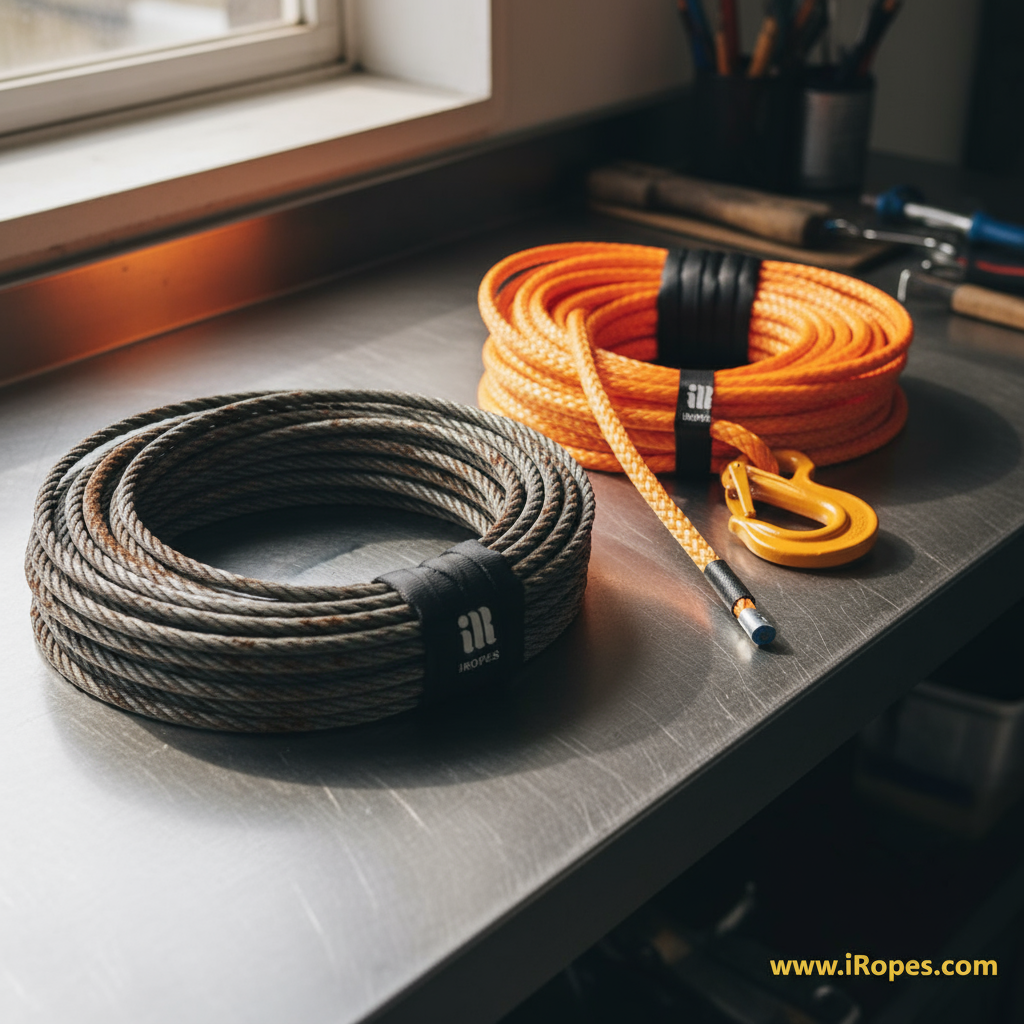
Below is a quick overview of the most common strengths and weaknesses you’ll encounter with each material in the field:
- Heat resistance – Steel cable tolerates high drum temperatures without losing tensile strength, making it generally reliable for prolonged, heavy‑duty winching.
- Weight – A steel line can be two to three times heavier than a synthetic counterpart of equivalent breaking strength. This significantly increases the load on the winch motor and demands greater manual effort during handling.
- Kinking and bird–nesting – Under sudden load spikes or improper winding, steel often folds into a knot, creating a painful “bird–nest” that can damage both the cable and the winch drum.
- Corrosion susceptibility – Even galvanised or stainless steel grades will eventually rust if moisture penetrates their protective coating, especially in harsh salty or humid environments.
- Safety on failure – When a steel rope snaps, it releases a substantial amount of kinetic energy, creating a dangerous recoil hazard that can cause serious injury or damage.
- Cost advantage – The initial purchase price for steel cable is typically lower, which may be attractive for projects constrained by tight budgets.
Synthetic winch ropes (often made from UHMWPE or Dyneema) address many of these formidable drawbacks, transforming performance characteristics.
- Assess the required load capacity. Synthetic ropes can match steel’s breaking strengths at smaller diameters, allowing you to achieve the same Working Load Limit (WLL) with a significantly lighter line.
- Consider the operating environment. If the winch will be exposed to sea spray, mud, or chemicals, a synthetic line’s inherent corrosion immunity provides superior longevity and reduces maintenance requirements.
- Factor in the budget over the product’s entire lifecycle. While the upfront cost of synthetic rope is generally higher, its lighter weight translates to less wear on the winch motor, fewer replacement cycles, and reduced energy consumption, often leading to lower overall costs.
In practice, many professionals intelligently pair a steel drum with a synthetic rope. This combination allows them to leverage the drum’s heat tolerance while strategically avoiding the heavy, dangerously recoiling snap‑back characteristic of steel. If safety and ease of handling are paramount—especially in off‑road recovery or marine winching—synthetic rope is almost always the smarter choice. However, for static, high‑temperature applications where budget remains the primary driver, a well‑coated steel cable continues to hold its own as a viable option.
Choosing the Right Customised Rope Solution for Your Industry
Having thoroughly examined how steel and synthetic lines perform within a wire cable winch setup, the logical next step involves selecting the rope that precisely matches your project’s unique demands. iRopes’ flexible design platform empowers you to fine‑tune every parameter – from the core construction to the final packaging – ensuring the rope integrates seamlessly as an extension of your equipment.
Diameter & Length
Select a diameter that delivers the required breaking strength while ensuring the rope remains light enough for easy handling. Length is custom–made to match drum size, rigging span, or unique storage constraints, effectively eliminating waste and simplifying inventory management.
Construction & Colour
Choose a construction – such as 6x19, 7x19, or 19x7 – based on desired flexibility, fatigue resistance, and the specific environment you’ll be operating in. Colour coding or incorporating reflective strips significantly aids on‑site identification and enhances safety compliance.
OEM/ODM Expertise
Our engineers collaborate closely with you to translate brand specifications, load charts, and regulatory data into a rope that meets every precise requirement. Whether you need a robust braided cable wire for heavy‑duty lifting or a low‑profile synthetic line for off‑road recovery, we provide tailored solutions.
Quality & Delivery
Our ISO 9001 certification guarantees systematic quality checks throughout every production stage. We meticulously protect your design with comprehensive IP safeguards and reliably ship pallets directly to your warehouse, ensuring products are ready for immediate deployment.
ISO 9001 Certified
Every rope undergoes rigorous testing, ensuring consistent performance and full intellectual–property protection for your custom specifications.

When finalising your specifications, consider the following essential checklist:
- Load requirement – Always verify the Safe Working Load (SWL) against the rope’s specified breaking strength to ensure optimal safety margins.
- Operating environment – Precisely match the material and coating to its intended exposure, whether it’s saltwater, harsh chemicals, or intense UV radiation.
- Explore the optimal outdoor rope material in our Manila rope guide.
- Handling preferences – Factor in the weight and flexibility of the rope, which is crucial for both manual and powered winching operations.
- Brand visibility – Utilise custom colours or printing to align the rope with your corporate identity, enhancing brand recognition on site.
- Regulatory compliance – Ensure the rope meets all relevant industry standards and certifications for your specific application and region.
By inputting these parameters into iRopes’ online configurator or consulting directly with one of our rope specialists, you receive a product that not only satisfies the stringent technical criteria of a braided wire rope but also aligns perfectly with your budget, lead‑time, and branding goals. The result is a rope solution that truly feels engineered exclusively for your operation.
Discover how our lifting wire ropes deliver lightweight strength in the benefits of iRopes lifting wire rope article.
With a clear understanding of your custom needs, this final chapter now ties together the performance insights, guiding you towards the most efficient, safe, and cost‑effective rope choice for any application.
By carefully weighing the data, fibre ropes unequivocally outperform steel in terms of weight, corrosion resistance, and safety. They effectively handle the same load with a mere fraction of the mass and provide a gradual stretch warning before failure. In distinct contrast, steel’s higher density significantly increases handling strain, its inherent susceptibility to corrosion can critically degrade strength, and a sudden snap releases dangerously high kinetic energy. Therefore, choosing the right material critically hinges on the specific load requirements, operating environment, and available budget. iRopes can meticulously fine‑tune every parameter, transforming a simple line into a reliable and robust extension of your equipment.
Get a personalised rope design from iRopes
For customised guidance and expert consultation, complete the form above. Our specialists will work closely with you to specify the perfect braided cable wire, braided wire rope or wire cable winch solution for your project.
