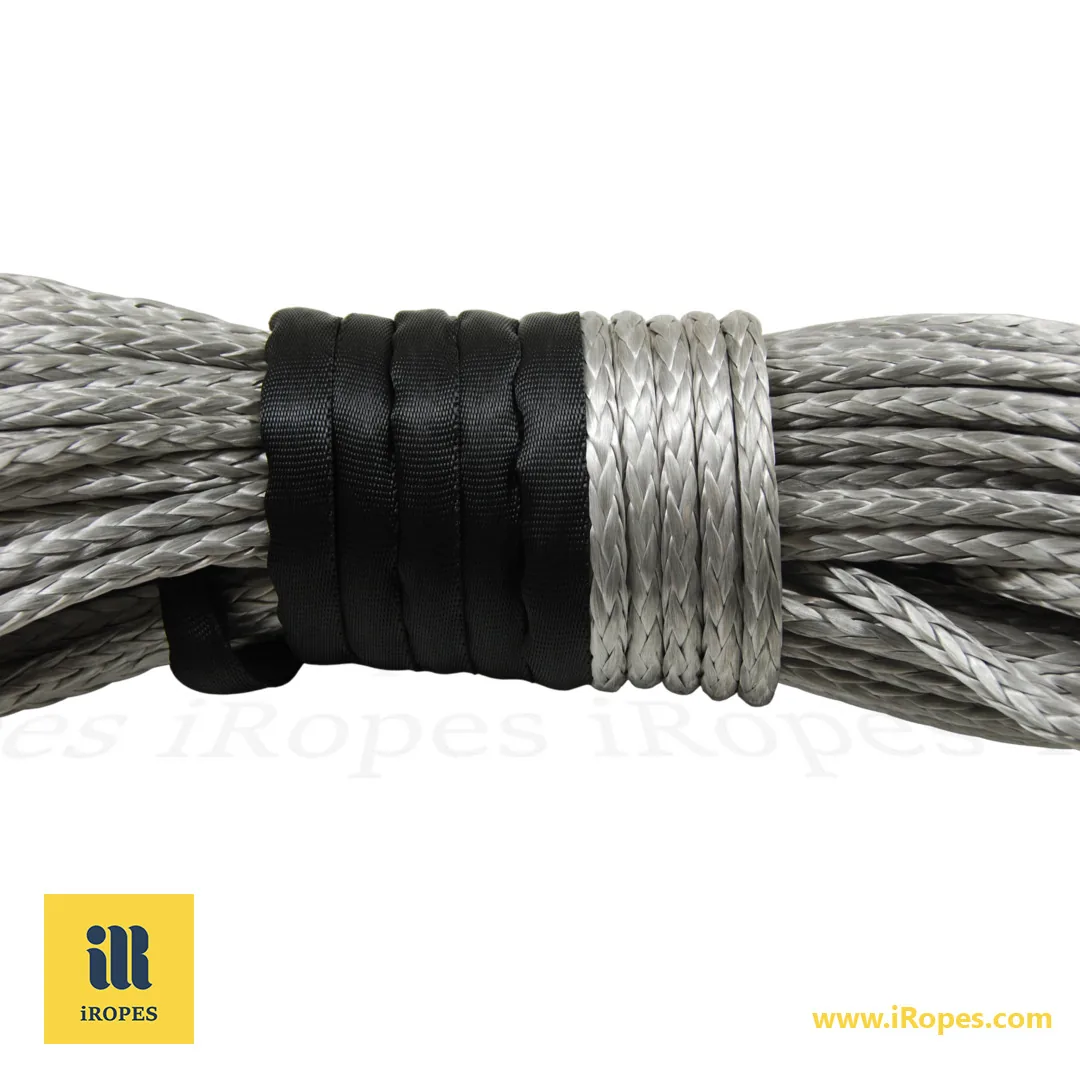
Rope slings retain about 15% more capacity at a 45° lift than flat web slings — that’s an extra 1.8 kN on a 12 kN rated sling.
Boost your lift – 2 min read
- ✓ Gain 12-15% higher effective capacity on steep angles.
- ✓ Cut sling wear and replacement costs by up to 30%.
- ✓ Tailor diameter, core type, and reflective features to fit any job.
- ✓ Follow built-in angle-factor steps for fast, error-free calculations.
You might assume that a flat web sling is the ideal choice because it folds away neatly. However, every steep-angle lift you perform is silently compromising capacity and increasing downtime. But what if a round **lifting rope sling** could reclaim up to 15% more load while significantly reducing wear and inspection time?
In the sections ahead, we’ll delve into the hidden physics of lifting, provide precise calculations, and reveal how iRopes’ custom rope solutions turn that promise into measurable profit for your operations. You’ll soon understand why **lifting rope slings** are often the superior choice for your **sling lifting** needs.
Understanding the challenges of flat sling lifting
When you opt for a flat web sling on a busy job site, convenience often comes first—it folds neatly, fits into tight spaces, and appears simple to attach. Yet, the very traits that make flat slings appealing also conceal a trio of performance issues. These issues can quickly transform a routine lift into a significant safety concern. Many businesses need to understand the true **lifting sling capacity** of their tools.

During inspections, three common drawbacks emerge repeatedly:
- Limited load distribution: The flat profile concentrates force along a narrow line, leaving adjacent fibres under-utilised.
- Higher angle-induced stress: When the sling is angled, its narrow width magnifies shear forces, accelerating fatigue.
- Susceptibility to damage: Surface abrasion, cuts, and UV exposure quickly erode the webbing’s integrity.
Because flat slings distribute the load over a smaller area, the angle reduction factor decreases more sharply than with a round or rope sling. For example, a 60° lift that would retain about 86% of a rope sling’s capacity may only preserve roughly 70% when a flat web is used. This loss directly shrinks the **lifting sling capacity** you can safely rely on, compelling you to either select a larger sling or accept a tighter safety margin.
Typical inspection failures on flat slings include frayed edges, burnt fibres, and broken stitching—each indicating that the sling has already lost a portion of its rated capacity.
Every premature replacement of a flat sling incurs additional costs. A single 1-inch webbing sling can run several hundred dollars. When you factor in the associated downtime, the financial impact becomes significant for any project budget.
Understanding these limitations is crucial for exploring a more resilient alternative for demanding lifts. The next section will illustrate why a **lifting rope sling** surpasses flat slings in strength, angle handling, and custom-fit options.
Why a lifting rope sling outperforms flat slings
Having identified the hidden drawbacks of flat web slings, you’ll observe that a **lifting rope sling** behaves more like a steadfast partner than a simple strap. Its round-core construction ensures the load is distributed across every fibre. This means the force travels along a continuous path, rather than being concentrated through a narrow edge. This inherent flexibility allows the sling to retain more of its rated strength, especially when working at steep angles. Ultimately, this directly translates to a higher **lifting sling capacity** on-site.

One of the most frequently asked questions is: How do you calculate rope sling capacity using angle-factor formulas? The answer involves three straightforward steps that allow you to convert a simple load rating into a reliable lift plan for your **sling lifting** operations.
- Identify the sling’s rated Working Load Limit (WLL) from the manufacturer’s data sheet.
- Determine the lift angle from the horizontal. For example, a 45° angle uses an angle factor of 0.707.
- Multiply the WLL by the angle factor. The result is the effective capacity for that specific configuration.
Because rope constructions like 6x19 or 6x37 possess a higher tensile modulus than flat polyester webbing, the same WLL often yields a greater effective capacity once the angle factor is applied. In practical terms, you might observe a 6x19 sling retaining up to 15% more capacity at a 45° choker configuration compared to an equivalent-width flat sling.
Tailor-Made Performance
iRopes offers extensive customisation options, allowing you to select the rope diameter, core type (solid or independent wire core), and even incorporate reflective or glow-in-the-dark elements. These custom choices fine-tune the sling for specific environments—whether you require UV resistance for outdoor rigs or a low-profile colour for high-visibility safety zones. These OEM/ODM services ensure your **lifting rope sling** is perfectly suited to your needs.
Beyond its inherent strength, rope slings handle dynamic loads more effectively because their braided strands absorb shock. This reduces the peak forces that would otherwise strain a flat web. This elasticity also allows for tighter bends without the concern of the dreaded D/d ratio loss that frequently affects thin-walled webbing.
When you combine the material’s superior load distribution, the minimal angle penalty, and the freedom to customise every dimension, you get a sling that not only lifts more safely but also endures longer. That durability translates into fewer replacements, less downtime, and a clearer path to meeting your project’s **sling lifting** requirements efficiently.
Maximizing lifting sling capacity with customized rope solutions
Building on the inherent advantages of rope-based rigging, the next step involves fine-tuning every variable that influences a sling’s effective strength. By treating material, diameter, construction, hitch type, and the D/d ratio as adjustable levers, you can extract the highest possible **lifting sling capacity** from a single piece of rope. iRopes’ expertise in OEM and ODM services facilitates this precision.

The most influential factors to consider for optimal **sling lifting** are:
Material Choice
Select steel, synthetic, or composite cores to align with strength and environmental demands. iRopes provides a wide range of materials for bespoke solutions.
Diameter & D⁄d Ratio
Larger diameters and appropriate D/d ratios are vital for preserving capacity when bending around loads, ensuring optimal **lifting sling capacity**.
Hitch Optimisation
Vertical, choker, or basket hitches each affect effective capacity. Choose the best configuration for the specific lift angle to maximise safety and performance.
Custom Add-Ons
Reflective strips, glow-in-the-dark fibres, or specialised terminations enhance safety and visibility, particularly in low-light environments.
With these levers identified, a quick capacity check becomes almost routine. Suppose you have a 12 mm, 6×19 steel rope sling rated at 20 kN WLL. For a vertical lift, the full 20 kN is usable. If you switch to a choker hitch at a 45° angle, you apply the angle factor (0.707) and the choker reduction (typically 0.8), resulting in:
Effective capacity = 20 kN × 0.707 × 0.8 ≈ 11.3 kN. A basket hitch at 60° uses a factor of 0.866 and a basket multiplier of 1.1, yielding approximately 19 kN, nearly the original rating. These simple calculations illustrate why understanding the interplay of **lifting rope sling** geometry can add significant usable load capacity.
iRopes translates these calculations into a bespoke product specifically for your needs. Through our OEM and ODM programmes, we can adjust the core type, strand count, and even integrate UV‑stable coatings or colour‑coded markings that align with your site‑specific safety protocols. The result is a **lifting rope sling** that precisely meets the load, environmental exposure, and branding requirements of your operation.
Always inspect rope slings before each lift; look for broken wires, corrosion, or compromised terminations to maintain rated capacity and ensure safe **sling lifting**.
Regular maintenance further extends that capacity. After every use, wipe the rope clean, store it on a dry rack, and perform a visual inspection for nicks or frayed ends. A quarterly check by a competent person should verify that the D/d ratio remains within the manufacturer’s limits and that any added accessories are still secure.
By combining precise engineering with hands‑on inspection, you transform a standard rope into a high‑performance **lifting rope sling**. This approach consistently delivers the maximum **lifting sling capacity** your project demands, ensuring both safety and efficiency.
Need a tailor-made rope solution for your next lift?
If you’d like expert guidance customised to your application, simply fill in the inquiry form above and our team will get back to you with personalised recommendations.
We've shown how flat slings concentrate stress, suffer angle‑induced losses, and wear quickly, which can jeopardise **sling lifting** safety and inflate replacement costs. In stark contrast, a **lifting rope sling** distributes load uniformly, tolerates steeper angles, and can be customised in diameter, core type, and visibility features to maximise **lifting sling capacity** while extending service life. Partner with iRopes to engineer the perfect solution for your demanding projects, ensuring superior performance and safety.