⚠️ The global marine trap: mistaking a 1 tonne lifting sling (1000kg WLL) for a 1 ton (just 907kg short ton) can trigger compliance fines up to €50,000 in EU ports—iRopes delivers dual-marked, ISO 9001-certified slings with 7:1 safety factors to keep your vessels sailing smoothly worldwide.
Unlock Safe Marine Lifting in ~8 Minutes →
- ✓ Navigate EU metric (EN 1492-1) vs. US imperial (ASME B30.9) rules to slash regulatory delays by 40% on international routes.
- ✓ Select webbing or round 1t slings tailored for yachting or cargo, reducing load damage risks through precise 25-50mm widths and endless-loop flexibility.
- ✓ Customize with iRopes' OEM services—add reflective elements or thimbles for 20% better visibility in low-light ops, backed by full IP protection.
- ✓ Ensure purple-coded compliance and TÜV/GS testing, preventing overload failures that impact 15% of global vessel inspections.
You've likely battled the frustration of mismatched sling ratings derailing a transatlantic shipment. Perhaps you wondered if that purple tag truly signals safety across borders. What if one overlooked conversion—a tonne's 2204 lbs versus a ton's 2000 lbs—exposed your operation to hidden liabilities in choppy international waters? Dive in to uncover iRopes' custom strategies that transform this trap into seamless, compliant lifts, empowering your fleet with precision-engineered solutions no competitor matches.
Understanding 1 Tonne Lifting Sling Fundamentals and the Metric-Imperial Trap
In the world of marine lifting, where every load counts, a 1 tonne lifting sling plays a crucial role in keeping operations smooth and safe. Picture this: you're coordinating cargo on a vessel crossing from Europe to North America, and suddenly a simple label mismatch turns into a compliance headache. That's the metric-imperial trap we're talking about here—the subtle difference between "tonne" and "ton" that can snag international shipping if overlooked.
At its core, a 1 tonne lifting sling is engineered as a reliable device capable of handling a working load limit, or WLL, of exactly 1000 kilograms. For those more familiar with imperial measurements, that equates to approximately 2204 pounds, often colloquially called a 1 ton lifting sling. But here's where misconceptions creep in during global trade: not everyone realises that the short ton, used in the US and Canada, is actually lighter at 2000 pounds. Conversely, the metric tonne serves as the international standard. This mix-up has led to genuine issues, such as vessels delayed at ports because equipment failed to match local specifications. Have you ever double-checked a sling's rating across borders? It's a small step that avoids substantial problems.
So, what does a 1 tonne lifting sling actually mean in practice? It refers to that maximum safe load of 1000 kg under standard conditions, designed with a built-in safety factor—often 7:1—to provide a buffer against unexpected stresses. This means the sling's breaking strength is at least seven times the WLL, ensuring it won't fail under normal marine use. Precise understanding of this capacity is vital in salty, dynamic environments where overloads from waves or shifting cargo could spell disaster. I recall a rigging team I knew who once pushed a sling beyond its limit during a stormy unload without incident; luckily, the safety margin held, but it was a close call that reinforced why clarity on these specifications saves lives and keeps schedules on track.
EU Metric Mandate
Strictly uses 'tonne' under EN 1492-1 for webbing slings, focusing on harmonised safety across member states.
Global Impact
Ensures vessels comply during EU port calls, preventing fines and operational halts.
US Imperial Preference
Relies on 'ton' (2000 lbs) via ASME B30.9 standards, tailored to North American rigging practices.
Vessel Challenges
Affects cross-jurisdiction operations, requiring dual-rated gear to navigate varying rules seamlessly.
These regulatory differences matter immensely for vessels operating internationally. In the EU, the emphasis is on metric tonne compliance through EN 1492-1, which sets rigorous tests for strength and durability. Across the Atlantic, the US leans toward imperial tons under ASME B30.9, prioritising equipment suited to domestic industries. For a ship shuttling between these zones, mismatched slings could mean rejected cargo or safety violations—therefore, versatile, dual-compliant options are essential.
To cut through this confusion, capacity marking systems on slings are a game-changer. Modern labels clearly display the WLL in both metric (1000 kg) and imperial (2204 lbs) units, making verification easy at a glance. Colour coding adds another layer of quick identification: purple is the standard hue for 1t slings, immediately signalling that 1000 kg capacity. At iRopes, our ISO 9001-certified processes ensure every 1 tonne lifting sling meets these international benchmarks, from precise labelling to rigorous testing, so you can trust them in any harbour worldwide.
With these foundational elements established, exploring the different types of 1t slings becomes the next logical step for tailoring solutions to your specific marine tasks.

Exploring 1t Sling Types: Webbing vs Round for Versatile Marine Applications
Having sorted out the basics of capacity and markings, it's time to look at the actual varieties that make 1t slings so adaptable for marine work. These tools aren't one-size-fits-all; choosing between webbing and round designs can make all the difference in handling loads on a pitching deck or during a tight yacht manoeuvre. Let's break down what sets them apart, keeping in mind those salty conditions where grip and flexibility really matter.
Start with flat webbing slings, often the go-to for straightforward jobs. These are essentially wide, flat straps made from double-layer polyester, complete with reinforced eyes at each end for secure attachments. The broad surface they provide spreads the load evenly, which proves perfect for yachting tasks like hoisting sails or cargo handling on smaller vessels. Imagine securing a stack of supplies without digging into the packaging—that's the webbing sling doing its job, reducing damage while keeping things stable even as waves rock the boat.
Conversely, round 1t slings offer a different kind of versatility, shaped like an endless loop of polyester fibres wrapped in a tough outer sleeve. Their cylindrical form allows them to conform tightly around awkward shapes, making them ideal for irregular marine loads such as defense crates or even spearfishing equipment bundled for transport. I once watched a crew use one to cradle an oddly shaped buoy during a rough sea transfer; it hugged the contours without slipping, saving them from a potential fumble. This flexibility means less stress on both the sling and the load, especially in dynamic environments.
So, what sets a webbing sling apart from a round one in everyday use? Both share that lightweight durability from polyester, which resists moisture and stretches minimally to hold steady under tension. However, the flat design of webbing excels at wide bearing surfaces, minimising pressure points on flat or broad items—think pallets of gear sliding aboard without marring finishes. Round slings, by contrast, shine in conformity, wrapping snugly around curved or uneven objects for a secure grip that distributes force all around. Neither is inherently better; it ultimately depends on your load's shape and the hitch you'll use, whether a simple basket or a tricky choke.
Webbing Slings
Flat and Reliable
Double-Layer Build
Extra thickness boosts wear resistance in abrasive marine settings.
Broad Contact
Distributes weight evenly over large areas, protecting delicate cargo.
Yachting Fit
Suits rigging and handling where flat stability is key.
Round Slings
Flexible and Adaptive
Endless Loop
No weak ends, ensuring uniform strength around irregular shapes.
High Conformity
Wraps tightly for secure holds on defence gear or odd bundles.
Spearfishing Use
Handles flexible, wet loads without compromising grip.
At iRopes, we lean heavily on polyester for these 1t sling types because of its low stretch and natural resistance to the dampness that plagues marine gear. Furthermore, we go further with custom constructions, adapting the same principles for off-road recovery, tree work climbs, or heavy industry pulls that mirror the demands of sea operations. Whether you require a webbing sling beefed up for cargo edges or a round one tuned for spearfishing hauls, our builds ensure they transition seamlessly from dockside to deck.
Ever wondered how these choices play out in a real lift? Picking the right type starts with your setup, but nailing the details like length and width will lock in compliance and performance across international waters.

Key Specifications and Safety Standards for 1 Ton Lifting Slings in International Waters
Now that you've got a handle on the different sling types and how they flex to fit various loads at sea, zeroing in on the precise specifications is what turns a good pick into a great one. Think about it: on a vessel bouncing through choppy waves, the wrong length or width could mean instability or worse. These details aren't just numbers—they're the backbone of reliable performance when you're rigging gear across borders.
For 1 ton lifting slings, the working load limit sits at 1000 kilograms, but customisation shines through in other areas. Lengths typically run from 1 to 12 metres, letting you adjust for everything from quick deck lifts to longer hauls, and we can tweak them to your exact needs at iRopes. Widths vary between 25 and 50 millimetres, balancing strength with manoeuvrability—narrower for tight spots, wider for better stability on broader items. And yes, these slings follow global norms with purple colour coding for instant recognition, a simple visual cue that speeds up checks during busy operations. It's like having a built-in reminder that keeps things safe without slowing you down.
- Custom Lengths (1-12m) - Tailor to your lift height or storage space, ensuring full reach without excess material dangling in the wind.
- Widths (25-50mm) - Choose based on load contact; slimmer profiles slip into crevices, while broader ones spread force evenly.
- Purple Coding - Aligns with EN 1492-1 for quick ID, helping crews spot capacity at a glance amid the salt spray.
When it comes to vessels plying international routes, regulatory compliance is non-negotiable, and selection guides help navigate the patchwork of rules. In metric-driven zones like the EU and Asia, stick to tonne-based markings under EN 1492-1 to avoid port-side scrutiny. Over in the US or Canada, where imperial tons rule, ASME B30.9 calls for clear 2000-pound equivalents, but dual labelling bridges the gap for seamless operations. Every sling requires visible tags for WLL, material, and manufacture date—essential for audits. For branded marine gear, iRopes wraps in full IP protection, so your custom designs remain yours, no matter the jurisdiction. For more on how braided slings enhance marine durability and compliance, explore our insights on braided slings' secret edge in marine durability.
What safety standards should a 1 tonne lifting sling meet to hold up in harsh waters? For webbing versions, EN 1492-1 sets the bar with tests for abrasion, UV exposure, and chemical resistance, ensuring they won't fray under relentless marine conditions. Layer on ISO 9001 for overall manufacturing rigour, and you've got gear that's not just compliant but built to last. At iRopes, we push further with TÜV/GS testing and precision features like weather-resistant coatings, which fend off corrosion from saltwater splashes. It's these extras that turned a routine cargo shift into a smooth run for one captain I spoke with—his slings shrugged off a sudden squall without a hitch.

Armed with these specifications and standards, picturing how 1 ton lifting slings tackle real-world marine jobs—from yacht rigging to defence logistics—starts to make sense, especially when you factor in tailored options that fit your setup perfectly.
Selecting and Customizing 1 Ton Lifting Slings for Global Marine Success with iRopes
Building on those key specifications and standards, let's turn to how 1 ton lifting slings actually shine in marine settings, where versatility can mean the difference between a seamless operation and a frustrating delay. These tools handle a range of tasks, from rigging sails on yachts to securing logistics for defence shipments or managing industrial cargo aboard freighters. In developed markets like Europe and North America, they're perfect for lightweight lifts—think hoisting engines onto smaller vessels or bundling supplies without the bulk of heavier gear. The beauty lies in their adaptability; a single sling might cradle a yacht's tender one day and steady crates during a cargo transfer the next, all while enduring the constant slap of saltwater and wind. For specialized applications in yachting, check out our yachting ropes and slings tailored for such demanding environments.
One question that often comes up for teams gearing up for international voyages is whether 1t lifting slings can be customised to fit unique needs. Absolutely, and that's where iRopes steps in with our OEM and ODM services, crafting everything from the core material to finishing touches. For example, we might swap in a more abrasion-resistant fabric for rough deck work, adjust lengths beyond the standard ranges for specific hoist heights, or match colours to your fleet's branding. Add-ons like sturdy loops for quick attachments, protective thimbles to prevent kinks, or even reflective strips for low-light safety make them jurisdiction-ready—say, brighter visibility for EU night operations or reinforced ends for US port inspections. It's like having a sling that's not just functional but feels like an extension of your own setup, tailored right down to the details that matter most on the water. Learn more about our full customization options for marine lifting solutions.
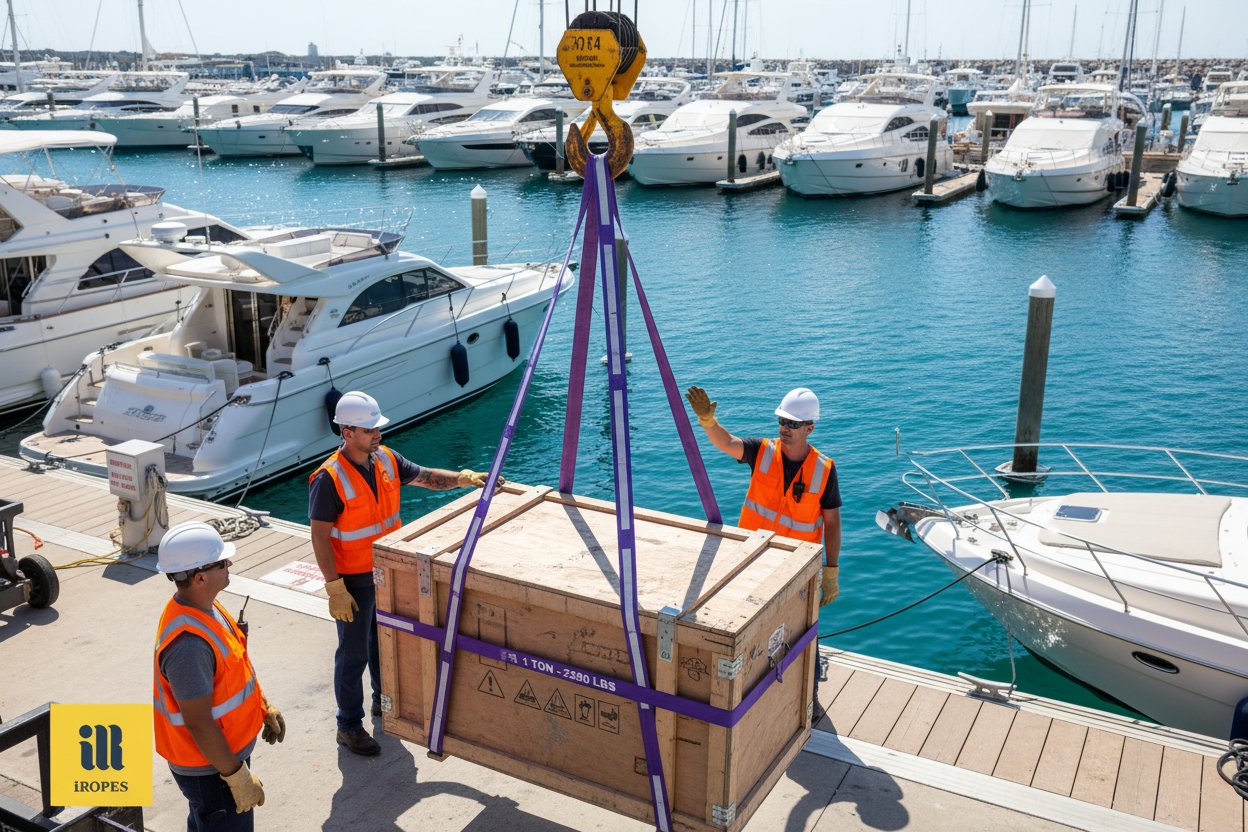
Choosing the right sling starts with matching it to your load's shape—flat for broad items, flexible for curves—while considering the environment, like adding chafe guards to fend off rope-on-metal wear from constant vessel motion. Regulations also play a significant role; opt for metric-focused builds in Asia or dual-labelled for North American runs. To keep things straightforward, here's a quick checklist for pre-use inspection and ongoing care that can stretch your sling's life through seasons of tough service:
- Check for cuts, frays, or discolouration on the webbing—any sign of UV damage means retire it immediately.
- Inspect fittings like eyes and hardware for bends or corrosion, especially after saltwater exposure.
- Test seams and stitching for loose threads; tug gently to ensure hold without stretching.
- Verify load tags are legible and match your planned use—no assumptions here.
- After each job, rinse with fresh water and store coiled in a dry spot away from direct sun.
What really sets iRopes apart for wholesale buyers navigating global marine operations is our blend of sharp pricing that keeps costs down without skimping on quality, reliable shipping that hits deadlines across continents, and rock-solid IP protection so your custom designs stay confidential. We're not just suppliers; we're strategic partners who understand the nuances of international waters, helping you build operations that run smoother and safer every trip. To enhance marine safety further with custom slings for cargo and containers, discover our guide on sling cargo solutions for marine safety.
These practical steps and custom touches not only help you dodge common pitfalls but also pave the way for lifting strategies that maximise efficiency across your entire fleet.
Navigating the global marine trap between a 1 tonne lifting sling and 1 ton lifting slings demands clarity on conversions—1000 kg equates to about 2204 lbs. This clarity must be accompanied by precise capacity marking systems, such as dual-unit labels and purple colour coding, for quick identification. Regulatory differences, from EN 1492-1's metric focus in the EU to ASME B30.9's imperial standards in the US, underscore the need for compliant, versatile options like webbing and round 1t slings tailored for yachting, defence, and cargo. With iRopes' customisation, including lengths, accessories, and IP protection, vessels can ensure safe, efficient lifts across jurisdictions without costly delays.
These insights equip you to select the right sling for your operations, but applying them perfectly often benefits from expert input on specific marine needs.
Need Tailored Advice for Your Lifting Slings?
If you're seeking personalised guidance on customising 1 tonne or 1 ton lifting slings for international marine use, the inquiry form above connects you directly with iRopes specialists ready to assist with your wholesale requirements.
