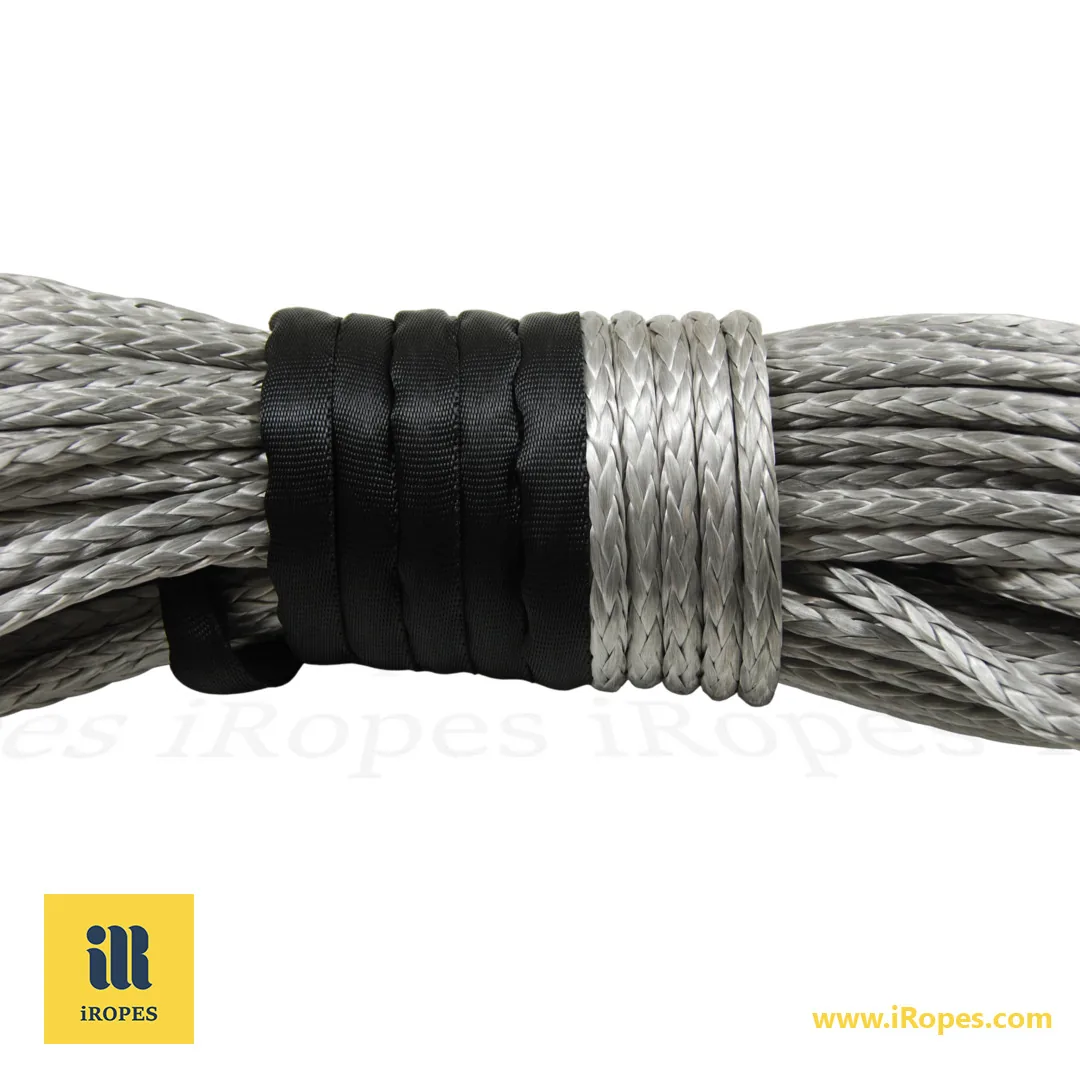
Synthetic winch ropes are up to 9× lighter than steel while delivering equal or higher breaking strength – iRopes’ SK78-grade line saves an average of 12 kg per 30-ft spool.
Read in 3 min – What you’ll gain
- ✓ Cut vehicle recovery weight by 7-9 kg per winch line – boosting fuel economy.
- ✓ Reduce kinetic-energy recoil ≈ 60 % versus steel – lowering injury risk.
- ✓ UV-stable Gator-ize® coating preserves > 98 % tensile strength after 12 months of sun exposure.
- ✓ Custom colour or reflective finish speeds night-recovery spotting by up to 30 %.
Many mechanics still assume steel cables are the only viable option for hauling heavy loads. However, data indicates that a Dyneema-based synthetic line not only matches steel’s breaking strength but also achieves this while being up to nine times lighter. Furthermore, it releases 60% less kinetic energy upon failure. In the following sections, we will explore how iRopes’ advanced coatings lock in this performance and how you can tailor a rope to fit your exact recovery needs.
best synthetic rope winch – Why Synthetic Winch Ropes Outperform Steel
Building on the material discussion, let’s examine why the best synthetic rope winch solutions often surpass steel lines in everyday recovery work. A synthetic winch rope is primarily made from ultra-high-molecular-weight polyethylene (UHMWPE) fibres, commonly known by trade names such as Dyneema or Spectra. These fibres are meticulously spun into a tightly woven construction, which can be customised in terms of diameter, length, and strength to suit any winch capacity.

Safety is a primary motivation for many operators choosing synthetic over steel. When a synthetic line reaches its breaking point, the energy stored in the rope is released gradually as the fibres stretch and fray. This is in stark contrast to steel cables, which can snap back violently. This reduced kinetic energy significantly lowers the risk of injuries on the job site, and the frayed synthetic end is soft enough to handle without causing splinters.
- Reduced kinetic energy – upon snapping, the stored energy in a synthetic line dissipates gradually, unlike the sudden, dangerous snap-back of steel.
- Splinter-free failure – the fibre strands fray without sharp shards, dramatically lowering the risk of injury.
- Heat-resistant coating – modern UV-stable sleeves prevent material degradation, which extends the rope's safe service life.
Beyond safety, the strength-to-weight advantage of synthetic rope is substantial. A 3/8-inch Dyneema rope can manage the same load as a larger 5/8-inch steel cable, yet it weighs a mere fraction of the mass – often eight to nine times lighter. This significant weight reduction allows for carrying additional recovery gear, improves fuel efficiency, and simplifies handling on the winch drum. In practical terms, a typical 12,000 lb synthetic rope saves approximately 12 kg compared to its steel equivalent, providing a noticeable difference on any off-road adventure.
If you're still considering which line ranks as the best synthetic winch rope, focus on UHMWPE construction. Look for a reputable coating like Gator-ize® for superior abrasion resistance and a clear grade label (SK75 or SK78). The higher-grade SK78 offers approximately 40% more tensile strength than SK75, making it the preferred choice for demanding, heavy-duty applications.
“Switching to a Dyneema-based rope saved our 4×4 team roughly 12 kg per winch setup. The reduced recoil also protected us from a near-miss during a desert recovery.” – Off-road veteran
So, whether you're comparing a steel cable with the best synthetic winch cable for a heavy-duty truck or choosing a lightweight line for a UTV, the material science behind UHMWPE offers a safer, lighter, and stronger solution. This performance edge leads us to discuss how advanced coating technologies further protect and extend your rope’s lifespan.
best synthetic winch rope – Key Features, Coating Technologies, and Performance Grades
Understanding how material choice influences strength and handling is crucial. Now, let’s explore how specialised coatings and carefully selected grades further enhance these advantages for real-world applications.

Modern synthetic ropes typically feature one of three protective finishes. Gator-ize® is a proprietary abrasion-resistant polymer that encases the fibres like a second skin, making it ideal for navigating rocky trails. UV-resistant sleeves utilise a clear elastomer that effectively blocks over 98% of UV light, preventing colour fade and strength degradation even after prolonged sun exposure. Additionally, reflective or glow-in-the-dark finishes incorporate micro-prisms or phosphorescent pigments, ensuring easy visibility during low-light recoveries and enhancing safety for crew members.
- SK75 – This standard grade provides reliable breaking strength suitable for most consumer-grade winches.
- SK78 – A premium grade, it delivers approximately 40% higher tensile strength while maintaining similar elongation characteristics.
- Custom-blend – iRopes can combine fibres from both grades to achieve a precise strength-to-weight ratio tailored to a specific winch capacity.
When you ask, "Which synthetic winch rope is best?" the answer depends on three key criteria: the fibre grade (SK75 vs. SK78), the coating best suited for the operating environment, and the rope’s diameter in relation to the winch’s rated load. For instance, a higher-grade SK78 line with a UV-shielded sleeve will generally outperform a standard SK75 line in desert conditions. Conversely, a reflective finish proves to be a smarter choice for night-time off-road missions.
Tip: If your vehicle frequently hauls heavy gear, choose an SK78 core with a Gator-ize® outer layer. This additional tensile margin helps compensate for occasional overloads.
In addition to the core and coating, iRopes offers OEM/ODM customisation options like tailored colour-coding, integrated reflective strips, and packaging featuring your brand logo. These choices allow wholesale buyers to differentiate their product line without compromising the core performance that makes the best synthetic winch rope a dependable partner in any recovery situation.
Therefore, choosing the right line becomes a clear decision process: match the winch capacity, opt for SK78 in high-load scenarios, select the coating that suits your environment, and finally, add any necessary branding or safety accents. Following this logic, the next section will detail how to size the rope correctly for your vehicle’s weight and load requirements.
best synthetic winch cable – Choosing the Right Rope for Your Application and iRopes Custom Solutions
Following our discussion on coating durability, the next critical step is to match the rope precisely to your vehicle’s winch capacity and overall weight. A frequent error is choosing a diameter that appears robust but overloads the winch drum’s safe limits. To determine the required breaking strength, begin with your vehicle’s curb weight, add the anticipated recovery load, and then select a rope with a working load limit (WLL) that is at least 1.5 times that total. This margin protects the line from sudden overloads and ensures smooth drum rotation.
Quick Sizing Guide
1️⃣ Determine your winch’s rated load (e.g., 12,000 lb). 2️⃣ Multiply by 1.5 to get the minimum rope WLL. 3️⃣ Select a rope diameter that meets or exceeds that WLL – a 3/8-inch line often covers 9,000 lb-12,000 lb ranges, while a 1/2-inch line safely handles 15,000 lb-20,000 lb.
iRopes’ OEM/ODM program empowers you to fine-tune every aspect of your rope. Do you require a bright orange jacket for maximum daytime visibility? Or a reflective strip that glows in low light? You can choose from various UHMWPE grades, colour palettes, and optional glow-in-the-dark fibres. Additionally, you can add your branding to bags, colour boxes, or custom-printed cartons. Our production line can also integrate specialised terminations such as thimbles, soft shackles, or chafe guards, guaranteeing the final product fits your exact winch model and operational requirements.
One of the most common questions we encounter is, “What is the difference between SK75 and SK78 winch rope?” The answer is quite direct: SK78 fibres are engineered with a tighter molecular alignment, providing approximately 40% higher tensile strength while maintaining the same elongation characteristics as SK75. Practically, an SK78 line allows you to carry the same load with a thinner diameter, reducing weight without compromising safety. For heavy-duty trucks or high-capacity winches, SK78 is typically the superior choice. However, for lighter UTVs, SK75 offers ample strength at a more economical price point.
When you combine the correct diameter, the appropriate grade, and a coating that suits your environment, the result is a rope that feels integrated with the winch itself, as detailed in our comparison of UHMWPE and steel winch cables. It's light enough to handle effortlessly yet strong enough to recover a 4x4 from a deep sand pit. Have you ever considered how much weight you could save by switching from steel to the best synthetic winch cable? The difference can be as much as eight kilograms, contributing to better fuel economy and more space for recovery gear.

Ready for a custom rope solution?
After exploring the material science behind UHMWPE fibres, you can now appreciate why the best synthetic rope winch systems offer dramatic weight savings, reduced kinetic energy, and splinter-free failure. For more detailed selection tips, see our Ultimate Guide to Choosing the Best Winch Line.
Whether you require the best synthetic winch rope for a lightweight UTV or the best synthetic winch cable for a heavy-duty truck, our OEM/ODM team can fine-tune the grade, colour, reflective elements, and branding to precisely match your specifications. For a broader view of our off‑road offerings, see our Best Rope for Winch and Off‑Road Adventures. For personalised advice or a quote, please use the form above, and our specialists will help you design the perfect solution.