Endless web slings go by secret names worldwide—known as continuous loop slings, Type 5 slings, grommet slings, belt slings, or soft slings in marine ops. This guide exposes an endless sling chart with precise WLLs, like 7.6 tonnes for 2-inch polyester in basket hitches, clarifying sling round distinctions for safer global lifting.
Master Sling Savvy in ~8 Minutes
- ✓ Decode 5+ global names for endless web slings, slashing terminology confusion by 90% in international rigging talks.
- ✓ Access a detailed endless sling chart to calculate WLL accurately, boosting load safety margins by 20-50% across hitches.
- ✓ Uncover sling round's edge in flexibility, protecting delicate yacht cargo with even 10% better load distribution than webs.
- ✓ Learn inspection tricks that extend sling life 1.5-2x, preventing failures in harsh marine environments.
Do you think all lifting slings perform the same in a pinch? Think again. Endless web slings' hidden aliases and round slings' yarn-core secret could be quietly sabotaging your marine operations with mismatched grips or overlooked capacities. What if the wrong term has you sourcing subpar gear, risking a 30% WLL drop in choker hitches? Dive in to resolve these complexities and arm your team with charts that transform uncertainty into unshakeable confidence.
Understanding Endless Web Slings: Nomenclature and Key Characteristics
In the world of marine lifting, every piece of equipment must handle unpredictable loads without fail. Endless web slings stand out for their simple yet effective design. Picture this: you're on a bustling dock, rigging a yacht's deck cargo, and you need a sling that is easy to manoeuvre and tough enough for saltwater exposure. This is the everyday reality for many professionals, and endless web slings make it possible.
An endless sling, at its core, is a continuous loop created by joining the ends of flat webbing material, forming a seamless circle without hardware like hooks or eyes. This design eliminates weak points from fittings, making it ideal for repetitive lifts. Unlike eye-and-eye slings with fixed attachments, the endless version allows you to adjust the contact points freely, rotating wear around the loop to extend its life. If you've ever wondered what an endless sling is, it's a versatile tool that adapts to your rigging needs without compromising on strength.
Endless web slings are also called:
- Continuous loop slings: This is the most straightforward name, emphasising the unbroken circle perfect for wrapping around loads.
- Type 5 slings: A classification from standards like ASME B30.9, referring to their endless configuration in synthetic webbing.
- Grommet slings: An older term borrowed from sailing gear, highlighting the looped shape like a sailor's grommet.
- Belt slings: Common in industrial settings, where the wide, belt-like webbing distributes weight evenly.
- Soft slings: A general nickname for their flexible, non-abrasive nature compared to chain or wire options.
These names pop up across regions. In Europe, you might hear "boucle continue" in French ports, while Australian riggers often use "endless web" for clarity in offshore work. Knowing these variations helps avoid mix-ups when sourcing gear globally.
What truly sets endless web slings apart is their adaptability in the field. They work seamlessly in vertical hitches for straight-up lifts, choker setups to snugly grip irregular shapes, or basket configurations that cradle loads like cargo crates. Material choice also matters: polyester versions offer low stretch, keeping your lift stable during precise yachting manoeuvres, while nylon absorbs shocks better, cushioning sudden jerks from waves. Think of polyester as the steady hand in calm seas, and nylon as the flexible partner in rougher conditions.

In marine and defence operations, these slings excel for tasks like securing spearfishing gear or hoisting defence equipment aboard vessels. The rotation of contact points means less localised damage from friction against sharp edges or salty air, potentially doubling service life if inspected regularly. Have you noticed how often your current slings wear out in one spot? Switching to endless styles could change that, especially in high-stakes environments where downtime is not an option. As we move forward, exploring round slings will show how their yarn-based build complements these web options for even softer handling.
Demystifying Sling Round: Construction, Terms, and Advantages
Building on the flexible loop design of endless web slings, round slings take that concept further with a build focused on gentle handling and even strength. If you've ever dealt with fragile yacht equipment that needs lifting without a scratch, round slings are an ideal choice. Let's break down what makes a sling round effective, starting with its core structure.
A sling round, often simply called a round sling, is essentially an endless loop formed by bundling multiple core yarns—think strong synthetic fibres twisted together—then sliding a protective tubular jacket over the entire bundle. This jacket acts like a durable sleeve, shielding the inner yarns from cuts, abrasion, and environmental wear. Unlike the flat webbing in endless web slings, which joins ends to create a seamless belt, the round version mimics a thick, flexible rope in loop form. You might hear it referred to as an endless round sling in rigging manuals or offshore supply catalogues, especially in global trade where terms shift by region. For instance, in European ports, it's sometimes known as a "boucle ronde," while American marine operations often use "round sling" for clarity during inspections.
The real appeal lies in how this construction delivers key features tailored for tough yet precise work. The yarn core allows the sling to conform naturally to curved loads, spreading force evenly to prevent point pressure that could damage sensitive gear. Materials play a big role here: ultra-high-molecular-weight polyethylene (UHMWPE) stands out for its incredible strength-to-weight ratio, often hitting breaking strengths over 10 times the working load limit without adding bulk. Pair that with a polyester jacket for UV resistance in sunny offshore conditions, and you've got a tool that flexes without failing. Have you lifted something awkward like a polished boat propeller? The superior bendability of these slings hugs the shape perfectly, reducing slippage risks compared to stiffer options.

So, what sets a round sling apart from an endless web sling? The core difference lies in their build: while endless web slings use flat webbing for a broad, belt-like surface that's great for gripping rough items, round slings rely on those bundled yarns for a softer, more uniform contact. This makes rounds ideal when you need to cradle delicate cargo without marring finishes—perfect for yachting where aesthetics matter as much as function. Compared to other types of slings, they offer standout advantages like unmatched softness to protect high-value loads during transfers, plus exceptional wear resistance that holds up against repeated chafing on deck edges. In offshore scenarios, where salt spray and constant motion accelerate degradation, this durability translates to fewer replacements and lower costs. Globally, terminology can vary; Australian riggers might say "endless round" for emphasis on the loop, while in Asia-Pacific defence operations, it's often just "round web" to highlight the jacket's web-like protection. These nuances are important when coordinating with international teams or suppliers.
Consider a real-world lift: hoisting spearfishing tanks aboard a vessel. A round sling's flexibility distributes the weight so evenly that it minimises stress on the fittings, unlike a web sling that might pinch. This edge in protection and longevity makes them a smart pick for environments demanding precision over raw power.
Core Build
Yarn bundle encased in jacket for seamless strength.
Material Edge
UHMWPE yarns boost load capacity lightly.
Soft Handling
Protects yacht cargo from scratches effectively.
Wear Longevity
Resists offshore abrasion for extended use.
When weighing these against web styles in your next rigging plan, the choice often hinges on the load's delicacy and the job's demands. This leads us to a closer look at how they stack up side by side.
Endless Web Slings vs. Sling Round: Detailed Comparison for Marine Applications
Now that we've unpacked the basics of both endless web slings and sling rounds, it's time to compare them head-to-head to see how they perform in real marine setups. Imagine you're rigging a defence crate onto a supply ship—choosing the right sling here could mean the difference between a smooth operation and costly damage. This direct matchup highlights where each excels, helping you select the best option based on the task at hand.
At the heart of their differences lies construction. Endless web slings form a flat, belt-like loop from joined synthetic webbing, creating a broad surface that's straightforward to produce and inspect. In contrast, a sling round builds its strength from bundled core yarns—hundreds of parallel fibres—fully enclosed in a seamless tubular jacket that mimics a soft rope. This yarn setup gives sling rounds a rounder profile, which improves flexibility around tight bends. Consider the D/d ratio, a rigging term for the bend diameter (D) over sling diameter (d); web slings handle lower ratios better in sharp chokes without kinking, but rounds conform more gently to curved loads, reducing stress concentrations during lifts like hoisting yacht fittings.
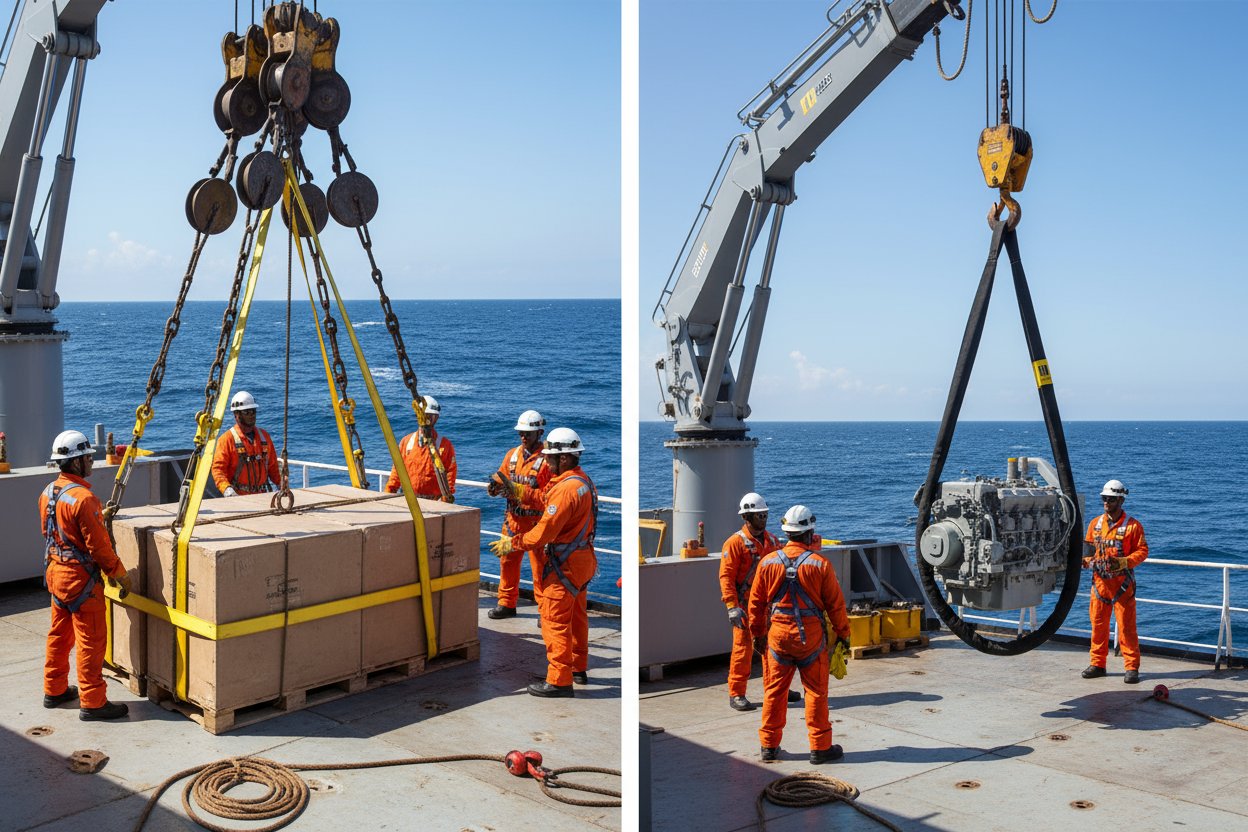
Performance shifts significantly depending on the task. Web slings grip tightly in choke hitches, making them reliable for securing irregular shapes like tree branches in coastal cleanups or bulky industrial pallets—think wrapping around a load to pull it snug without slipping. Sling rounds, however, excel at spreading loads evenly across their surface, ideal for defence lifts where equipment needs uniform support to avoid dents, or spearfishing gear transfers that demand minimal marking on fibreglass tanks. In basket hitches, both double the working load limit (WLL) compared to vertical setups, but chokers reduce it to about 80% for webs due to the pinch effect, while rounds maintain closer to full capacity thanks to their softer bend. For deeper insights into optimizing choker setups at sea, explore techniques that unlock hidden capacity without added risk.
Materials add another layer: polyester in web slings resists acids common in marine cleaning agents, holding shape under tension without much give, which keeps lifts predictable. Nylon versions in rounds allow 8-10% elongation to absorb impacts from rolling seas, though they are less resistant to alkalis. These traits directly influence safe capacities; for instance, a hitch's angle below 60 degrees significantly reduces the WLL for both, as the force vectors pull harder on the sling body. Have you ever calculated that for your own gear? It's why matching material to environment prevents surprises.
Endless Web Slings
For Tough Grips
Choke Strength
Suits tight wraps on rough loads, such as industrial crates.
Harsh Environments
Polyester handles acids in salty, chemical-exposed areas.
Industrial Fit
Best for heavy, abrasive tasks in ports or factories.
Sling Round
For Gentle Lifts
Even Spread
Protects delicate items in spearfishing or yacht operations.
Elongation Absorb
Nylon cushions shocks in dynamic defence manoeuvres.
Yachting Precision
Soft contact preserves finishes on luxury vessels.
For marine professionals, suitability boils down to the load's nature—web slings tackle harsh industrial hauls where grip trumps gentleness, like dragging anchors ashore, while sling rounds protect delicate yachting cargo from scratches during loading. Internationally, Brits might call rounds "endless yarn slings" in naval contexts, and Scandinavians use "rund slinga" for offshore rigs, so aligning terms during global sourcing keeps teams on the same page. These insights pave the way for sizing up capacities through detailed charts in your next planning session.
Navigating the Endless Sling Chart: Load Capacities and Safety Essentials
Those insights from our comparison just scratch the surface; to make them actionable, you need the numbers that guide every lift. Think back to rigging that defence crate; knowing the exact load limits turns guesswork into confidence. An endless sling chart lays it all out, showing working load limits (WLL) based on how you hitch the sling. WLL is the maximum weight a sling can safely handle under normal conditions, always with a built-in safety factor to prevent failures. For endless styles, it's straightforward: vertical hitches rate at full capacity (1x), basket setups double it (2x) by supporting from below, and chokers drop to 80% (0.8x) due to the tighter bend squeezing the load.
Take polyester endless web slings, often chosen for marine stability—their low stretch keeps things steady. A typical 2-inch wide model might lift 3.8 tonnes vertically, jumping to 7.6 tonnes in basket mode but easing to 3.0 tonnes for chokers. Nylon rounds, with more give for shock loads, follow similar multipliers; a medium-duty 8-strand version could manage 4.5 tonnes straight up, scaling accordingly. These charts vary by manufacturer, but they all factor in real-world physics to keep your operations smooth. For why endless lifting slings often dominate in marine repetitive lifts, their design doubles lifespan and ensures scratch-free versatility in demanding conditions.
Of course, angles present a challenge—drop below 60 degrees in a bridle hitch, and WLL can halve as tension skyrockets. Marine environments amplify this: UV rays degrade synthetics over time, weakening fibres like a slow fade under constant sun, while chemicals from deck washes corrode nylon more than polyester. Heat from friction or engines can melt cores too, reducing strength by half if it hits 93°C (200°F). That's where ASME B30.9 steps in, mandating regular checks to catch issues early and adjust capacities accordingly.

To bring it home, here's a sample endless sling chart for common polyester web sizes—always cross-check your gear's tag for precision:
| Width (inches) | Vertical WLL (tonnes) | Basket WLL (tonnes) | Choker WLL (tonnes) |
|---|---|---|---|
| 1 | 1.9 | 3.8 | 1.5 |
| 2 | 3.8 | 7.6 | 3.0 |
| 3 | 5.7 | 11.4 | 4.6 |
Ever wondered how hitches really shift those limits? The choker's squeeze reduces capacity because it pinches the sling, stressing the inner layers—basket avoids that by cradling openly. For round slings, multipliers hold, but their yarn design often eases choker penalties slightly due to even flex.
Inspection directly influences safety; skip it, and even a strong chart won't save you. Per ASME guidelines, scan for cuts deeper than half the width, frays exposing cores, or discoloration from chemicals—these signal immediate retirement. Here's a quick checklist to run before each use:
Pre-use sling inspection checklist:
- Visual scan: Look for abrasions, burns, or UV fading that dulls the colour.
- Feel test: Run hands along the length to detect soft spots or embedded grit from marine debris.
- Load check: Ensure no prior overload signs, such as stretched eyes or melted jacket sections.
- Tag review: Confirm WLL and serial numbers match your chart; illegible tags mean the sling is out of service.
Once damaged, retire it outright—no repairs are recommended on synthetics, as hidden weaknesses may linger. Stick to ISO 9001-certified suppliers like iRopes for peace of mind; their custom options, such as adding reflective strips for low-light yacht operations, integrate these safety layers into your setup. With this foundation, tailoring slings to your global needs becomes second nature.
We've demystified the various terms, from "endless web slings are also called continuous loops" to "Type 5 slings," and explored the softer sling round with its yarn core for delicate marine loads. This guide equips you with global nomenclature variations and practical comparisons for safer rigging. Whether gripping industrial crates with web slings or cradling yacht gear with rounds, understanding hitch impacts on working load limits ensures reliable performance in offshore environments. The endless sling chart provides essential capacities for vertical, basket, and choker setups, complemented by inspection checklists to extend equipment life and comply with ASME standards.
Armed with these insights, you can optimise your marine operations. However, tailoring slings to specific needs, such as custom materials or reflective elements, further enhances safety. For personalised OEM solutions from iRopes, explore the options below.
Need Custom Endless Web or Round Slings? Contact Our Experts
If you're ready to discuss bespoke sling designs that fit your marine applications, use the inquiry form above. Our team at iRopes offers expert guidance on customisation, IP protection, and global delivery to meet your wholesale needs.
