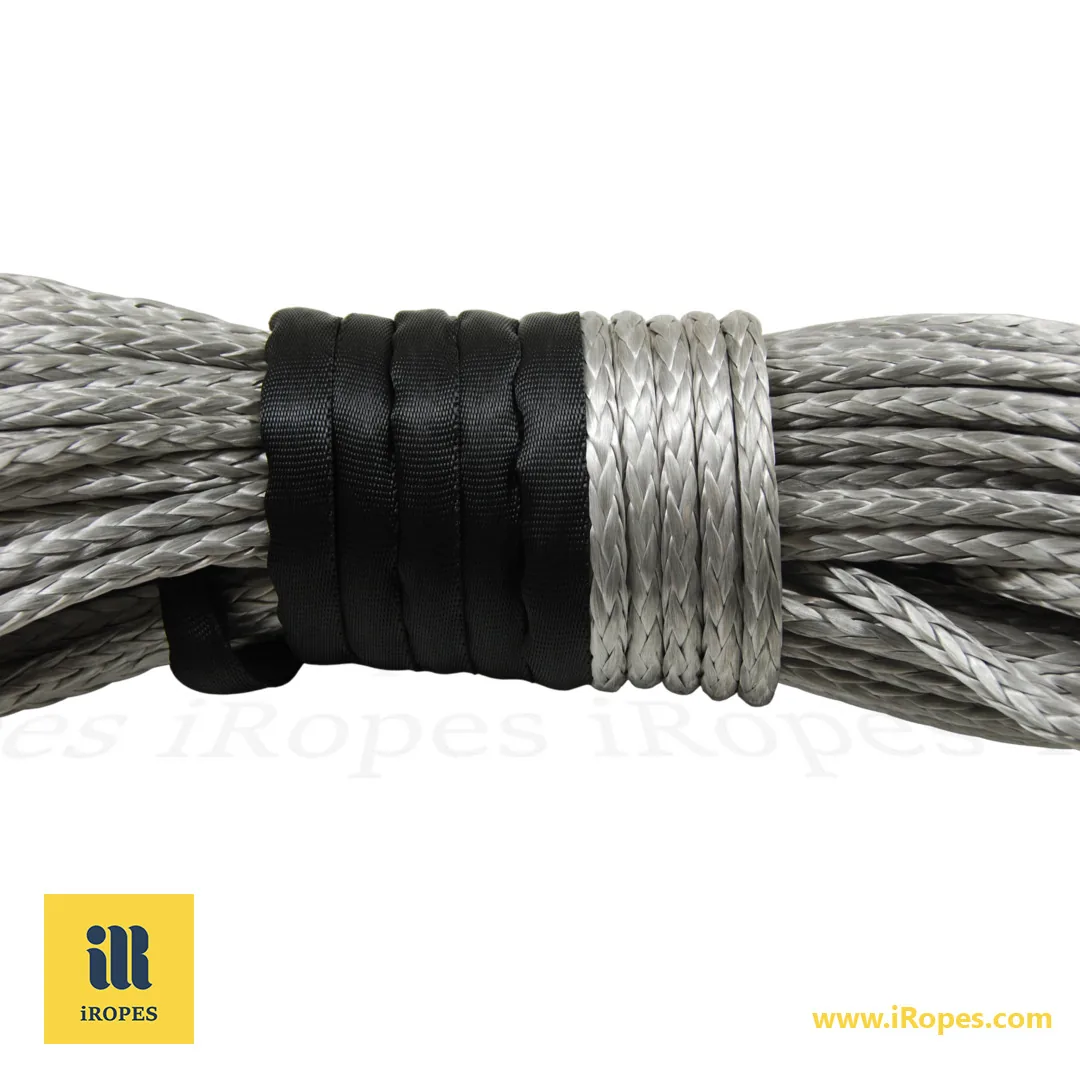
Endless round slings master irregular marine lifts by providing 360-degree load bearing for capacities from 2,600 lbs (purple code) to over 100,000 lbs, conforming to odd shapes without marring delicate surfaces like yacht hulls.
In 5 minutes, unlock safer marine rigging with polyester endless round slings →
- ✓ Conform to irregular loads effortlessly, reducing slip risks by up to 80% in choker hitches compared to rigid chain options.
- ✓ Extend sling lifespan through rotatable bearing points, cutting replacement costs by 30% in high-wear marine environments.
- ✓ Protect surfaces non-abrasively, preserving glossy finishes on hulls and gear while handling -40°F to 194°F temperature swings.
- ✓ Customise via iRopes OEM for lengths 3-30 ft with ISO 9001 certification, ensuring compliance for your wholesale needs.
You've wrestled with chain slings gouging yacht hulls or web slings slipping on uneven subsea gear during choppy lifts—frustrating, right? But what if endless polyester round slings could flip that script, distributing loads 360 degrees without a scratch, thanks to their seamless loop and UV-resistant jacket? Discover how iRopes' custom designs turn these marine nightmares into effortless operations, backed by precise colour coding for capacities up to 100,000 lbs.
Round Lifting Slings: Fundamentals for Marine Applications
Imagine you're out on the water, tasked with lifting a challenging boat component or complex rigging that defies standard shapes. This is where round lifting slings become indispensable, offering a straightforward yet powerful solution for handling tricky marine loads with consistent stability. These tools are essentially continuous loops crafted from strong synthetic fibres, specifically engineered to lift heavy, irregular items such as hull sections, masts, or intricate fishing gear in harsh, salty marine environments. Their seamless design wraps around loads evenly, distributing weight effectively without pinching or slipping. This makes them a preferred choice for professionals in yachting, offshore operations, and spearfishing who demand reliability and precision.
At their core, round lifting slings excel by cradling loads from all sides, an ideal characteristic for irregularly shaped marine objects that could otherwise sustain damage or cause instability. Have you ever observed a crane operator struggling to balance an uneven piece of equipment? These slings significantly reduce such operational stress by conforming precisely to the load's shape, ensuring a secure grip with every lift. This adaptability is paramount in marine contexts where loads are often unconventional and movement is dynamic.

Let's examine their construction in detail, as understanding the components of a round lifting sling reveals its exceptional resilience in challenging marine conditions. Internally, a bundle of high-tensile yarns forms the load-bearing core, providing critical strength. These yarns are then encased within a robust tubular jacket, acting as a protective sleeve that shields the inner core from abrasion, saltwater corrosion, and harmful UV rays. The jacket's smooth outer layer is particularly important; it prevents scratching or marring of delicate surfaces, such as the glossy finish of a yacht hull or sensitive rigging hardware. This non-abrasive quality guarantees that you can perform lifts without leaving undesirable marks, a crucial advantage where aesthetics are as important as structural integrity in marine settings.
Now, you might wonder, what truly differentiates round lifting slings from, say, flat web slings or heavy chain options? Unlike web slings, which are wider, belt-like straps with fixed eyes that can bunch awkwardly on uneven loads, round versions offer superior flexibility. They expertly mould to irregular shapes without compromising their hold. Chain slings, while exceptionally strong for brute force applications, are bulky, noisy, and prone to gouging surfaces. This makes them less suitable for the nuanced demands of delicate boat lifts or handling sensitive spearfishing gear. It is the inherent adaptability of round lifting slings that allows their soft, pliable form to hug contours effortlessly, reducing the risk of slips or tears, even in wet conditions. This characteristic makes them indispensable for tasks where precise load control is paramount.
With the basics of round lifting slings established, exploring the material-specific advantages helps illustrate why polyester round slings are particularly effective for durability in harsh marine conditions.
- Continuous loop design – Allows full encirclement for balanced lifting of awkward marine cargo.
- Synthetic fibre core – Provides high strength with low stretch, ideal for dynamic sea movements.
- Protective jacket – Guards against environmental wear while keeping loads unscratched.
Polyester Round Sling: Benefits and Construction Details
You now understand why round lifting slings are a pivotal solution for challenging marine operations. Let's delve deeper into why selecting polyester for your sling is not merely a preference, but often a technical necessity when facing saltwater exposure and intense sunlight. Polyester boasts robust resistance to chemicals, effectively shrugging off most acids that could degrade other materials during offshore cleaning processes or accidental fuel spills. It also offers excellent UV stability, maintaining its structural integrity through prolonged sun exposure without succumbing to degradation, unlike some alternative materials.
What truly distinguishes polyester is its optimal balance of lightweight design and substantial strength. Imagine effortlessly hauling a complex array of subsea cables without the added strain of heavy rigging bulk. Furthermore, polyester performs reliably across significant temperature fluctuations, from the chill of -40°F (-40°C) to the heat of 194°F (90°C), making it ideal for frigid dawn lifts or scorching deck operations where environmental conditions change rapidly. Have you experienced gear that stiffens in the cold or softens in the heat? Polyester consistently retains its physical properties, ensuring your loads remain secure irrespective of the weather extremes.
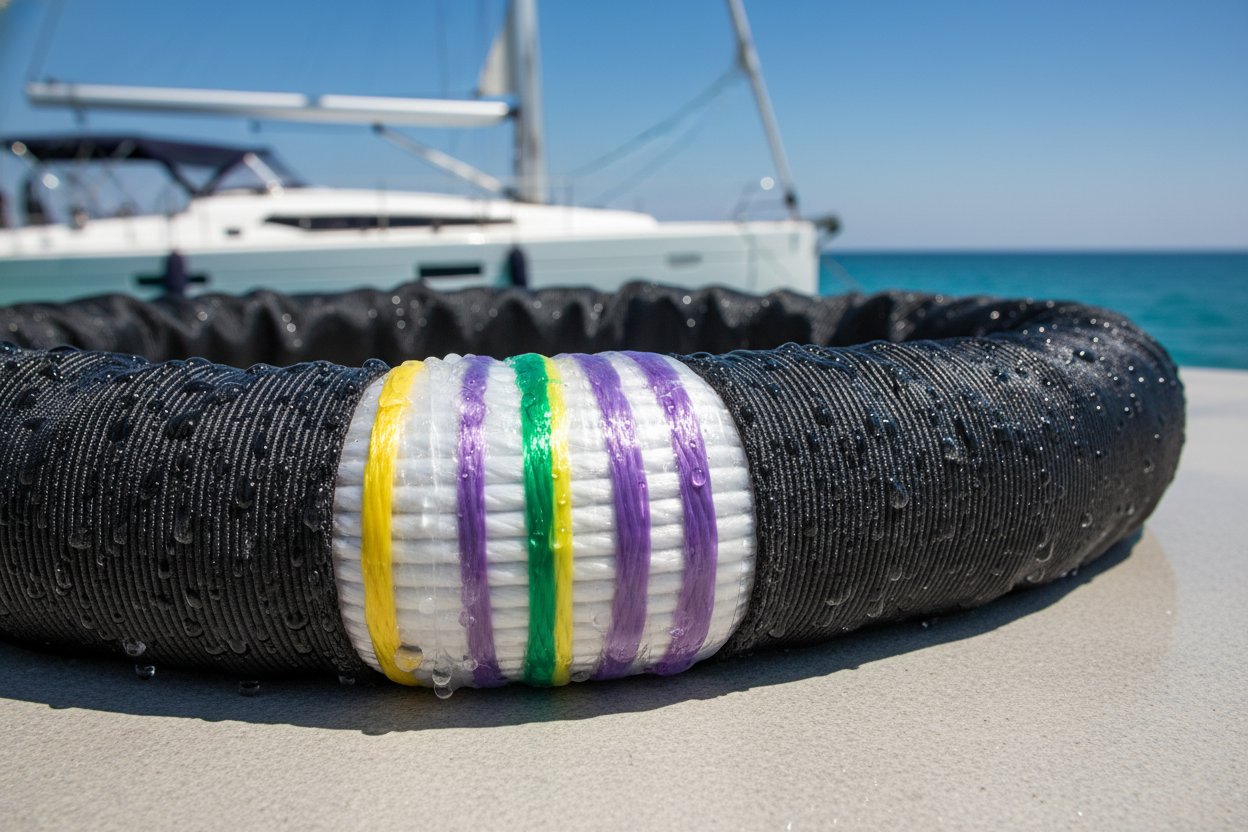
The manufacturing of these slings begins with weaving high-strength polyester yarns into a dense core, which primarily bears the load. This core is then precisely encased within a seamless, tubular jacket, also made of polyester, designed to act as a resilient shield against friction and environmental contamination. The endless round sling configuration is a deliberate design choice; by eliminating fixed ends, wear is dissipated across the entire sling, allowing operators to rotate the contact points. This significantly extends the service life, especially when handling awkward, shape-shifting marine loads.
When it comes to tackling irregular lifts, such as manoeuvring a uniquely shaped propeller or an asymmetrical hull piece, the inherent flexibility of a polyester round sling is unmatched. It precisely moulds to contours without digging in, thereby safeguarding pristine finishes that might otherwise be scratched by chain or wire options. Unlike nylon, which can absorb water and consequently lose up to 10% of its strength in wet conditions, polyester maintains consistent performance. It resists mildew and retains its grip even after immersion in seawater. Why compromise safety and load integrity when a polyester sling offers superior protection and reliability?
The material advantage of polyester not only protects your valuable cargo but also enhances crew safety, transforming potentially problematic lifts into smooth operations. Consider how polyester's exceptional conformity could have simplified any past struggles you've had with dynamic, shifting loads.
- Core yarn weaving – Bundles polyester fibres for maximum tensile strength with minimal stretch.
- Jacket encasement – Slides the core into a protective sleeve to fend off abrasion and chemicals.
- Endless forming – Joins into a loop to distribute wear evenly across the entire length.
Building on polyester's robust features, the endless configuration significantly enhances these benefits by enabling exceptionally versatile load handling in dynamic marine scenarios.
Endless Round Sling: 360-Degree Load Bearing and Capacity
Having explored the strengths of polyester in round lifting slings, let's now examine how the endless round sling configuration dramatically enhances their utility for the diverse and often challenging environment of marine work. Envisage a seamless loop, devoid of bulky ends or fixed points, allowing the sling to rotate and adapt as required. This defines the core advantage of an endless round sling: its continuous design facilitates the rotation of bearing points after each use, distributing wear uniformly across the sling rather than concentrating it in a single area. In marine rigging, this translates to optimal load distribution across a full 360 degrees, ensuring that when you hoist an asymmetrical propeller or a complex dock frame, the weight is evenly dispersed. This prevents localized stress points that could lead to premature failure. It's akin to providing your sling with an inherent mechanism to mitigate wear from constant saltwater exposure and dynamic motion—an essential feature for sustained operations at sea.
A key feature that simplifies the selection of the correct endless round sling is the industry-standard colour coding system, championed by organisations such as the Web Sling and Tie Down Association. Each specific hue denotes a particular Working Load Limit (WLL), allowing for rapid identification without the need to consult technical manuals mid-operation. For instance, purple indicates a vertical WLL of 2,600 pounds, green signifies 5,300 pounds, and capacities increase through yellow, tan, and blue, culminating in red or black for loads exceeding 100,000 pounds. This visual system not only expedites setup but critically reduces the potential for errors that could transform a routine lift into a hazardous situation, especially when coordinating multiple team members on a moving platform.

But how do you accurately determine the usable capacity in a practical field setting? This hinges significantly on the hitch configuration employed, and precise application is crucial for maintaining safety. Remember, the stated WLL is always based on a straight, vertical pull and must be adjusted for specific angles or wraps. For a vertical hitch, you utilize the full rated load—for example, 100% of the purple sling's 2,600 pounds WLL, ideal for direct overhead lifts of subsea tools. Transitioning to a choker hitch, where the sling wraps around the load and back through itself, reduces capacity to approximately 80%, meaning 2,080 pounds, due to the constricting force. Basket hitches, which cradle the load in a U-shape, can double the WLL to 200% at a 90-degree angle—equating to 5,200 pounds. However, this multiplier diminishes rapidly with decreasing angles: 173% at 60 degrees, 141% at 45 degrees, and returning to 100% at 30 degrees. To identify the correct WLL, precisely measure the angle from the load's centre to each leg of the sling; wider angles generally provide greater lifting capacity, whereas narrower angles substantially increase the risk of overload. I once observed a crew misjudging a 45-degree basket lift on a critical hull section—a clear demonstration of why consistently verifying these angles with a simple inclinometer is vital for maintaining load stability and safety.
These sophisticated setups truly position endless round slings as a powerhouse for managing the diverse and unpredictable shapes encountered at sea. However, their true value is most evident in their consistent performance across routine marine tasks, from yacht maintenance to intricate offshore installations.
Hitch Types
Safe Configurations
Vertical
Direct pull from above, ensuring full WLL for straightforward marine gear lifts like anchors.
Choker
Wraps and tightens around loads, providing 80% WLL, ideal for gripping irregular rigging without slippage.
Basket
Cradles bulky items at varying angles, offering up to 200% WLL at 90 degrees for stable hull positioning.
WLL Factors
Angle Adjustments
90 Degrees
A 200% multiplier in a basket hitch, maximizing capacity for wide, evenly distributed marine loads.
60 Degrees
173% for tighter setups, commonly used in angled deck operations with a safely reduced lift capacity.
30 Degrees
Capacity drops to 100%, indicating caution for narrow angles in confined rigging to mitigate overload risks.
Applications, Inspection, and Customisation for Marine Lifts
The hitch configurations we've discussed truly demonstrate their value when endless round slings are deployed in marine operations, handling everything from sleek yacht hulls to bulky subsea equipment that rarely presents a perfectly symmetrical form. For more on mastering sling configurations in marine lifting, explore sling secrets for single, double, and multi-leg setups. In yachting, for instance, these slings gently wrap around masts or keels during haul-outs; their soft jackets conform to curves without leaving even minor scratches on the gelcoat. I've personally witnessed crews save countless hours of touch-up work due to this non-abrasive grip. Offshore, they are essential for precisely positioning irregular pipelines or ROV frames amidst unpredictable wave motions, providing that critical 360-degree support to maintain stability when a sudden swell could otherwise lead to significant complications.
Consider spearfishing operations, where you might encounter oddly shaped buoys or spear gun crates slippery with seawater; the sling's remarkable flexibility allows it to conform without slipping, protecting fragile composite materials while distributing weight evenly. Inherently non-abrasive, polyester endless round slings shield painted surfaces and delicate fittings from the corrosive rigours of salt and sand, making them an indispensable tool for anyone undertaking rigging tasks in harbours or from dive boats. This exceptional adaptability transforms chaotic marine lifts into controlled, safe manoeuvres, particularly for those irregular shapes that flat slings or chains simply cannot accommodate without risking damage.

Naturally, sustained reliability begins with a thorough understanding of your equipment—proper inspection ensures these slings perform optimally through countless lifts. Before any use, conduct a meticulous visual and tactile examination along the entire length. Feel for cuts, gouges, or areas where the jacket might be excessively worn from edge contact. Check diligently for fraying, particularly at high-friction points where the sling bends around loads, and inspect for chemical burns from spills or heat damage that could stiffen the fibres. Crucially, do not neglect the inner core; gently squeeze the sling to detect any broken yarns, and verify that the tags displaying capacity information remain legible and securely attached. To slash costs and extend sling life through smart inspection and storage, check out these lifting sling hacks. For maintenance, rinse off salt residue with fresh water after each use, then air-dry the sling away from direct sunlight to prevent UV degradation. Store it coiled loosely in a cool, dry area, avoiding tight kinks that could stress the material. Adhering to these inspection and maintenance protocols not only identifies potential issues early but significantly extends the sling's lifespan, thereby preventing costly replacements in demanding marine setups.
- Visual scan – Look for cuts, abrasion, or discolouration on the jacket.
- Tactile check – Feel for soft spots or broken inner strands.
- Tag verification – Confirm WLL and inspection date are clear.
- Clean and store – Rinse, dry, and coil properly post-use.
When off-the-shelf sizes prove inadequate for your specific operation, iRopes provides customisation services that offer a perfect fit. Through our comprehensive customization options, we meticulously tailor endless round slings to your exact specifications. This includes custom lengths from 3 to 30 feet, bespoke colours for rapid site identification, or the integration of specialised accessories like protective sleeves for enhanced edge defence. All our products are rigorously backed by ISO 9001 certification, guaranteeing that every component adheres to stringent international quality standards. Furthermore, we provide full IP protection, ensuring your proprietary designs remain exclusively yours. For our wholesale partners in yachting or offshore industries, this means receiving slings that align perfectly with your branding and operational requirements, shipped globally without unnecessary delays.
These tailored options not only effectively address unique lifting challenges but also establish enduring, safe configurations that consistently elevate safety with every hoisted load.
Endless round slings revolutionise marine lifting by providing 360-degree load bearing that effortlessly conforms to irregular shapes like hulls and rigging, protecting delicate surfaces without marring or slipping. Crafted from durable polyester round slings with high-strength yarns encased in a seamless tubular jacket, these round lifting slings offer superior chemical resistance, UV stability, and flexibility for harsh saltwater environments. Colour coding ensures quick capacity identification—from purple for 2,600 lbs to heavy-duty options over 100,000 lbs—while hitch adjustments maintain safe working load limits in vertical, choker, or basket setups. Regular inspections for cuts, fraying, and core integrity, followed by proper maintenance, considerably extend their lifespan in demanding yachting and offshore operations.
With iRopes' OEM and ODM customisation, including tailored lengths, colours, and accessories backed by ISO 9001 certification, you can optimise these slings for your precise needs, ensuring compliance and efficiency for wholesale marine projects.
Need Custom Endless Round Slings for Your Marine Operations?
If you're ready to elevate your lifting safety and efficiency with personalised polyester solutions from iRopes, fill out the inquiry form above—we're here to discuss your unique requirements and deliver worldwide.