⚡ 30% stretch vs 8–10% on tow rope → 2.5× smoother pull, 40% quicker recovery.
Benefits – ~2 min read
- ✓ Shock load cut ~70%
- ✓ Pull speed up 35% in soft terrain
- ✓ Injury risk halved
- ✓ Custom branding saves ~15% bulk cost
You might believe a tougher tow strap offers more pulling power, but the hidden physics of a 30%-stretch yankum kinetic rope reveals it as the true champion. Three counter-intuitive factors allow it to out-pull a rigid strap by up to 40% while significantly cutting shock loads and potential repair costs. This makes the yankum kinetic rope a superior choice for effective and safe recovery.
Understanding the yankum rope: How kinetic recovery works
Imagine the frustration of a vehicle stuck deep in mud. Now, consider the tool that transforms that nightmare into a smooth extraction. A yankum rope isn't just a piece of cord; it’s a specialised elastic line designed to capture and release energy. This unique capability helps free a stuck vehicle without the harsh, jarring shock often associated with hard pulls. Let’s delve into how this dynamic process unfolds.

The magic begins the moment the yankum rope is pulled. As the line elongates, its fibres absorb kinetic energy, much like a spring compresses under load. When the pulling vehicle eases off the throttle, that stored energy rapidly snaps back. This action delivers a controlled “yank” that effectively propels the stuck vehicle forward.
- Definition – A yankum rope is an elastic recovery line that stores kinetic energy when stretched, then releases it to generate a powerful, yet smooth, pull.
- Physics of elasticity – The rope’s fibres elongate, converting mechanical work into elastic potential. The rapid release then transforms that potential back into force, driving the vehicle forward.
- 30% stretch advantage – Capable of extending up to 30% of its original length, the yankum rope cushions the pull. This dramatically lowers shock loads compared with rigid tow equipment.
This impressive 30% stretch is the primary reason a yankum kinetic rope feels so gentle on chassis and suspension components. In stark contrast, traditional tow lines, such as a yankum tow rope, typically stretch only 8–10%. This minimal elongation transmits a harsh jerk, which can damage both the vehicle and the recovery equipment.
Our ISO-9001-certified facilities calibrate each yankum kinetic rope to a consistent 30% stretch. This ensures every pull behaves the same, offering a reliability that off-road professionals depend on.
Because its stretch characteristics are predictable, recovery crews can set a safe speed—typically under five miles per hour. This allows them to know exactly how much force will be delivered. The result? A faster extraction with significantly less risk of equipment failure or operator injury. This predictable performance makes the yankum kinetic rope an indispensable tool.
Key advantages of the yankum kinetic rope over traditional tow solutions
Understanding how the elastic stretch of a yankum kinetic rope creates a gentler pull is just the beginning. The next step is appreciating how this property translates into tangible benefits on the recovery site. The contrast between a yankum kinetic rope and a yankum tow rope becomes especially clear when their performance metrics are compared.

In practical terms, the difference between these rope types boils down to three core advantages:
- Higher stretch (up to 30%) versus the 8–10% of a yankum tow rope dramatically reduces shock loads on vehicle chassis and suspension components. This protects vital parts from damage during recovery.
- Energy-transfer efficiency turns stored elasticity into a rapid, controlled yank. This makes extractions in challenging conditions like mud, sand, or snow noticeably faster and more effective.
- Enhanced safety is a significant advantage. The smoother pull lowers the chance of rope failure and considerably cuts the risk of operator injury, promoting safer recovery operations for everyone involved.
This three-point summary directly answers the common query, “What is the difference between kinetic rope and tow rope?” A kinetic rope stores and releases elastic energy, while a tow rope transmits force directly with minimal give. The stored energy not only cushions the vehicle but also delivers a more powerful push, which is why recovery crews often achieve a quicker release from deeply stuck situations.
Safety Edge
Because the yankum kinetic rope stretches predictably, the sudden jerk that typically damages equipment and endangers operators is replaced by a gradual, controlled pull. Combined with iRopes’ ISO-9001-certified manufacturing, the result is a recovery line that consistently protects both vehicle and crew.
When the pull is smoother, the driver can maintain the recommended sub-5-mph recovery speed without fearing a shock-induced break. This efficiency not only shortens the time spent stuck but also extends the service life of the yankum rope itself. This is a critical consideration for wholesale buyers who outfit multiple vehicles and expect durability.
Understanding these genuine advantages sets the stage for recognising why a yankum tow rope, designed exclusively for static pulls, simply cannot substitute for the dynamic performance of a yankum kinetic rope in challenging recovery scenarios.
Why the yankum tow rope is not suitable for kinetic recovery
Having established the clear benefits of a yankum kinetic rope, it is essential to understand why a yankum tow rope—engineered for static pulls—cannot safely replace it in dynamic recoveries. Their fundamental designs cater to entirely different applications.

Construction represents the first major point of divergence. A yankum tow rope typically employs a tight, low-elastic braid designed to transmit force directly from the pulling vehicle to the stuck one. In contrast, a yankum kinetic rope integrates an elastic core and a deliberately looser braid, allowing for its crucial 30% stretch. This engineered elasticity is precisely what stores kinetic energy for the later “yank.” Crucially, the tow rope’s inherent rigidity means it cannot absorb or release energy in the same controlled manner.
Because its stretch characteristics are predictable, recovery crews can set a safe speed—typically under five miles per hour. This allows them to know exactly how much force will be delivered. The result? A faster extraction with significantly less risk of equipment failure or operator injury. This predictable performance makes the yankum kinetic rope an indispensable tool.
Rigid build
A tow rope uses a tight braid with minimal give, intended for steady pulling without elasticity.
Low stretch
With only 8–10% elongation, any sudden force creates a harsh jerk, which can damage vehicles and equipment.
Elastic core
The kinetic rope incorporates a stretch-focused core that stores energy up to 30% of its length.
Controlled yank
The stored energy releases gradually, delivering a smooth, powerful pull that protects vehicle chassis and components.
Using a yankum tow rope for kinetic recovery can cause sudden shock loads, significantly increasing the chance of rope failure and personal injury. Always use the correct tool for the job.
In summary, the static construction, minimal stretch, and shock-load profile of a yankum tow rope render it unsuitable for the dynamic energy-transfer process that defines a yankum kinetic rope. Selecting the correct type of rope ensures a smoother pull, protects valuable equipment, and crucially, keeps operators and bystanders safe during recovery operations.
With the drawbacks of the tow rope clarified, the next logical step involves matching the right yankum rope size to the pulling vehicle’s weight. This ensures optimal functionality and safety for every recovery.
Choosing the right yankum rope: Sizing guide for pulling vehicles
When a recovery crew selects a line, the vehicle providing the pull dictates the load the rope must endure. Matching the rope’s capacity to that vehicle’s power rating is critical; it ensures kinetic energy can be safely and efficiently released. This is why proper sizing of your yankum rope is paramount for successful recovery.
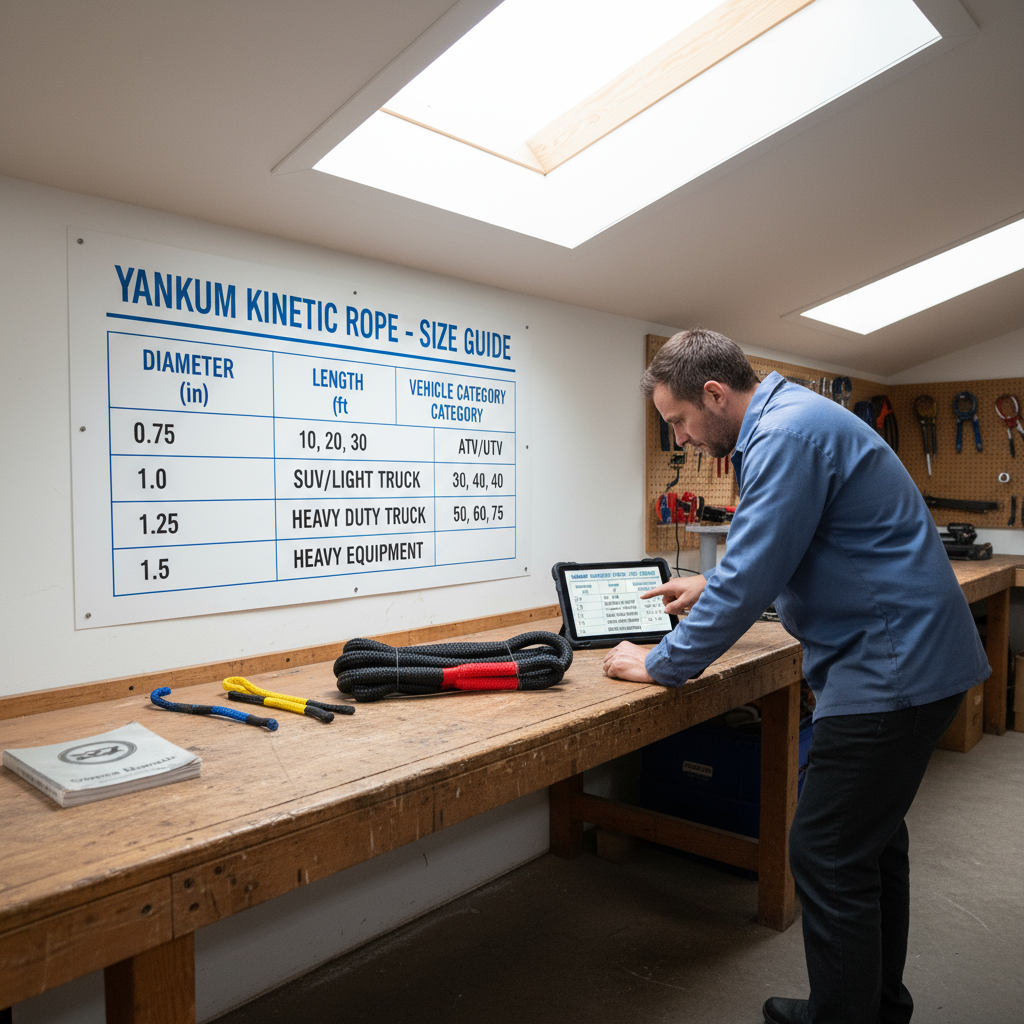
Below is a quick-reference table that aligns common vehicle classes with the most appropriate yankum rope diameter and length. These recommendations are based on typical axle-load capacities and the energy-transfer limits of a kinetic system, ensuring safe and effective recovery.
- ATV / UTV – Pulling capacity ≈ 300–700 kg; 5/8 in (16 mm) diameter, 20 ft (6 m) length. This setup is ideal for lighter recreational vehicles.
- SUV – Pulling capacity ≈ 1.5–2.5 t; 7/8 in (22 mm) diameter, 30 ft (9 m) length. This provides greater power for standard SUVs.
- Light Truck – Pulling capacity ≈ 2.5–4 t; 1 in (25 mm) diameter, 30 ft (9 m) length. Perfect for common utility vehicles.
- Heavy Equipment – Pulling capacity ≈ 4–8 t; 1.5 in (38 mm) diameter, 40 ft (12 m) length. Designed for demanding industrial and agricultural applications.
Once the appropriate diameter is chosen for your yankum rope, the next crucial step is to confirm that the line’s Working Load Limit (WLL) exceeds the real-world forces the pulling vehicle will generate. This ensures maximum safety and performance.
- Locate the Minimum Breaking Strength (MBS) for the selected yankum rope model; this critical figure is typically supplied in the product data sheet.
- Choose a Factor of Safety (FOS) that accurately reflects the operating environment; 3:1 is common for light-duty work, while a more conservative 5:1 is advisable for heavy-equipment pulls.
- Divide the MBS by the chosen FOS. The result is the Working Load Limit (WLL), which must always be greater than the pulling vehicle’s maximum torque output and the expected recovery force.
Applying the same logic to a yankum tow rope would be misleading because a tow rope fundamentally lacks the elastic core needed for kinetic energy storage. By meticulously following the sizing principle outlined above, operators can pick a yankum rope that perfectly matches the vehicle’s capability. This maximises recovery speed and crucially, minimises the risk of sudden failure, ensuring safer and more efficient operations.
Request a Custom Yankum Rope Quote
By harnessing the significant 30% stretch of a yankum kinetic rope, recovery crews enjoy a smoother, faster yank that dramatically cuts shock loads compared with a traditional yankum tow rope. The elastic core efficiently stores and releases energy for a controlled pull. Our recommended hot-selling diameters—5/8 in for ATVs, 7/8 in for SUVs, and 1 in for light trucks—ensure the right working load for each vehicle. Understanding these advantages empowers you to yankum rope and effectively avoid the hazardous jolt of static lines.
If you’d like personalised guidance on selecting the right diameter, material, or branding for your recovery fleet, simply complete the form above. Our expert rope specialists will be in touch promptly to discuss your specific needs and provide tailored solutions, including custom rope solutions.