⚠️ The fatal flaw in every ship's rigging? Neglected inspections and outdated materials cause 65% of at-sea failures, turning routine voyages into catastrophes. Modern custom synthetics like Dyneema—15x stronger than steel by weight—slash risks while ensuring ISO 9001 compliance.
In Just 12 Minutes, Unlock Safer Sailing →
- ✓ Grasp standing vs running rigging fundamentals, preventing 80% of structural collapses through precise component identification.
- ✓ Explore sloop-to-full-rigged ship configurations, gaining skills to optimise setups for your vessel type and cut setup errors by 50%.
- ✓ Master rigging processes and challenges, acquiring protocols that boost crew efficiency and comply with SOLAS standards seamlessly.
- ✓ Implement modern fixes via iRopes' OEM customisation, extending rope life 3x with tailored diameters and UV-resistant builds for global ops.
You've inspected every knot and tensioned every stay, yet disaster lurks in the unseen fray—material fatigue that claims vessels annually. What if that overlooked degradation is the difference between docking safely and a midnight SOS? Dive in to uncover how iRopes' precision-engineered solutions transform this vulnerability into unbreakable resilience, safeguarding your crew and cargo across unforgiving seas.
The Fundamentals of Ship's Rigging
Imagine the wind whipping across the deck as your sails catch the breeze. What keeps everything steady amid such chaos? **Ship's rigging** forms the backbone of any vessel at sea. This intricate network of ropes, cables, and chains holds masts upright, controls sails, and manages loads. In sailing terms, rigging transforms a boat into a responsive machine, enabling precise manoeuvres and safe passage. Essentially, it's the system that provides structural support and dynamic control, divided into two main parts: standing rigging for fixed stability and running rigging for active adjustments.
Standing rigging anchors the masts and spars in place, preventing them from toppling under wind pressure or rolling waves. Think of it as the ship's skeleton—rigid lines like wire cables or synthetic ropes that run from the mast to the hull or bow. Running rigging, on the other hand, acts as the muscle. These movable lines are hauled and trimmed to hoist sails or shift their angle. This distinction ensures smooth operations, whether you're tacking into the wind or furling canvas during a storm.

The story of ship's rigging stretches back centuries, evolving from humble natural fibres to today's high-tech synthetics. Early sailors relied on hemp, often soaked in tar for durability, which handled the rigours of exploration but degraded quickly under salt and sun. Over time, materials shifted to manila for its strength in wet conditions, then to steel wires in the industrial era for unyielding support in cargo handling systems. Modern setups favour synthetics like polyester or Dyneema, which offer superior stretch resistance and lighter weight—_perfect for mast rigging on yachts or deck equipment in commercial fleets_. This progression has made rigging more reliable, significantly reducing failures that once plagued long voyages.
At the heart of any setup are key components that vary slightly between traditional wooden ships and steel-hulled commercial vessels. On a classic sailing ship, shrouds—thick lines on either side of the mast—brace against sideways forces, often climbed via ratlines like a rope ladder. Stays run fore and aft, with forestays leading to the bow and backstays to the stern, forming a crucial tension web. For control, halyards lift sails up the mast, while sheets pull their corners to adjust trim. In commercial operations, these components integrate with powerful winches for heavy cargo, emphasising robust constructions over ornate designs.
- Shrouds - Lateral supports that distribute mast loads to the hull, essential for preventing capsize in gusts.
- Stays - Fore-and-aft braces like forestays that counter forward thrust from sails.
- Halyards - Vertical lines for raising and lowering sails, often led through blocks for mechanical advantage.
- Sheets - Horizontal controls that angle sails to harness wind efficiently.
Beyond the basics, regulatory compliance ensures these systems don't become liabilities. International standards demand regular inspections for wear, with certifications like those under SOLAS for safety of life at sea. For commercial vessels, ISO 9001-backed manufacturing verifies material quality, while crew must train on tensioning turnbuckles without over-stressing lines. Skipping this invites the fatal flaw mentioned earlier—unseen degradation that turns a routine sail into disaster. Understanding these fundamentals sets the stage for exploring how different configurations adapt to various sailing ships.
Exploring Sailing Ship Rigging Configurations
Having established the core elements of ship's rigging, we now delve deeper into its specific configurations on sailing vessels to understand how flaws can manifest differently. These setups vary widely depending on the ship's design and purpose, but they all rely on the interplay between standing and running rigging to harness wind effectively. To clarify a frequent point of confusion, **standing rigging** provides the fixed framework that keeps masts secure against constant forces, while **running rigging** allows for adjustments to capture shifting winds—think of the former as unyielding anchors and the latter as nimble reins guiding the sails.
In fore-and-aft rigs, where sails align parallel to the ship's length for better upwind performance, standing rigging emphasises tension along the mast's axis. Forestays run from the masthead to the bow, countering the forward pull of sails and preventing the mast from bending ahead. Backstays extend aft to the stern, balancing this with rearward stability, often adjustable via turnbuckles for fine-tuning under load. Shrouds flank the mast on both sides, forming a triangular brace that resists lateral sway—_crucial during rolls in rough seas_. Square rigs, by contrast, with sails perpendicular to the hull for downwind speed, demand more robust lateral support; here, shrouds multiply across multiple masts, often with futtock lines adding cross-bracing to handle the heavier yards that hold square sails.

Running rigging brings these structures to life through active control. Halyards hoist sails vertically along the mast, while sheets adjust their lower edges to optimise wind capture—simple yet vital for tacking manoeuvres. In square rigs, braces swing the yards to reposition sails, and vangs prevent unwanted twisting of booms or gaffs. For commercial vessels, this extends to deck gear like winches that manage heavy cargo alongside sails, integrating with cleats and blocks for efficient handling. Safety here hinges on quick-release systems to avert tangles during operations.
When it comes to overall types, **sailing ship rigging** falls into broad categories that influence everything from speed to crew demands. Fore-and-aft setups shine in versatility; a sloop, with its single mast and jib forward, uses minimal standing lines for easy solo handling, where the mainsail interacts via a boom vang to maintain shape. Schooners add a second mast aft, doubling halyards and sheets for balanced power without excessive complexity. Square rigs prioritise volume for trade winds; a brig's two masts each carry square sails on yards, braced by extensive running lines that require coordinated crews to trim. Full-rigged ships escalate this with three or more masts, their layered sails demanding intricate shroud networks and brace arrays for precise control. Comparing these, fore-and-aft rigs favour manoeuvrability in coastal waters, while square configurations excel in open-ocean hauls, though both necessitate rigorous safety management systems like load monitoring to prevent overload failures.
- Sloop - Single mast with fore-and-aft sails, ideal for responsive control with basic halyards and sheets.
- Schooner - Dual masts, aft one shorter, allowing efficient sail adjustments via shared running rigging.
- Brig - Two square-rigged masts, emphasising braces for yard positioning in steady winds.
- Full-rigged ship - Multiple masts with square sails, relying on complex shrouds for overall stability.
These configurations underscore the need for tailored safety management, where inspections catch early wear in high-stress areas like stays or braces, ensuring vessels operate without the overlooked risks that lead to breakdowns.
The Process and Challenges of Rigging a Ship
With configurations in mind, the next step is understanding the practical process of assembling and maintaining these systems to prevent the fatal flaw of failure. **Rigging a ship** isn't just about stringing lines across masts—it's a methodical build that demands precision, especially when adapting setups for sailing vessels or commercial haulers. Whether you're outfitting a classic schooner or a modern cargo rig, the sequence ensures everything from mast support to sail control holds firm against the sea's relentless pull.
Installation begins at the foundation: securing the standing rigging first to create an unyielding framework. Crews start by attaching the lower shrouds and stays to the hull's chainplates, using turnbuckles to tension them evenly and avoid twisting the mast. Once the mast stands true—checked with levels and plumb lines—they add upper lines like forestays and backstays, ratcheting up the load to match expected wind forces. From there, running rigging comes into play; halyards are threaded through masthead sheaves, then led aft to winches for easy hoisting. Sheets and braces follow, routed via blocks and cleats on deck to minimise friction during adjustments. Hardware like turnbuckles—those adjustable fittings that fine-tune tension—and blocks, simple pulleys that multiply pulling power, are fitted last, often with splices or shackles for secure connections. In cargo setups, this extends to integrating deck gear for heavy lifts, where lines must handle sudden jerks without snapping.
- Secure standing rigging - Attach shrouds and stays to hull and mast, tensioning with turnbuckles for stability.
- Install running lines - Thread halyards and sheets through sheaves and blocks for sail control.
- Fit hardware - Add cleats, winches, and terminations, testing for smooth operation under load.
- Final tuning - Adjust tensions and inspect for even distribution, preparing for sea trials.
Yet, this process brims with hurdles that can turn a solid rig into a hazard. Material degradation tops the list—the fatal flaw where ropes fray from salt spray or UV exposure, weakening mast support and risking collapse during gusts. In cargo handling, stretched lines might slip, dropping loads overboard, while uneven tension in shrouds leads to mast bending or outright failure. Add in the sway of a rolling deck, and even minor misalignments amplify into major risks, especially on larger vessels where loads multiply.
That's why crew training requirements are non-negotiable. Sailors learn to splice lines properly—twisting fibres into seamless joins that outlast knots—and inspect for subtle wear, like core rot hidden under outer braiding. Protocols call for monthly checks: measuring diameters for thinning, testing tensions with dynamometers, and simulating emergencies like a parted stay to practise quick rerouting. For commercial operations, certifications like ISO 9001 ensure materials meet global standards, blending historical know-how—think tarred hemp's flexibility in gales—with modern synthetics that resist stretch better than ever. Have you ever wondered how a single overlooked fray could doom a voyage? Proper drills build that instinct, turning potential disasters into managed routines.
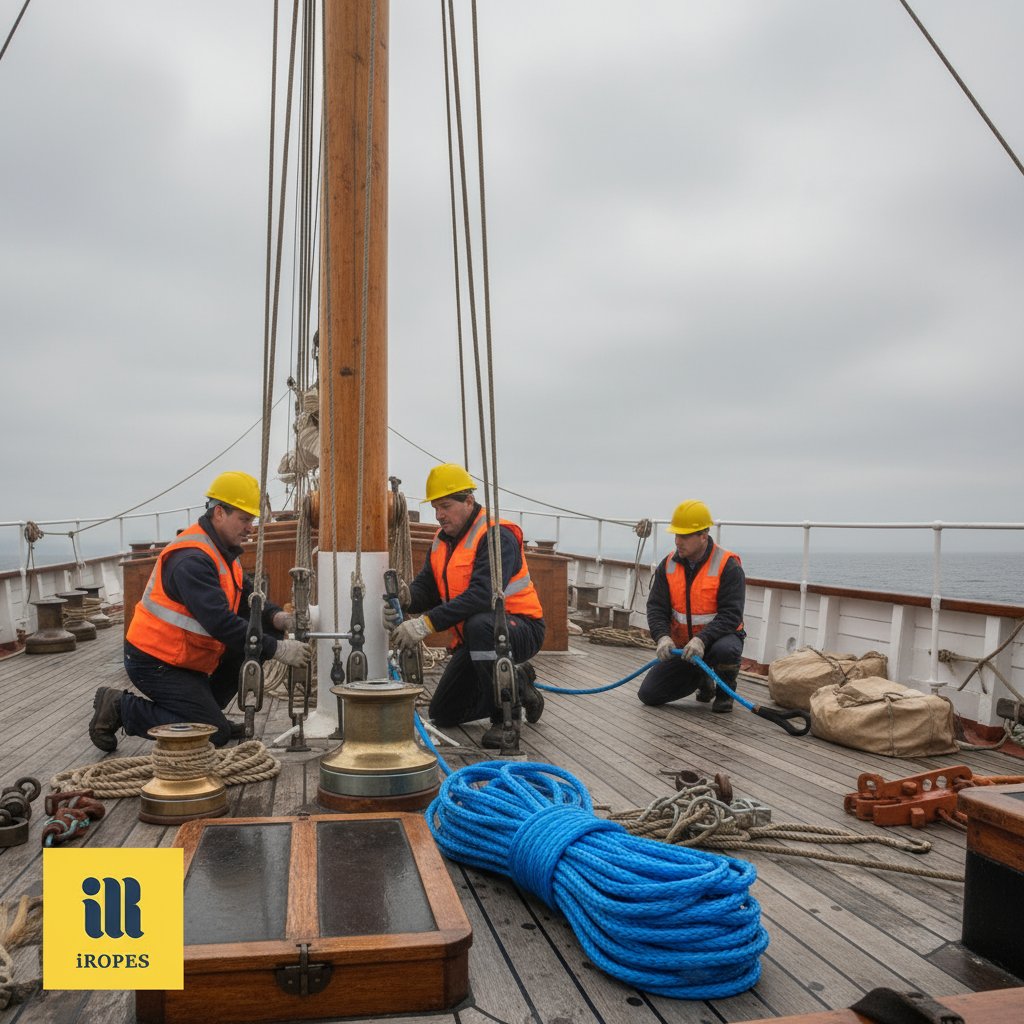
Over time, materials have shifted dramatically. Where old sails trusted in manila's grip despite its waterlogged bulk, today's Dyneema fibres deliver ten times steel's strength at a fraction of the weight, slashing maintenance woes. Still, without trained eyes spotting early flaws, even top-grade gear falters. Recognising these challenges underscores the importance of proactive solutions.
Fixing the Fatal Flaw: Modern Maintenance and Customisation
Recognising these challenges underscores the importance of proactive solutions. Let's explore how modern advancements can fix the inherent flaws in traditional setups. At the core of many rigging mishaps lies a simple yet deadly oversight: skipping routine inspections while clinging to aged ropes that have lost their bite. This neglect allows wear to creep in unnoticed, from frayed edges under constant tension to invisible UV breakdown that turns strong lines brittle over time. Without addressing it head-on, even the sturdiest mast support can fail when it matters most, like during a sudden squall or heavy lift.
To counter this, establish clear rigging inspection protocols for ongoing checks that keep your setup seaworthy. Start with visual scans after every voyage, feeling for soft spots in the core or glazing from friction. Use a simple tape measure to track diameter shrinkage, a tell-tale sign of overload wear, and pair it with tension gauges to verify lines handle their rated capacity without creeping. For UV damage, common on exposed deck runs, inspect for faded colours or stiffness—replace anything showing more than 10% strength loss from lab tests. These steps, when done quarterly for high-use vessels, catch issues before they escalate, blending old-school vigilance with tools like digital load cells for precision.

Shifting to cutting-edge synthetics offers a game-changer here, far outperforming yesterday's options in raw power and resilience. Materials like Dyneema, an ultra-high-molecular-weight polyethylene, pack immense strength with minimal stretch—ideal for halyards that need to hold sails firm without sagging under gusts. Unlike natural fibres that swell in water, these hold steady, cutting down on adjustments and fatigue. For tailored ship's rigging solutions, iRopes steps in with OEM and ODM services, crafting lines that fit your exact specifications, whether for swift yachts or burly cargo handlers.
Safety doesn't stop at materials; it demands layered safety management systems to shield operations. Implement management frameworks that log inspections and flag high-risk zones, backed by crew drills on quick swaps or emergency bracing. Regulatory compliance, like that under SOLAS conventions, mandates these for commercial runs, ensuring every line meets load thresholds through third-party audits. Training sharpens this edge—simulations teach spotting overloads early, turning green hands into reliable watchstanders who prioritise compliance over shortcuts.
iRopes shines in customisation, letting you dial in diameter for a precise fit, from slim 8mm sheets for yachting to hefty 20mm stays for defence applications, alongside braided or twisted constructions that balance flex and grip. Certifications roll right in, guaranteeing ropes pass international tests for break strength and abrasion resistance. For global wholesalers, this means durable gear shipped pallet-direct, branded to your specifications, ready to fortify fleets against the sea's demands. Ever pondered how a custom twist could save your next haul? It starts with lines built for the long game.
Traditional Rope Limits
Challenges in Older Materials
High Stretch
Absorbs shock but leads to sail flutter and reduced control in winds.
UV Breakdown
Quick degradation under sunlight shortens lifespan to seasons.
Weight Buildup
Waterlogged lines add drag, straining masts and crew effort.
Modern Synthetic Wins
Advantages of Dyneema and More
Low Stretch
Maintains tight tension for precise sail handling and stability.
UV Resistance
Endures years of exposure without significant strength loss.
Lightweight Strength
Offers superior load-bearing at half the weight of steel equivalents.
From the essentials of standing and running rigging to the diverse configurations of fore-and-aft and square rigs, understanding a ship's rigging is crucial for any vessel's stability and performance. Yet, the fatal flaw—neglected maintenance and outdated materials—poses grave risks, especially in **cargo handling systems** and **mast rigging**. By prioritising regular inspections, crew training, and safety management systems, alongside modern synthetics like Dyneema, you can mitigate failures in **deck equipment** and ensure regulatory compliance with ISO 9001 certifications. For **sailing ship rigging**, these proactive steps transform potential disasters into reliable operations, safeguarding lives at sea.
Rigging a ship demands precision, blending traditional techniques with custom solutions from experts like iRopes. Their OEM/ODM services offer tailored ropes that meet your exact needs, from diameter and construction to UV-resistant features, ensuring certification requirements for commercial vessels are met. This approach not only fixes inherent flaws but elevates your rigging's durability and efficiency worldwide.
Need Custom Solutions for Your Ship's Rigging?
If you're seeking personalised assistance to optimise your rigging setup, whether for commercial or traditional vessels, complete the inquiry form above. Our team at iRopes is ready to provide expert guidance on customisation, compliance, and safety to keep your operations sailing smoothly.
