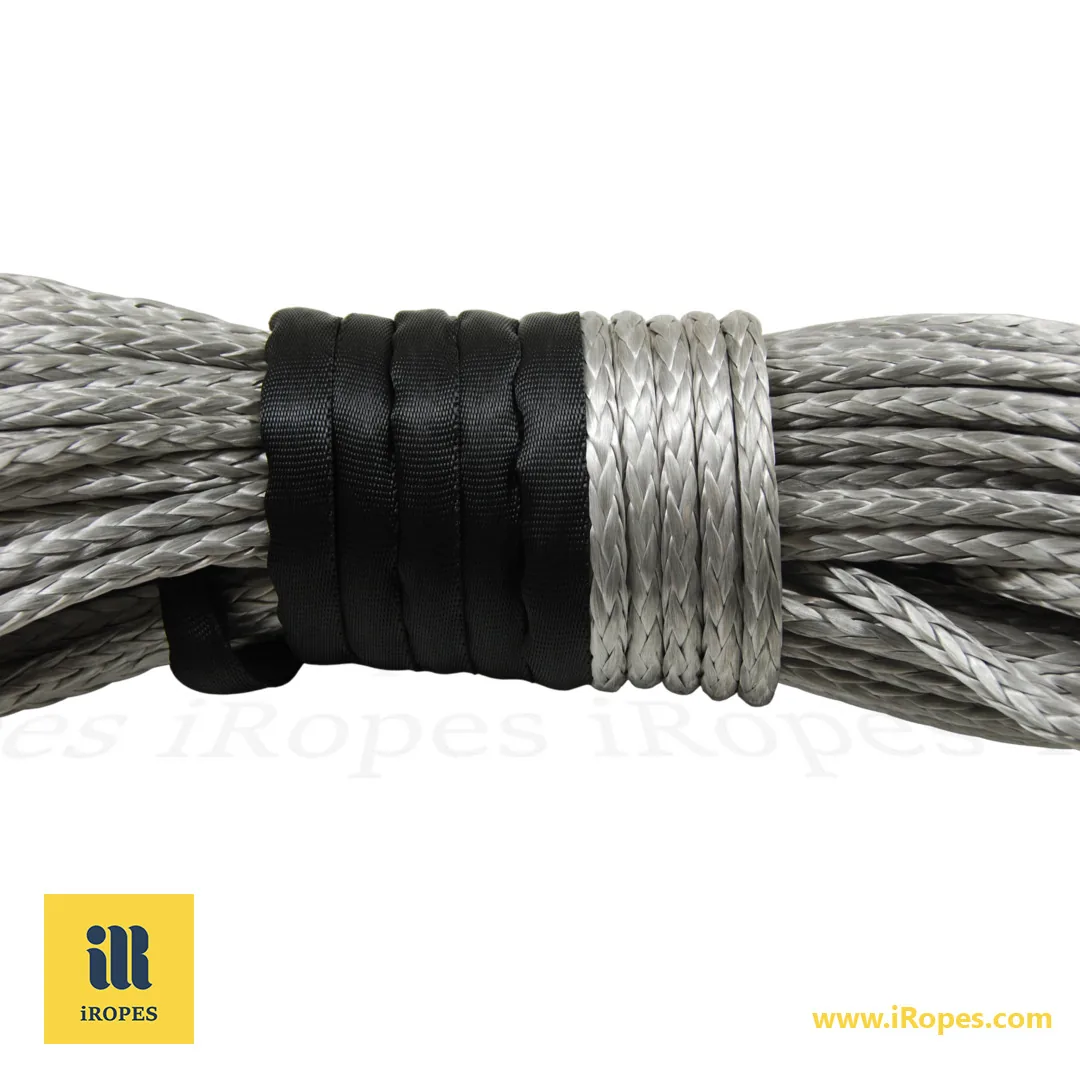
A 1‑inch iRopes Stable Braid breaks at 40,672 lb while weighing only 0.45 lb/ft – the heavyweight champion for heavy‑duty rigging.
Key gains – 2 min read
- ✓ 40 k lb break strength delivers ≈18 t Working Load Limit (WLL) at a 5:1 safety factor.
- ✓ 90% lighter than steel, significantly easing handling and reducing fatigue.
- ✓ Custom colours, reflective trims, and OEM options available for tailored solutions.
- ✓ ISO 9001‑certified manufacturing ensures quality, backed by on‑time global delivery.
Most engineers instinctively reach for steel when facing heavy-duty tasks. However, the latest 1‑inch Stable Braid synthetic rope from iRopes matches the strength of comparable rigging steel with a mere fraction of its weight. Discover why this advanced synthetic line is rapidly transforming heavy‑duty rigging practices across various industries.
Understanding the Power of 1-Inch Rigging Rope
Building on the fundamentals of rigging, let’s explore why the 1‑inch diameter has become the standard for demanding **rope and rigging** tasks. A rigging rope is a purpose‑built line engineered to safely transfer significant loads, secure heavy equipment, and enable controlled recovery, particularly in critical environments where operational failure is simply not an option.
When selecting a line for heavy loads, three key technical dimensions significantly influence the decision-making process. These factors ensure optimal performance and safety for any operation.
- Material options: Consider polyester for its low‑stretch performance, nylon for higher elasticity, or high‑modulus fibres for maximum strength and extreme durability.
- Construction types: Double braid, 12‑strand, or 16‑strand designs each offer a unique balance of flexibility and inherent core strength, tailored for specific applications.
- Breaking strength values: A typical 1‑inch synthetic line provides approximately 40,000 lb (roughly 18 tonnes) of breaking strength before failure, offering a substantial safety margin for most heavy‑load lifts.
So, how thick should rigging rope be for heavy‑duty tasks? For high‑load operations, the industry frequently standardises on a 1‑inch diameter. This size provides the optimum balance of immense tensile capacity and manageable weight. Opting for anything smaller risks under‑rating the specific load requirements, potentially compromising safety. Conversely, larger diameters add unnecessary bulk without offering a proportionally significant increase in strength, making them less practical for many applications.
iRopes’ 1‑inch Stable Braid line perfectly exemplifies this benchmark. Engineered with a robust double‑braid weave, it effectively resists abrasion, tolerates prolonged UV exposure, and maintains a low stretch ratio even under a formidable 40,000 lb break load. The result is a line that feels remarkably light and easy to handle, yet demonstrably refuses to give under a 20‑tonne lift. This makes the iRopes Stable Braid ideal for demanding rigs prevalent on construction sites, in arborist operations, or during critical off‑road recoveries. Furthermore, 1” iRopes Stable Braid is incredibly strong for its size, making it a great heavy duty rigging line.
When you need a line that can hold a 20‑tonne load without stretching, the 1‑inch Stable Braid is my go‑to solution.
Understanding these fundamentals regarding synthetic ropes clears the path to our next topic: how **rigging steel** compares to synthetic options and where each material truly excels in various heavy‑duty applications.
Exploring Rigging Steel Options for Heavy‑Duty Applications
After outlining the impressive strengths of synthetic rope, the next logical step is to examine how steel wire rope matches—or even surpasses—those benchmarks in the very toughest lift scenarios. **Rigging steel** brings a distinct set of attributes to the table, and a thorough understanding of these properties helps you appropriately choose the right tool for each critical heavy‑duty job.

Wire rope is available in several standard lay patterns, with each configuration directly influencing its flexibility, abrasion resistance, and ultimately, its load capacity. For a 1‑inch diameter, the three most common constructions are:
- **6x19**: Offers balanced flexibility and good wear resistance, suitable for general purpose applications.
- **19x7**: Primarily chosen for its excellent rotation‑resistant properties, crucial for specific lifting scenarios.
- **Compacted**: Features a high‑core density, providing superior breaking strength for specialised, extreme loads.
Each distinct lay delivers a particular breaking‑strength range. For instance, a standard 1‑inch 6x19 steel cable typically breaks at approximately 84,400 lb (roughly 42 tonnes), making it a robust choice for heavy crane lifts and standard construction slings. The 19x7 configuration, with its tighter strand arrangement, pushes the limit further to roughly 104,000 lb (about 52 tonnes). This offers an increased margin of safety for applications where the rope must rotate around a sheave without kinking. Furthermore, compacted cores, meticulously engineered for maximum core density, can exceed 130,000 lb (over 65 tonnes) when fabricated from high‑grade stainless or bright steel. This construction provides the ultimate strength for highly specialised anchoring or the most demanding heavy‑load recovery systems.
A standard 1‑inch 6x19 steel cable breaks at about 84,400 lb (≈ 42 tonnes), while a 19x7 version reaches roughly 104,000 lb (≈ 52 tonnes). Compacted cores can exceed 130,000 lb (≈ 65 tonnes) depending on the specific grade and construction.
In practical industrial applications, these numerical values translate into clear operational guidelines. Crane manufacturers frequently specify a safety factor of 5 : 1, which means a 1‑inch 6x19 cable with an 84,400 lb break strength can safely support a Working Load Limit (WLL) of approximately 16,880 lb. Construction slings crafted from 19x7 wire rope typically operate with a 4 : 1 safety factor, yielding a WLL nearing 26,000 lb. For permanent anchoring situations—such as securing communication towers or stabilising heavy winch drums—engineers may adopt a 3 : 1 factor. This allows massive compacted-core cables to reliably handle loads well exceeding 40,000 lb. Therefore, selecting the appropriate construction critically depends on the required WLL, the operating environment (e.g., corrosive marine vs. dry construction site), and the degree of flex the cable must endure during its operational lifespan.
Understanding these crucial nuances of **rigging steel** truly equips you to pair the optimal cable with the specific job requirements. This thorough knowledge sets the stage for our next discussion: how synthetic and steel solutions can be strategically blended and customised to meticulously meet even the most demanding **rope and rigging** specifications.
Integrating Rope and Rigging Solutions with Customisation
Having thoroughly examined how **rigging steel** confidently meets extreme load demands, the next crucial step is to explore how synthetic lines and steel cables can effectively work together within a unified rigging system. Choosing the right 1-inch rigging rope for a particular job often means striking a precise balance between sheer raw strength and practical handling ease. It is precisely in achieving this delicate balance that iRopes’ specialised expertise truly shines.

The following visual comparison directly pits these two material families against each other. It clearly highlights critical factors such as the strength‑to‑weight ratio, flexibility, and environmental resilience—attributes that frequently determine which material is best suited for a given application.
Synthetic 1‑Inch Rope
Lightweight Performance
Strength‑to‑Weight
Approximately 40,000 lb breaking strength for ~0.4 lb/ft, offering over ten times the load capacity per pound compared to steel.
Flexibility
Double‑braid construction bends effortlessly around pulleys with minimal kinking, making it an ideal choice for complex rigging geometries.
Environment
UV‑stable polyester effectively resists moisture and harsh chemicals, consistently remaining lightweight and easy to manage on‑site.
Steel 1‑Inch Cable
Maximum Power
Strength‑to‑Weight
84,400 lb breaking strength for ~3.5 lb/ft, delivering raw power essential for applications where extreme static loads are paramount.
Rigidity
A robust wire core maintains its shape under immense tension, making it perfect for static anchoring and high-impact, controlled lifts.
Durability
A galvanised coating significantly enhances corrosion resistance, ensuring a long service life in challenging marine or aggressive industrial settings.
When you ask, “What is the best rope for rigging?” the answer ultimately depends on three practical questions: how much load will you be lifting, what specific environment will the line encounter, and how much flexibility do you have with your budget? For instance, with high‑rise crane lifts where the load consistently exceeds 80,000 lb, a steel cable provides the essential safety margin you absolutely need. Conversely, if the job involves frequent pulley work, exceptionally long runs, or continuous exposure to water, a synthetic 1-inch rigging rope significantly reduces handling fatigue and offers superior resistance to rot and degradation.
Custom Solutions
iRopes can meticulously tailor any 1‑inch line to your exact specifications. Choose from polyester, nylon, or high‑modulus fibres; incorporate custom colours, reflective strips, or bespoke terminations. We can also provide certifications such as ASTM RR‑W‑410, and protect your proprietary design with full Intellectual Property (IP) rights. All our production strictly adheres to ISO 9001 standards, and we efficiently ship pallets directly to your warehouse, anywhere in the world.
By carefully weighing the strength‑to‑weight ratio, flexibility, and environmental factors, you can precisely match the ideal 1-inch rigging rope or steel cable to your project’s unique demands. And when standard, off‑the‑shelf options simply won’t suffice, iRopes’ comprehensive OEM/ODM service transforms your precise specifications into a high-performance finished product that not only meets every stringent safety standard but also adheres to your required shipping schedule.
The 1” iRopes Stable Braid is incredibly strong for its size, making it an excellent heavy-duty rigging line. From the 40,000 lb break strength of the 1” iRopes Stable Braid to the massive 84,400 lb capacity of a 1‑inch rigging steel cable, you now possess a clear and detailed understanding of how material choice profoundly impacts performance, weight, and handling characteristics. Whether your project demands a lightweight 1-inch rigging rope for intricate pulley work or a heavy‑duty steel line for extreme lifts, iRopes has the expertise to tailor colour, accessories, certifications, and packaging to perfectly fit your exact rope and rigging requirements. Our ISO‑9001‑backed processes guarantee uncompromising quality and timely delivery, instilling confidence in every single lift you undertake.
Ready for a tailored solution?
If you would like a personalised recommendation or a detailed quote for your specific needs, simply complete the form above. Our dedicated specialists will promptly connect with you to design the perfect solution for your unique application.