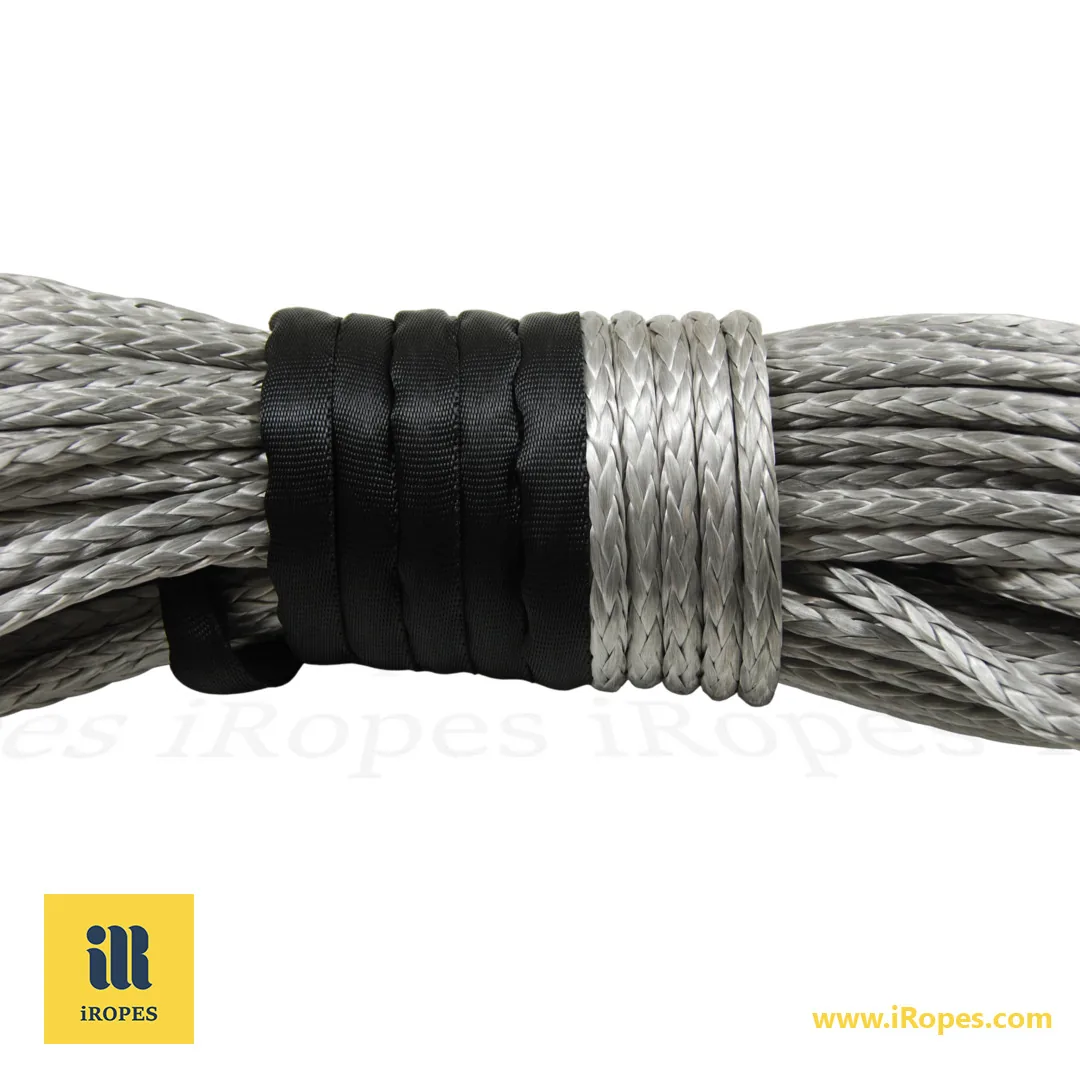
A typical 12 mm polyamide rope has a breaking strength around 3 300 daN (≈ 33 kN, ≈ 7 400 lbf). For design, apply a safety factor (e.g., 5), giving an SWL near 6.6 kN (≈ 1 480 lbf).
⏱️ 2‑minute read – What you’ll gain
- ✓ Clear explanation of breaking strength with example values (e.g., 12 mm ≈ 33 kN).
- ✓ A 3‑step formula to convert strength into safe working load in seconds.
- ✓ Practical insight: moisture can reduce strength by up to 2%; UV exposure accumulates over time.
- ✓ Access to iRopes’ ISO‑9001‑verified data for any custom‑designed rope.
Many engineers apply a generic safety factor of 5 to simplify selection. In practice, moisture, UV exposure, abrasion, and especially knots can reduce capacity. The guidance below shows how to account for these losses and choose a safety factor that keeps your design within limits.
Understanding Polyamide Rope Breaking Strength
When a newly manufactured rope snaps under load, the resulting downtime can cost a project thousands of dollars and jeopardise safety. Engineers therefore rely on the polyamide rope breaking strength value to set design limits, choose appropriate safety factors, and validate that a rope will perform as expected throughout its service life.

The breaking strength is defined as the highest load a brand‑new polyamide rope can endure before it ruptures. This single figure becomes the baseline from which all safety calculations are derived.
- Definition – maximum load a new polyamide rope can sustain before rupture.
- Standard test – ASTM D2256, straight‑line pull at 100 mm/min, results recorded in kN or lbf.
- Units – kilonewtons (kN) and pounds‑force (lbf); 1 kN ≈ 224.8 lbf.
- Safety conversion – SWL = Breaking Strength ÷ Safety Factor; typical factor ranges from 5 to 12.
- iRopes assurance – every custom polyamide rope ships with ISO‑9001 verified breaking‑strength data.
Applying the conversion is straightforward. For example, a rope tested with a breaking strength of 33 kN and a safety factor of 5 yields a safe working load of 6.6 kN (33 ÷ 5). In imperial units, the same rope would have a breaking strength of roughly 7 400 lbf, giving a working load of about 1 480 lbf when the same factor is applied. Engineers use this simple division to size rigging, mooring lines, or lifting equipment without resorting to complex spreadsheets.
Because iRopes documents each custom batch within an ISO‑9001‑certified quality management system, the published breaking‑strength values are traceable to the exact manufacturing lot. This level of data integrity enables specifiers to trust the numbers when calculating load margins for offshore platforms, yacht deck hardware, or industrial hoists.
With the definition and calculation method clarified, the next discussion will explore the material characteristics—such as elasticity and moisture absorption—that directly influence the numerical strength of polyamide rope.
Key Material Properties and Performance Characteristics
Having clarified the definition of breaking strength, engineers now turn to the material traits that shape those numbers. Polyamide rope exhibits a combination of elasticity, moisture behaviour, and construction options that together determine how much load it can safely bear.

The most striking attribute of nylon is its high elasticity, typically 16–27 % elongation at break. This stretch capacity allows the rope to act like a spring, dissipating sudden impact energy and reducing peak stresses on anchors or winches. In marine‑offshore applications, that shock‑load absorption can be the difference between a safe recovery and a catastrophic snap.
Moisture also matters. When wet, polyamide’s breaking strength may drop by up to about 2 %, so designers often apply a modest safety margin for humid or splash‑zone environments. UV‑stabilised variants mitigate sun‑induced degradation, preserving strength over years of outdoor exposure.
Construction choices further tailor performance. Increasing the strand count or selecting a parallel‑core design can boost overall tensile capacity, while a twisted‑lay construction may trade some peak strength for flexibility and handling. Core type and braid pattern also influence how load is transferred through the rope.
- Material grade – nylon 6 vs. nylon 6.6 affects baseline tensile strength.
- Construction – strand count, braid pattern, and core type determine load distribution.
- Environmental exposure – moisture, UV, temperature can reduce the nominal breaking strength.
- Age and wear – abrasion, repeated flexing, and chemical exposure gradually diminish capacity.
- Knotting and splicing – each knot can cut strength by 30–50 %.
Material Impact Summary
High elongation gives nylon superior shock‑load handling, while moisture and UV exposure modestly lower tensile values. Selecting a higher strand count or a parallel‑core design raises the breaking strength, enabling engineers to match rope performance to the specific demands of marine, industrial, or off‑road projects.
Understanding how these factors interact equips specifiers to interpret the breaking‑strength data supplied by iRopes and to apply the appropriate safety factor for their application. → The next section will describe how manufacturers quantify and certify those strength figures.
How Breaking Strength Is Measured and Certified
Building on the material‑influence overview, the next logical step is to understand how the certified breaking‑strength figure is actually generated in a laboratory. The process is deliberately controlled so that every new polyamide rope leaves the factory with a trustworthy number that engineers can rely on for design and safety calculations.

The standard laboratory procedure follows a strict sequence:
- Prepare a straight‑line specimen of the exact length specified by the test method.
- Mount the sample in the grips of a calibrated universal testing machine.
- Apply load at a constant rate of 100 mm min⁻¹ (the speed mandated by ASTM D2256).
- Record the peak load at the instant the fibres part; this peak is the breaking strength.
ASTM D 2256 requires a straight‑line pull at 100 mm min on a fresh specimen, with the maximum load recorded as the breaking strength.
Both ASTM D2256 and the Cordage Institute’s test guidelines are cited in iRopes’ ISO‑9001‑controlled reports, guaranteeing repeatable and trustworthy results across every production batch.
Industry safety factors typically range from 5 to 12; dividing the certified breaking strength by this factor yields the safe working load for design.
Designers often ask, “How do you calculate breaking strength?” In practice, the breaking strength is measured in a test lab; you then calculate a working limit. Use this concise three‑step routine:
- Identify the rope’s certified breaking strength from the test report.
- Select an appropriate safety factor based on application risk (commonly 5–12).
- Divide the breaking strength by the safety factor to obtain the safe working load (SWL).
For example, a 12 mm polyamide rope with a reported breaking strength of 3 300 daN and a safety factor of 5 produces an SWL of 660 daN, suitable for many marine‑mooring scenarios. By adhering to the recognised standards and applying the safety‑factor conversion, engineers can move from raw laboratory data to reliable field‑ready specifications.
With certified numbers in hand, the next discussion will translate those figures into practical selection guidance, helping specifiers match the right rope to each load requirement.
Practical Guidance for Selecting the Right Rope for Your Application
With certified numbers in hand, engineers can now translate those figures into a clear decision pathway that matches load demands with the most suitable polyamide rope.

Load Requirement
Identify the maximum expected load for the application, expressed in kN or daN.
Diameter & Construction
Choose rope diameter and braid type that meet the load while considering flexibility.
Safety Factor
Apply a safety factor (commonly 5‑12) to convert breaking strength into safe working load.
Final Selection
Confirm the chosen rope meets the SWL and complies with relevant standards.
For illustration, a 12 mm polyamide rope with a certified breaking strength of 3 300 daN yields a safe working load of 660 daN when a safety factor of 5 is applied (SWL = 3 300 ÷ 5). This calculation aligns with the typical safety‑factor range recommended for marine and industrial hoisting tasks.
iRopes Customisation
Tailored to your project
Material Grade
Select nylon 6 or nylon 6.6 to balance strength and durability.
Strand Count
Increase strands for higher tensile capacity or reduce for flexibility.
Core Type
Opt for parallel‑core or twisted‑lay designs to suit load distribution.
OEM/ODM Services
Full‑scale production support
Branding
Add logos or custom colours on rope jackets and packaging.
IP Protection
Secure proprietary designs with iRopes’ confidentiality agreements.
Packaging
Choose non‑branded bags, colour boxes, or pallets for direct shipment.
The breaking strength of a 12 mm polyamide rope is typically 3 300 daN (≈ 33 kN, ≈ 7 400 lbf), as verified by iRopes’ ISO‑9001 test reports.
Armed with this practical workflow, engineers can confidently match rope specifications to project demands, paving the way for the concluding summary of key takeaways.
Ready for a Tailored Rope Solution?
In this article we introduced the key characteristics of nylon (polyamide) rope, including its high elasticity, moisture behaviour, and construction options, and clarified the definition of breaking strength and the ASTM D2256 testing method that iRopes uses to deliver ISO‑9001 verified data for every custom polyamide rope.
If you’d like personalised guidance to select the optimal rope for your project, simply complete the form above and our specialists will work with you to tailor a solution.