⚠️ Improper rope ends and clamps contribute to about 12% of rigging accidents, yet a correctly installed forged clamp can retain roughly 80–90% of the rope’s breaking strength. You can preserve more of that strength with iRopes’ custom‑engineered terminations.
Your 8‑minute cheat sheet →
- ✓ Maximise safe‑load capacity by correctly matching rope ends and clamps to the rope type.
- ✓ Avoid common installation errors by applying the 2‑clamp/3‑clamp rule.
- ✓ Choose the strongest fibre for your job — Dyneema (HMPE) delivers ≈3 800 kN/mm² (≈3 800 MPa) tensile strength.
- ✓ Leverage iRopes’ OEM/ODM service for branded, IP‑protected ends with ISO 9001 quality and timely delivery.
You’ve probably been tightening clamps the same way for years, trusting “good enough” hardware to hold the line. What if that habit is silently shaving 10–15% off the rope’s true capacity and setting you up for a costly failure? In the sections below we’ll expose the hidden loss, show the exact calculations you need, and reveal the custom‑fit approach that lets you reclaim strength — without reinventing your whole rig.
Understanding rope ends and clamps: Functions and Safety Considerations
Before we dive into selection, focus on the pieces that finish a line — the rope ends and clamps. These small components are the gatekeepers of safety; a poorly chosen or installed termination can turn a strong rope into a hazard.
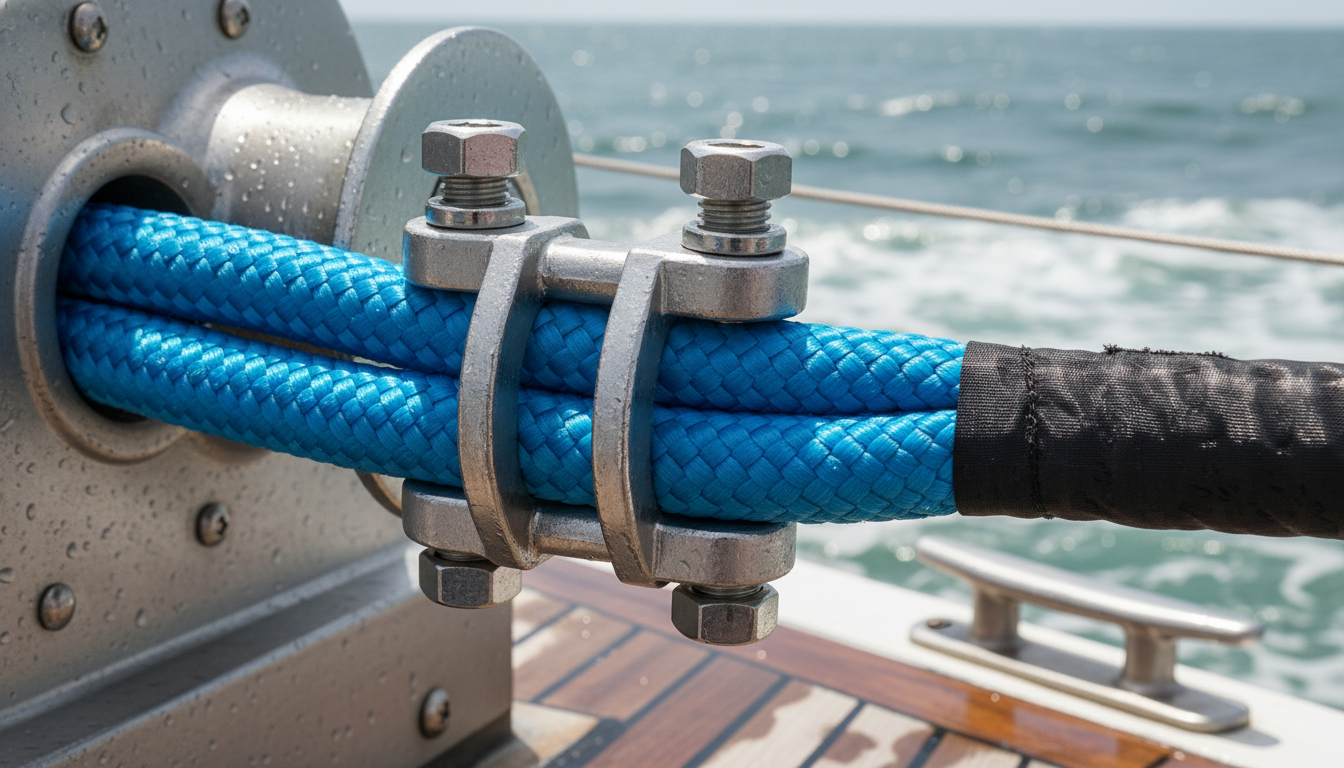
At their core, rope ends and clamps transform a raw strand into a usable loop, eye, or handle. The end‑product must hold the load without slipping, stretching, or failing at the point of attachment. When the hardware is matched to the rope’s material and diameter, the assembly can retain up to 90% of the rope’s breaking strength — a figure you’ll use in working‑load‑limit calculations later.
Safety limits matter. According to OSHA, roughly 12% of rigging‑related accidents involve improper clamps. Rope clamps are not rated for life‑support or fall‑arrest systems; they belong in static or controlled‑load applications such as winches, hoists, and towing rigs. Always consult relevant standards such as ASME B30.9 and manufacturer data, and assume a retention factor of about 0.80–0.90 when calculating WLL.
- Plastic caps – lightweight, corrosion‑free closures for low‑stress loops or storage ends.
- Metal eyes – forged or welded loops that provide a strong attachment point for hooks or carabiners.
- Crimp sleeves – precision‑machined tubes that, when compressed, create a permanent, high‑strength termination.
So, what are rope clamps? They are metal devices that grip a rope at two points, using bolts or a forged saddle to distribute the load across the fibres. When installed according to the 2‑clamp or 3‑clamp rule, they keep the rope from slipping while preserving most of its tensile capacity.
“A properly installed forged rope clamp retains 80%‑90% of the rope’s breaking strength – a figure that should be baked into every WLL calculation.” – Bishop Lifting, May 2025
Choosing the right rope‑clamp and end combination is a matter of matching material, diameter, and load class. Stainless‑steel clamps pair well with Dyneema and polyester ropes, while galvanised hardware is often chosen for polyester or polypropylene in cost‑sensitive applications. The next step is to examine how each clamp type — U‑bolt, double‑saddle, or forged — fits the rope you intend to use, so you can select the proper hardware for every application.
Choosing the right rope clamps and ends for different applications
Having seen how ends and clamps lock a rope into a safe loop, the next logical step is to match the hardware to the rope you plan to use. Different clamp designs excel under different loads, and selecting the proper size prevents the dreaded slip that turns a strong line into a hazard.

The three workhorse designs are:
- U‑bolt – a simple, cost‑effective option for light‑duty loops and general service.
- Double‑saddle – the industry‑standard shape that distributes pressure evenly; suitable for most static‑load applications.
- Forged (or drop‑forged) – a heavy‑duty profile that can handle high‑tensile fibres such as Dyneema or high‑modulus polyester.
Choosing the correct size follows a short, repeatable process:
- Measure the rope’s nominal diameter per the manufacturer’s specification.
- Select a clamp whose size matches that diameter.
- Apply the 2‑clamp rule for short loops or the 3‑clamp rule when the loop experiences higher bending stresses, and follow the manufacturer’s spacing and torque guidance.
Once the size is settled, the material pairing becomes the deciding factor. The guide below summarises common combinations based on manufacturer recommendations and standard practice.
Stainless‑steel clamps
Best for high‑strength synthetics
Dyneema
Retention typically around 90% when installed correctly; excellent corrosion resistance in marine environments.
Polyester
Good UV resistance from the rope; stainless hardware resists corrosion for long service life.
Nylon
Useful where elasticity is acceptable; stainless‑steel hardware offers dependable performance in humid or marine settings.
Galvanised clamps
Ideal for cost‑sensitive projects
Polypropylene
Lightweight and buoyant ropes pair well with galvanised clamps for freshwater or general‑purpose rigs.
Nylon
Provides a reliable grip for moderate‑load towing lines when budgets preclude stainless steel.
Polyester
Suitable where cost control outweighs the need for premium corrosion resistance.
Quick answer: How strong are wire rope clamps? Correctly installed clamps typically retain 80%–90% of the rope’s rated breaking strength. Use the lower end for conservative design and apply an appropriate safety factor in your WLL calculation.
With the right clamp type, correct sizing, and an appropriate material match, you can rely on rope clamps and ends to preserve the performance of any rope you choose. The next step is to understand how the rope’s own construction — HMPE, nylon, polyester, or polypropylene — affects overall strength and load‑capacity calculations.
Rope types and strength: How material influences performance
Now that you know which clamp suits each rope, the next question is how the rope itself behaves. Different fibres carry loads in very different ways, so picking the right material can mean the difference between a safe line and a premature failure.
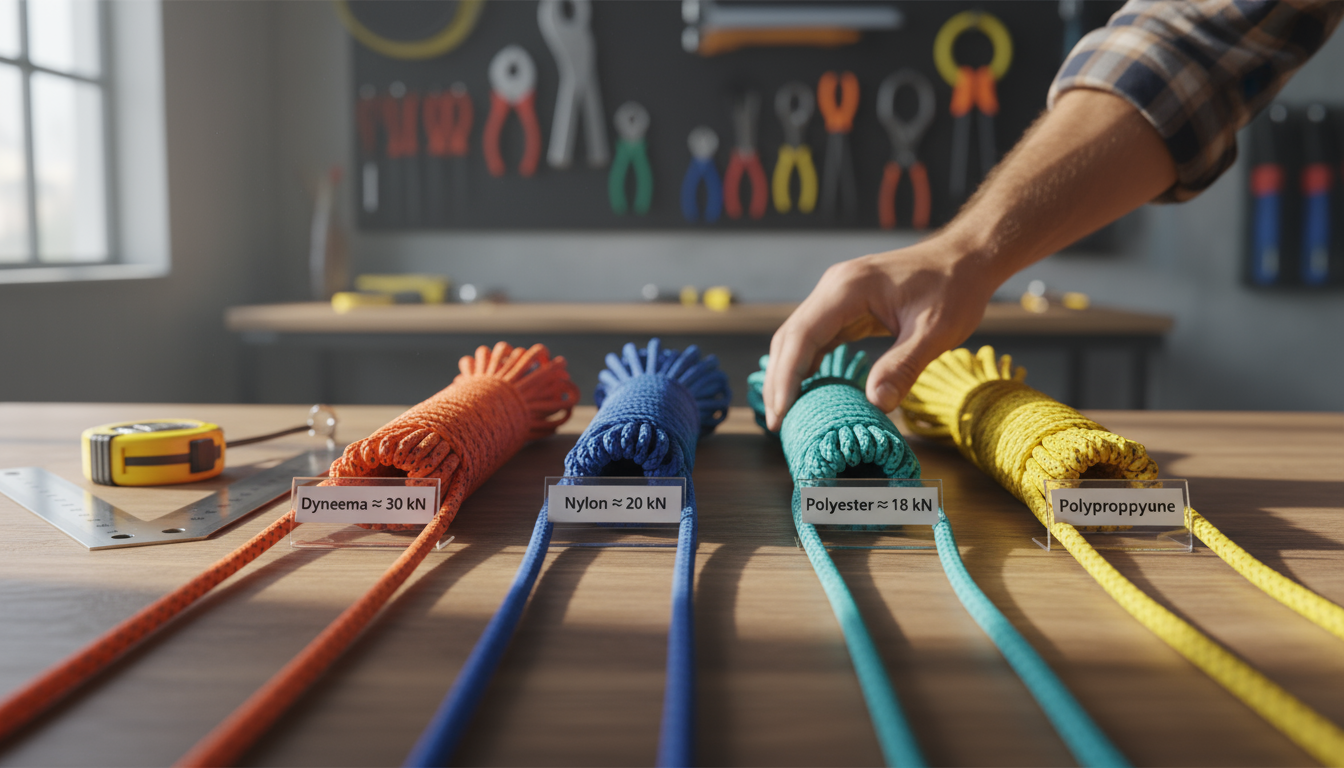
Four families dominate the market:
- HMPE/Dyneema – ultra‑high‑modulus fibre with tensile strengths up to 3 800 kN/mm² (≈3 800 MPa) and minimal stretch (≈1–2%).
- Nylon – strong but elastic; typical strength around 0.75 × steel and stretch of 12–15% under load.
- Polyester – slightly lower strength than nylon (≈0.65 × steel) with much less elongation (5–7%).
- Polypropylene – the lightest, floating fibre; strength about half that of steel and stretch near 4–6%.
When you combine a rope with a clamp, the Working Load Limit (WLL) is not simply the rope’s breaking strength. You must factor in the clamp’s retention percentage and the safety factor required by ASME B30.9. The formula looks like this:
WLL = (Rope Breaking Strength × Clamp Retention %) ÷ Safety Factor
For example, if a rope has a rated breaking strength of 100 kN and you use a forged stainless‑steel clamp that retains 90% of that value with a 5:1 safety factor, then:
WLL = (100 kN × 0.90) ÷ 5 = 18 kN. That number tells you the maximum safe load you can apply while staying within a conservative margin for static applications.
Quick answer: HMPE/Dyneema is the strongest rope material available, offering the highest tensile strength per unit weight.
iRopes can turn those numbers into a product that matches your exact needs. Whether you require a UV‑stabilised Dyneema line for marine winches, a colour‑coded nylon rope for camping rigs, or a buoyant polypropylene line for flotation devices, the factory can adjust fibre count, core type and sheath construction. Ends and clamps can be embossed with your logo, supplied in custom‑coloured polymer caps, or delivered in non‑branded packaging — all under ISO 9001‑controlled quality assurance with dedicated IP protection. Learn more about our custom rope solutions and how we tailor each product to your specifications.
iRopes Custom Options
Choose any high‑strength fibre, specify diameter, length and colour, then add branded ends or specialised terminations. Our rope specialists verify your clamp‑rope pairing against the required WLL using internal test data and ISO 9001 quality processes, and we safeguard every project with full IP confidentiality.
Understanding how material choice shapes tensile capacity lets you pair the right rope with the appropriate clamp, ensuring the assembly retains as much strength as possible. For applications requiring lightweight strength, see our guide on durable synthetic winch rope extensions. The next step is to understand how the rope’s own construction — HMPE, nylon, polyester, or polypropylene — affects overall strength and load‑capacity calculations.
Ready for a custom rope solution?
If you’d like a tailored recommendation that fits your exact application, please use the form above — our specialists are happy to help.
By now you know that the right rope ends and clamps, correctly sized and matched to the fibre, can preserve up to 90% of a line’s breaking strength, while the 2‑clamp or 3‑clamp rule safeguards against slip. Selecting the appropriate rope clamps and ends for each rope type — whether it’s a winch rope, nylon trailer rope, soft shackles, tent rope, sailing rope, kite line or fishing gun line — helps keep the calculated Working Load Limit within ASME B30.9 safety margins. Understanding rope types and strength lets you optimise performance and avoid costly failures, and iRopes can translate those calculations into a bespoke, ISO‑9001‑certified OEM/ODM solution with reliable, on‑time delivery. Explore our expertise in marine rope fittings for optimal performance.
