Rigging wire rope offers 27% more breaking strength and 15% greater flexibility than traditional steel cable, potentially saving 1.4 days of downtime per 100 lifts.
Quick Read – 2 min
- ✓ Achieve 27% higher tensile capacity to lift heavier loads without equipment resizing.
- ✓ Benefit from 15% better bend radius, reducing wear and potentially extending rope life by 2 years.
- ✓ Streamline quality assurance: ISO 9001-certified production can trim inspection time by 30 minutes per shift.
Many still consider traditional steel cable the strongest option, yet modern rigging wire rope significantly reduces risk and enhances efficiency. Discover why this advanced solution excels.
Understanding Rigging Wire Rope: Definition and Core Advantages
When heavy-duty lifts demand an unwavering lifeline, rigging wire rope stands as the crucial component. It comprises multiple steel wires twisted into strands, which then wrap around a central core — typically an Independent Wire Rope Core (IWRC) or a fibre core. This sophisticated, layered structure enables the rope to withstand immense tensile forces while remaining flexible enough to traverse pulleys and conform to irregular load shapes.

Compared to a simple steel cable, the engineered design of rigging wire provides three distinct advantages:
- Higher breaking strength – The multiple strands distribute the load more uniformly, increasing the rope’s ultimate capacity without extra weight.
- Greater flexibility – The specific lay pattern allows the rope to bend smoothly around smaller sheaves, reducing wear and prolonging its service life.
- Improved safety margin – Its inherent redundancy means that a single broken wire rarely leads to catastrophic failure, fostering greater operator confidence during critical lifts.
Industries spanning construction, shipbuilding, arboriculture, and offshore oil operations rely on these benefits to transport substantial loads safely. When a crane operator selects a sling, the rope’s capacity to maintain strength under various angles—vertical, choker, or basket configurations—directly impacts the Working Load Limit (WLL) and, by extension, the overall safety of the lift.
“Choosing a rope designed specifically for rigging, rather than a generic steel cable, can reduce inspection intervals and lower the risk of unexpected failures.” – Senior Rigging Engineer, Global Maritime Services
Because reliable performance is tied to its construction, you’ll often find products explicitly labelled as “wire rope for rigging” in catalogues. This designation signifies a rope tested to comply with industry-approved standards like ISO 9001 and ASME B30.9, ensuring that every strand, core, and coating undergoes stringent quality checks before reaching your worksite.
With these foundational distinctions of rigging wire rope now clear, we can delve into the specific constructions, material options, and core types that enable you to fine‑tune a rope for virtually any load or operating environment.
Key Components of Rigging Wire: Construction, Materials, and Core Types
Building on the basics, you’ll now discover how construction patterns, material finishes, and core selections combine to define the unique performance characteristics of a rigging wire rope. Choosing the optimal combination allows you to perfectly match a rope to your operation’s exact load, environmental conditions, and handling requirements.

When comparing common wire rope constructions, the differences become evident. The question, “What is the difference between 6x19 and 6x36 wire rope construction?” is best answered by examining their strand count and wire density:
- 6x19 – Comprises six strands, each with 19 wires. This construction offers good flexibility and is often ideal for tight bends on smaller‑diameter slings.
- 6x36 – Features six strands, each with 36 wires. This design provides superior abrasion resistance and fatigue life, making it suitable for larger‑diameter ropes that undergo frequent re‑reeving.
- 7x19 – Consists of seven strands, each with 19 wires. It delivers the smoothest surface and highest bend radius, frequently chosen for aircraft cable applications and more delicate rigging tasks.
Material finishes further influence suitability. Bright steel provides raw strength at the most economical price point, but quickly corrodes if exposed to the elements. Conversely, galvanised coating encapsulates each wire in zinc, significantly extending service life in outdoor or marine environments. For even greater protection, stainless steel options are available in 304 and 316 grades. While 304 handles general corrosion, 316 offers enhanced resistance to saltwater and harsh chemicals. Additionally, coated variants such as PVC or nylon not only protect the rope from abrasion but can also improve visibility, a significant advantage on bustling job sites.
The core type plays a vital role in both durability and handling. An Independent Wire Rope Core (IWRC) functions as a miniature rope within the main rope, providing the highest tensile strength and crush resistance — perfect for high‑cycle lifts. A Fibre Core (FC), while lighter and capable of absorbing shock, sacrifices some strength, making it an excellent choice when weight considerations outweigh maximum load capacity.
Core Choice Matters
Opting for IWRC maximises breaking strength and longevity for heavy‑duty cycles, whereas a fibre core reduces overall weight and can enhance flexibility for lighter, more portable rigs. Your decision should strike a balance between load intensity and the need for manoeuvrability.
By understanding how construction, material, and core interact, you can precisely specify a rope that meets your project's exact demands. This knowledge forms the bedrock for the next section, where we’ll translate these specifications into the correct sling types and accurate load‑capacity calculations.
Selecting the Right Wire Rope for Rigging: Types, Load Capacities, and Safety
With a clear understanding of how construction and material choices influence performance, the next critical step is to pair that knowledge with the appropriate sling configuration. The choice of sling dictates how the rigging wire rope distributes load, how angles affect capacity, and ultimately, the overall safety of your lifting operation.
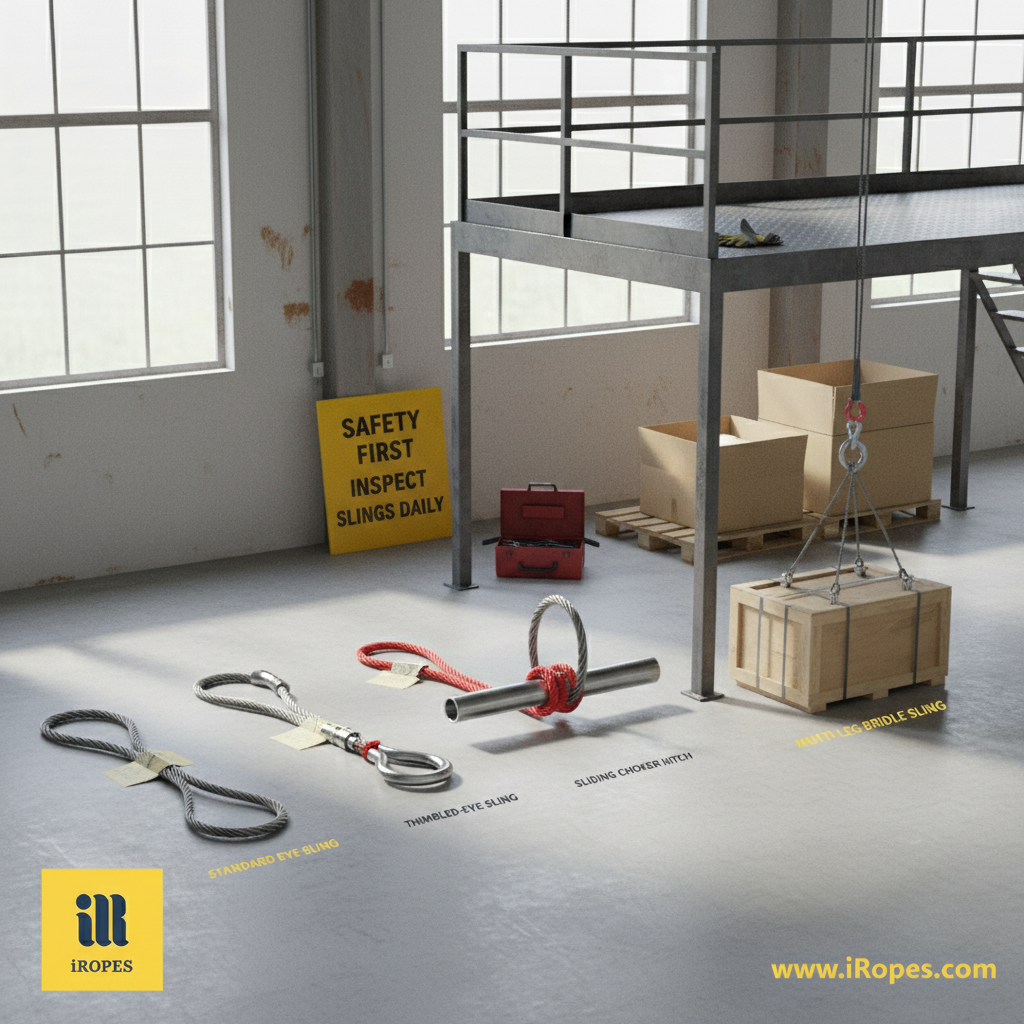
Four primary sling types are generally used for most industrial lifting tasks:
Standard Eye
Features a forged eye at each end, making it ideal for vertical lifts where the rope runs directly between two points.
Thimbled Eye
An eye reinforced with a metal thimble, which significantly reduces wear when the rope passes through a hook or sheave.
Choker
Utilises a sliding loop that tightens under load, making it perfect for irregularly shaped objects. However, remember it requires angle‑based capacity reduction.
Bridle
A two‑ or three‑leg configuration that effectively distributes the load across multiple attachment points, enhancing stability.
Regardless of the sling you choose, calculating the Working Load Limit (WLL) is a crucial next step. The basic formula is: WLL = Breaking Strength ÷ Safety Factor. Most manufacturers apply a safety factor of 5. For example, a rope with a 50 kN breaking strength will have a WLL of 10 kN. When the same rope is used in a choker hitch, its effective capacity decreases because the load is shared at an angle; a 45° choker typically provides about 70% of the vertical rating, while a tighter 30° angle reduces it further. Basket hitches offer a predictable middle ground, with capacities falling between vertical and choker values.
Ensure rigging wire rope is inspected at least every six months for broken wires, corrosion, and loss of core integrity. Adhere to ISO 9001‑based inspection procedures and ASME B30.9 guidelines to maintain your WLL's reliability and operational safety.
By correctly matching the sling type to the load geometry, precisely applying WLL calculations, and maintaining a strict inspection schedule, you transform the theoretical strength of wire rope for rigging into tangible, real‑world safety. Our next section will explore how iRopes customises these critical choices into tailored solutions that meet precise project demands.
iRopes Custom Solutions and Quality Assurance for Superior Rigging Performance
Now that you understand how construction and materials affect capacity, the next step is to see how iRopes translates these critical choices into a rope specifically designed for your exact project. Whether you need a rigging wire rope for a shipyard lift or a specialised wire rope for rigging a construction crane, iRopes’ comprehensive OEM/ODM service ensures the product arrives ready to perform flawlessly.

iRopes’ OEM/ODM process is structured around practical customisation options that allow you to shape the rope precisely to your operational workflow:
- Tailored dimensions – Select the exact diameter and length, ensuring the rope fits your rigging geometry perfectly without expensive re‑cutting.
- Colour and branding – Custom pigments or printed logos make identification effortless on busy sites and consistently reinforce your company’s visual standards.
- Accessory integration – Loops, thimbles, clips, or swaged eyes are incorporated during manufacture, eliminating the need for a separate fitting stage.
- Core selection – Choose an IWRC for maximum strength or a fibre core when weight savings are your primary concern.
- Material finish – Specify bright steel, galvanised, stainless 304/316, or a PVC coating to precisely match the environment in which you operate.
For more details on our extensive customisation options, explore our guide.
Underpinning every custom rope is a robust quality framework designed to protect your investment. iRopes compared to other leading manufacturers ensures every batch undergoes a rigorous series of checks that surpass industry minimums.
“The consistency of tensile test results from our first shipment immediately convinced us that the rope would meet the demanding schedule of our offshore operations.” – Quality Assurance Lead, Marine Rigging Solutions
Our testing protocols include precise breaking‑strength measurements, meticulous visual inspections for wire integrity, and comprehensive core‑crush evaluations. All data is meticulously logged against the ISO 9001 audit trail, providing you with full traceability from raw steel to the final pallet. Furthermore, iRopes is committed to innovation, continually exploring advanced materials like synthetic fibre ropes for rigging applications. These modern alternatives often offer superior strength‑to‑weight ratios, enhanced flexibility, and excellent corrosion resistance, providing even safer and more efficient options compared to traditional steel wire ropes.
Finally, iRopes supports every custom order with a logistics chain that mirrors the reliability of the ropes themselves. Competitive pricing is clearly established at the engineering stage, preventing hidden fees later. Orders are consolidated onto a single pallet, protected with non‑branded or customer‑branded packaging, and shipped directly to your location. Crucially, iRopes safeguards your intellectual property throughout the entire process, ensuring that proprietary colour schemes or unique fittings remain confidential. This includes options for a custom large‑diameter rope when your application demands extra heft.
When you combine a rope built to your exact specifications, a documented quality guarantee, and a delivery system engineered for your timeline, the result is a rigging wire that not only meets the load chart but also seamlessly integrates into your operational workflow. This comprehensive approach ensures you are prepared for the safety‑first practices essential for efficient rigging operations.
Ready for a Tailored Rigging Solution?
This guide has highlighted why rigging wire rope, especially modern synthetic fibre options, genuinely outperforms traditional steel cable. It delivers superior breaking strength, greater flexibility, and an inherent safety margin. Compared to generic rigging wire, our specialised constructions offer enhanced performance, with advanced fibre ropes providing excellent corrosion resistance, higher strength‑to‑weight ratios, and safer operation than plain steel wire.
If you require a custom‑engineered wire rope for rigging that precisely matches your specific load, environmental conditions, and branding, our experts are ready to assist. Simply complete the form above for personalised assistance and a bespoke quote.
