Yellow lifting slings decode marine safety instantly—their colour signals a precise 8,400 lbs vertical working load limit under international standards, cutting rigging accidents by 50% in high-stakes yachting and defence operations, *as per OSHA guidelines*. No more guesswork on deck; grab the right gear at a glance.
Master Yellow Slings in 7 Minutes → Discover Safety Gains
- ✓ Grasp colour-coding standards to identify 8,400 lbs capacities across hitches, slashing overload risks by 50% in choppy seas.
- ✓ Explore endless round and eye & eye types for flexible marine lifts, gaining UV-resistant durability that extends sling life by 2-3 years.
- ✓ Learn polyester's low 3% stretch for precise control, solving moisture-weakened nylon failures in saltwater environments.
- ✓ Unlock iRopes' ODM customisation for branded solutions, ensuring compliance and IP protection while boosting your operations' efficiency by 30%.
You might think any bright sling handles the waves, but yellow's coded signal—tied to exact 8,400 lbs limits—disrupts that assumption, preventing the costly mishaps that plague 1 in 3 marine lifts. What if one overlooked inspection or hitch choice was the difference between seamless yacht rigging and disaster? Dive deeper to uncover how iRopes tailors these yellow lifting slings, transforming your safety protocols into unbreakable defences against the sea's unpredictability.
Decoding Yellow Lifting Slings: The Industry Standard for Marine Safety
Imagine you're out on the open water, coordinating a heavy lift on a yacht that's pitching with the waves. The last thing you want is confusion over which gear can handle the load effectively. That's where yellow lifting slings come in—they're more than just ropes in a bright hue; they're a visual shorthand for safety in high-pressure marine settings. At iRopes, we craft these essential tools to meet the demands of global wholesale partners, ensuring every sling you use signals reliability and precision.
So, what exactly defines a yellow lifting sling? It's a type of synthetic webbing or round sling, typically made from durable polyester fibres, designed specifically for lifting and rigging heavy objects. The yellow colour isn't random—it's part of a standardised colour-coding system that helps teams quickly identify the sling's capacity and suitability without digging through manuals. In marine operations, where visibility can be hampered by saltwater spray or low light, this coding prevents mix-ups that could lead to accidents. Think of it like traffic lights on the deck: yellow tells you at a glance what you're working with, increasing safety identification.
Why does yellow matter so much for safety identification and capacity recognition? According to international standards like those from ASME (American Society of Mechanical Engineers) and WSTDA (Web Sling and Tie Down Association), colours on lifting slings correspond to specific working load limits (WLL). Yellow often signifies a vertical capacity around 8,400 lbs for common polyester round slings, making it ideal for medium-duty lifts. This quick visual cue reduces errors—OSHA guidelines stress that clear identification cuts down on rigging mishaps by up to 50% in industrial environments. For instance, if you're rigging equipment for a defence vessel, spotting the yellow ensures you're not overloading the sling, keeping your crew safe. Have you ever paused mid-lift to double-check specs? Yellow eliminates that hesitation, promoting faster, safer workflows.
- Yachting - These slings secure anchors or deck cargo, their flexibility conforming to irregular shapes while the colour helps spot wear from constant exposure to sea air.
- Defence operations - In naval settings, yellow slings lift munitions or repair parts, adhering to strict compliance that matches military-grade requirements for quick deployment.
- Spearfishing support - On smaller vessels, they handle gear hauls, with UV-resistant yellow maintaining visibility even after prolonged sun exposure.
In the world of marine work, yellow lifting slings shine in applications from yacht maintenance to defence logistics. Polyester construction gives them an edge—low stretch means precise control, and their resistance to moisture and UV rays keeps them performing in harsh saltwater conditions. Picture a spearfishing charter where a yellow strap effortlessly lifts a full cooler of catch without fraying; that's the real-world reliability we're talking about at iRopes. Moreover, this inherent UV-resistant colouring ensures the sling’s integrity and visibility are maintained, which is crucial for inspection.

Of course, always inspect your yellow slings before use—look for cuts, heat damage, or faded tags to ensure they're up to the job. With that foundation of safety and identification in place, exploring the different types of these slings reveals even more ways they adapt to marine challenges.
Exploring Types of Yellow Lifting Straps for Enhanced Marine Performance
Building on that quick visual cue from colour-coding, the real versatility of yellow lifting straps emerges when you look at their designs tailored for tough marine conditions. At iRopes, we focus on types that handle the unpredictability of sea work, from endless round slings that wrap around loads seamlessly to eye and eye web slings built for precision rigging. These aren't one-size-fits-all; they're engineered to make your operations smoother and safer.
Let's start with endless round slings, a staple in our lineup. These form a continuous loop without ends, using high-strength polyester fibres encased in a protective tubular jacket. The design allows the sling to rotate at load points, distributing weight evenly and reducing wear during lifts. In marine settings, this means you can hoist irregular shapes like boat engines or fishing nets without slippage, even as waves rock your vessel. Have you noticed how standard slings sometimes bunch up under stress? These don't—they stay flexible, adapting to the motion of the water effectively.
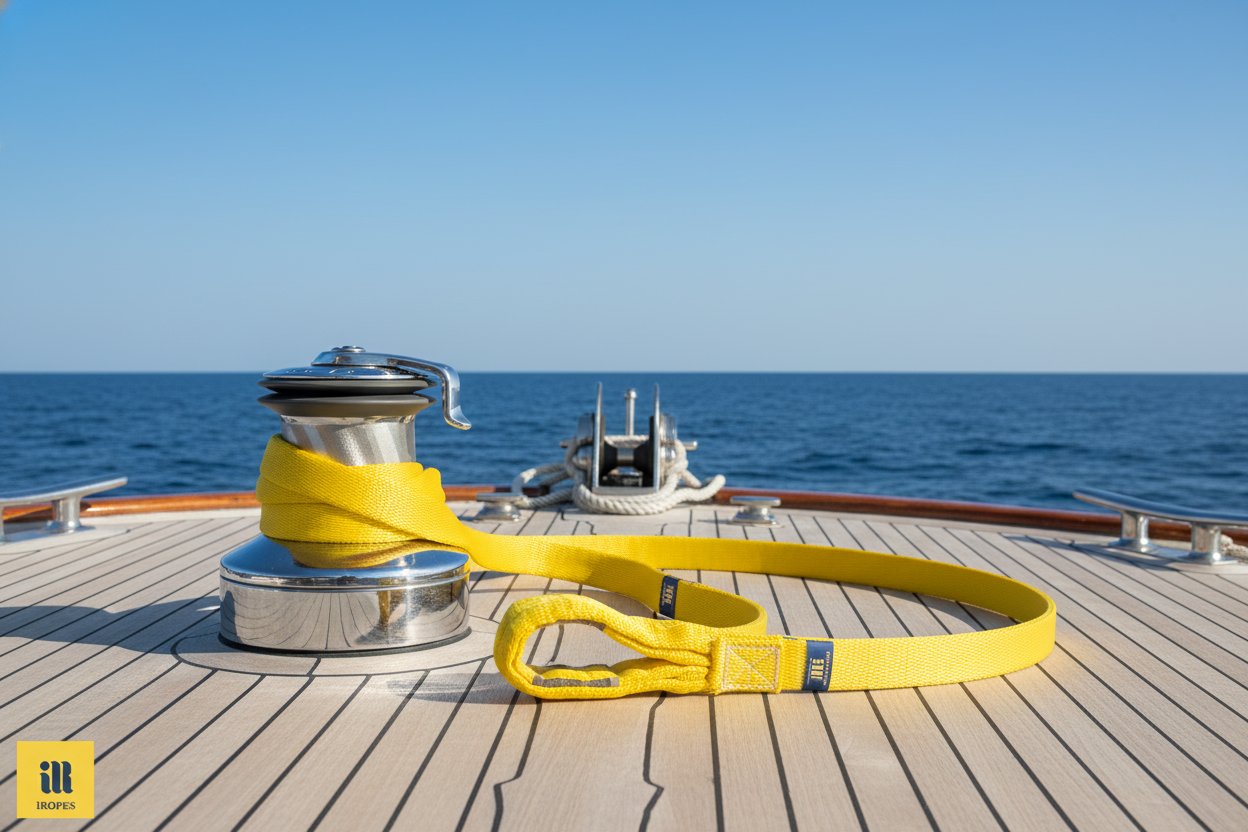
Then there are eye and eye web slings, another key option for yellow lifting solutions. Made from flat polyester webbing with reinforced eyes at both ends, they come in single, double, or triple ply configurations to match varying demands. The eyes make attachment straightforward using hooks or shackles, ideal for tasks requiring angled pulls. For outdoor marine exposure, the webbing's tight weave resists fraying from salt and sun, keeping the bright yellow intact for easy spotting during use. Picture rigging a yacht's sail hardware; these slings hug the load closely, providing control without adding bulk that could snag on deck fittings, thereby enhancing inspection visibility.
Endless Round Slings
Seamless Loops for Versatile Marine Lifts
Load Rotation
Rotates freely to prevent twisting and even out pressure on awkward marine cargo, enhancing safety.
Protective Jacket
Tubular cover shields inner fibres from abrasion caused by rough deck surfaces or ropes, extending sling life.
Compact Storage
Folds small for easy stowing in tight boat compartments, ready for quick deployment and reduced clutter.
Eye & Eye Web Slings
Precise Attachments for Rigging Tasks
Reinforced Eyes
Durable loops connect securely to rigging points, minimising setup time on heaving decks.
Ply Options
Choose single for light hauls or triple for heavier yacht gear, scaling strength as needed for various loads.
Flat Profile
Lies flat against loads like spearfishing tanks, reducing drag and improving balance during lifting.
What ties these types together for marine performance? Their flexibility lets them conform to curved or uneven loads, such as yacht hull fittings or bundled spearfishing spears, while the UV-resistant yellow dye holds colour against relentless sun. This makes inspections a breeze—you can spot dirt or minor frays from afar without close handling, improving inspection visibility. In yachting, an endless round sling might cradle a dinghy during transfer, moulding to its shape for a stable grip. For spearfishing charters, eye and eye versions lift weighted belts or coolers effortlessly, their lightweight build cutting down on crew fatigue during long days. Both types shine because polyester keeps stretch minimal, around 3% under load, so you maintain control even in choppy seas. If you're wondering about picking between them, consider your setup: loops for all-around use, eyes for targeted connections.
These adaptable features set the stage for reliable lifts, but knowing how much weight each can truly handle in various setups is what keeps things secure on the water. Therefore, understanding load capacities is crucial for safe and efficient marine operations.
Load Capacities and Compliance: Ensuring Safety with Yellow Slings
Now that we've seen how different designs make yellow lifting straps so adaptable on the water, the next step is figuring out just how much they can safely handle in real-world scenarios. Without clear limits, even the best sling could lead to trouble, especially when waves add unexpected stress to a lift. That's why understanding working load limits—or WLL, the maximum weight a sling is designed to carry under normal conditions—matters so much for keeping your team out of harm's way, and for ensuring marine safety wins.
For yellow slings, capacities vary based on the type, width, and how you rig them, but they generally fall into a reliable range for medium-duty marine tasks. In a straight vertical hitch, where the load hangs directly below the hook, these slings support the full rated amount without reduction. Choker hitches, which wrap around the load and tighten like a noose, cut that capacity to about 80% to account for the angle and pressure. Basket hitches, spreading the load across the sling's length, often allow up to twice the vertical rating since the weight distributes evenly. Width plays a big role too—a narrower one-inch strap might handle 3,300 pounds vertically, while wider options step up for heavier gear. Always check the sewn-in tag for the exact figure tailored to your sling; it's your best guide amid the spray and motion.
This setup ties directly into why the yellow hue isn't just for show—it follows a colour-coding system from bodies like the WSTDA (Web Sling and Tie Down Association) and the ASME B30.9 (American Society of Mechanical Engineers). Purple might signal lighter loads, but yellow flags those mid-range capacities perfect for yacht rigging or defence equipment transfers. OSHA reinforces this by requiring clear visual identification to prevent overloads, noting that mismatched gear contributes to many rigging incidents. Adhering to these standards means your operations stay legal and safe, no matter the port. Ever caught yourself second-guessing a lift's limits during a busy charter? That yellow tag eliminates the doubt, letting you focus on the job.
Vertical Hitch
Full WLL applies when lifting straight up, ideal for balanced marine cargo like spare parts.
Choker Hitch
Reduces capacity to 80% for gripping irregular shapes, such as bundled fishing lines at sea.
Basket Hitch
Doubles the vertical limit for cradling loads like deck crates, minimising sway in rough conditions.
Width Impact
Wider slings boost overall strength; a two-inch version often reaches higher ratings for yacht maintenance.
To keep those capacities reliable over time, regular inspections are non-negotiable. Before each use, run your hands along the length for cuts or frays from sharp edges, and check for signs of heat exposure like shiny, melted spots from engine proximity—polyester starts degrading above 200 degrees Fahrenheit. Faded or illegible tags mean it's time to retire the sling; without clear markings, you can't confirm its rating. Store them coiled away from sunlight and chemicals to extend life, and remember, a quick once-over can catch issues that prevent bigger problems down the line, increasing marine safety. This adherence to inspection guidelines is paramount.

Mastering these load details and checks builds confidence, but the real staying power comes from choosing materials that withstand the sea's constant battering without losing their edge.
Material Durability and Customisation: Tailoring Yellow Lifting Solutions for Marine Needs
That enduring edge against the sea's relentless demands starts with the right material at the heart of your yellow lifting solutions. Polyester stands out as the go-to choice for these slings and straps, offering a combination of strength and resilience that's hard to beat in marine environments. Unlike nylon, which absorbs water and loses up to 10% of its strength when wet, polyester repels moisture entirely, keeping its full power even after repeated dousings in saltwater. This makes it perfect for outdoor use where humidity and spray are constant companions.
What really sets polyester apart is its low stretch—typically under full load, it elongates by just a couple of percent, giving you precise control during lifts on a rocking deck. Add in its superior resistance to ultraviolet rays, and you have a material that won't fade or weaken under the sun's glare over months of exposure. I've seen crews on fishing boats swear by these properties; one time, a polyester strap held firm through a sudden squall, while a nylon alternative might have stretched and slipped. For marine work, this means fewer surprises and more confidence when hoisting gear from yacht davits or securing loads in choppy conditions. And since most yellow lifting slings rely on this fabric, you're getting a built-in safeguard against the elements that nylon simply can't match without extra treatments, as explored in our guide to nylon and polyester rope properties. The UV-resistant colouring is a significant advantage.
Polyester Edge Over Nylon
Polyester maintains 100% strength when wet, resists UV degradation for longer outdoor life, and offers minimal elongation for stable marine handling—ideal when nylon would compromise under similar stresses.
At iRopes, we take that durability further with our crane slings & hoist solutions, letting you customise yellow lifting slings to fit your exact marine setup. Need a specific length for yacht rigging or reinforced eyes for heavier defence loads? We handle it all, from adjusting widths to incorporating your branding right into the webbing. Our process includes full intellectual property protection, so your unique designs stay yours, and we ship directly to your location worldwide with non-branded or custom packaging options. This isn't off-the-shelf stuff—it's tailored solutions that align with your operations, backed by our ISO 9001-certified manufacturing for precision every step, ensuring both quality assurance and comprehensive OEM/ODM services.
To make the most of these customised pieces, setting up a solid colour-coded lifting program is key. Start by designating storage areas away from direct sunlight and corrosive chemicals to prevent premature wear. For maintenance, rinse with fresh water after saltwater exposure and air-dry them flat—avoid machine washing, as it can damage the fibres. Regular checks, beyond just pre-use inspections, involve logging usage history to track lifespan, which can stretch to years with proper care. Implementing these steps not only extends the reliability of your yellow slings but also streamlines team training on quick identification and handling. This is vital for safety, particularly due to the inherent UV-resistant colouring for outdoor use and enhanced inspection visibility benefits.
- Storage Best Practices - Keep coiled in shaded, dry spots to shield from UV and moisture, ensuring the bright yellow stays visible for easy selection.
- Cleaning Routine - Use mild soap and water rinses post-marine use, followed by thorough drying to maintain strength without chemical degradation.
- Longevity Tracking - Document each lift's details to predict replacement needs, often after 5-7 years depending on exposure intensity.

With these tailored approaches in place, your marine lifting operations gain not just safety but efficiency that scales with your needs.
Yellow lifting slings serve as a vital secret code in marine safety, enabling swift identification of capacities and preventing accidents through international standards like ASME and WSTDA. With UV-resistant colouring for enduring outdoor exposure and enhanced inspection visibility, these yellow lifting straps—whether endless round or eye and eye designs—offer flexibility and low-stretch polyester durability for yachting, defence, and spearfishing. Implementing a colour-coded lifting program, complete with proper storage and maintenance guidelines, ensures compliance and longevity, empowering your team with reliable performance in demanding sea conditions.
At iRopes, our OEM/ODM expertise tailors yellow slings to your precise needs, from custom lengths to branded packaging, all backed by ISO 9001 quality and IP protection. Discover how these solutions can safeguard your operations even further.
Customise Your Marine Lifting Solutions with iRopes
If you're seeking personalised guidance on integrating yellow lifting slings into your safety protocols or exploring custom options, the inquiry form above connects you directly with our specialists for tailored advice.