Protect your rated capacity – apply the standard formula and the 25:1 D/d rule to avoid avoidable losses of up to 30% from sling angle and undersized eyes. iRopes’ customised slings help you maintain safe, reliable lifts.
≈ 9‑minute read – What you’ll gain
- ✓ Calculate the exact SWL for any diameter, construction and hitch angle in seconds.
- ✓ Compare steel, UHMWPE, Kevlar™ and Vectran™ to choose a material that can deliver higher capacity at the same diameter.
- ✓ Apply the 25:1 D/d eye‑size rule and avoid up to 30% capacity loss from undersized eyes.
- ✓ Follow OSHA and ASME guidance to streamline inspections and stay compliant.
Many lift plans still rely on vertical‑only tables, assuming the same value applies at any rigging angle. In reality, sling angle can reduce wire rope load capacity significantly. By using published angle‑correction factors and selecting the right construction and material, you can preserve capacity, reduce risk and improve cost control. Below, we outline the exact formulas, eye‑size rules and material choices that convert theory into safe, repeatable practice.
Understanding the load capacity of wire rope slings
When you need to know the load capacity of wire rope slings, start with the Safe Working Load (SWL). OSHA requires a design factor of 5, so SWL equals the rope’s breaking strength divided by five. This simple rule keeps lifts within a conservative safety margin.

Below is a quick‑answer table that matches common rope diameters with their vertical SWL values. The figures follow a design factor of 5 and apply to straight‑up (vertical) hitches. Always verify against the sling tag and manufacturer tables for your exact construction and grade.
| Diameter (mm) | Construction | Breaking Strength (kN) | Safe Working Load (kN) |
|---|---|---|---|
| 32 | 6×19 | 1 250 | 250 |
| 40 | 6×19 | 2 000 | 400 |
People Also Ask: What is the capacity of a wire rope sling? Its SWL equals breaking strength divided by the OSHA design factor of 5. A typical 32 mm 6×19 steel sling has an SWL of about 250 kN (≈ 25 t) in a vertical hitch. Values vary by grade and construction.
- SWL definition – the maximum load you may lift while maintaining the design factor.
- Design factor 5 – required by OSHA for wire‑rope slings; SWL = Breaking Strength ÷ 5.
- D/d ratio rule – eye diameter should be at least 25 × rope diameter for steel slings to maintain rated capacity.
“Never rely on a sling’s colour or branding alone; always verify its SWL against the official table. A quick reference saves time and prevents costly accidents.” – Certified Rigging Engineer, John D. Miller
Now that you understand how SWL is calculated and how diameter directly influences the wire rope load capacity, we can move on to calculating capacities for custom configurations and angles.
Calculating wire rope load capacity for custom applications
With the definition of safe working load clear, the next step is applying it. Using a standard rigging approach, you can determine the load capacity of wire rope slings for any diameter, construction or hitch angle.

A widely used rigging formula is:
SWL = (Breaking Strength ÷ 5) × sin(θ ⁄ 2)
Here, θ is the included angle between the two legs of a basket or two‑leg hitch. For a single‑leg vertical hitch, omit the sine term entirely. Below is a step‑by‑step illustration for a 32 mm 6×19 steel sling in a two‑leg basket at a 60° included angle.
- Locate the breaking strength: ≈ 1 250 kN (≈ 125 t) for a typical 32 mm 6×19 rope.
- Apply the design factor: 1 250 kN ÷ 5 = 250 kN (≈ 25 t) per leg in vertical.
- Calculate the angle factor: sin(60° ⁄ 2) = sin 30° = 0.5.
- Two‑leg basket capacity: 2 × (250 kN × 0.5) = 250 kN (≈ 25 t).
The final figure, 250 kN, is the sling load capacity at a 60° included angle for this two‑leg basket. In a single‑leg vertical hitch, capacity equals 250 kN because no angle correction applies.
While angle drives the biggest changes, the D/d ratio also affects usable capacity. As a rule of thumb, the eye diameter (D) should be at least 25 times the rope diameter (d) for steel slings; synthetic slings often use 8:1. Undersized eyes reduce the effective breaking strength and therefore lower the calculated SWL.
When a user asks, “How to calculate sling load capacity?” the concise answer is: find the rope’s breaking strength, divide by 5, then apply the appropriate angle factor (use sin (θ⁄2) for two‑leg baskets). For a quick reference, see our wire rope sling capacity chart that walks you through each variable.
Never overlook eye size: a 25:1 D/d ratio is the common minimum for steel slings; failing to meet it can cut the allowable load by up to 30%.
iRopes brings 15 years of expertise in tailoring rope constructions. Whether your application calls for UHMWPE, Technora™, Kevlar™ or Vectran™, each material’s intrinsic tensile strength influences the breaking strength used in the formula. Specialised coatings—such as corrosion‑resistant galvanising or UV‑stable PVC—can further help retain performance, allowing engineers to tune wire rope load capacity for harsh environments.
With the calculation method set, the next step is to choose the right material and align with safety standards to optimise performance.
Optimising sling load capacity with material choices and safety standards
After turning breaking strength into a usable figure, decide which rope material best delivers the required load capacity of wire rope slings while meeting on‑site safety rules.
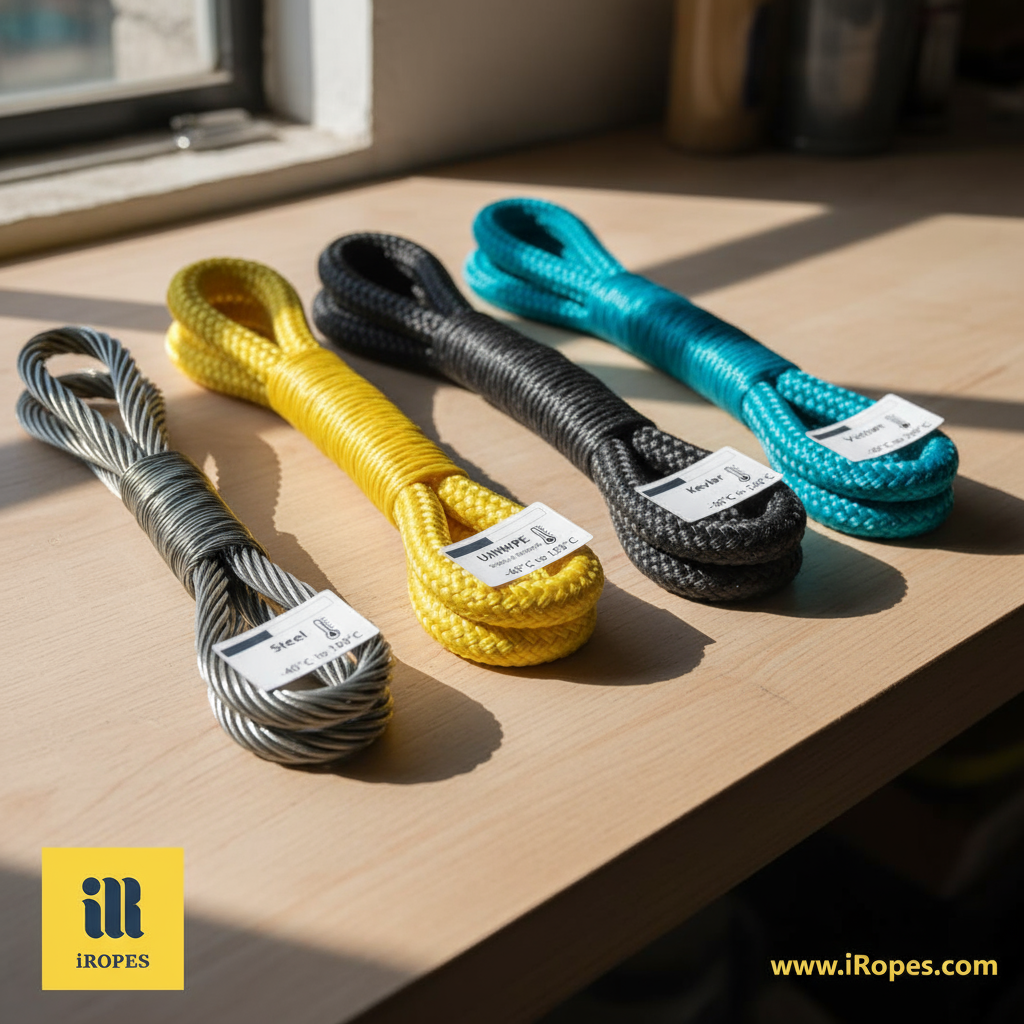
Material Strength
Key performance figures that drive capacity
Steel
Tensile strength ≈ 1 800 MPa, temperature range −50 °C to 400 °C, typical vertical SWL for a 32 mm 6×19 rope ≈ 25 t (grade‑dependent).
UHMWPE
Very high tensile strength at ≈ 3 200 MPa, excellent low‑temperature behaviour down to −40 °C; a 32 mm UHMWPE sling can exceed 30 t vertically.
Kevlar™
Strength around 3 600 MPa; retains performance at elevated temperatures; a comparable 32 mm sling typically achieves ≈ 28 t vertically (construction‑dependent).
Regulatory Checklist
What you must verify before lifting
OSHA §1926.251(b)(1)
Mandates a design factor of 5 for wire‑rope slings. Apply a minimum 25:1 D/d eye‑diameter ratio for steel slings per industry guidance.
ASME B30.9
Defines requirements for wire‑rope slings, including hitch‑angle effects, inspection criteria and temperature considerations.
ISO 9001 & Inspection
Ensure suppliers maintain ISO 9001 quality systems. Inspect at least annually—or more often for offshore and high‑risk service.
Two questions come up frequently. How does sling angle affect load capacity? As the included angle between sling legs increases, the correction factor decreases; for example, at 60°, sin(θ⁄2) equals 0.5. Consequently, greater angles reduce effective capacity—always consult the published charts.
What safety factor is used for wire‑rope slings? OSHA and industry standards use a five‑to‑one margin—allowable load is one‑fifth of breaking strength.
iRopes OEM Advantage
With 15 years of manufacturing in China, iRopes delivers ISO 9001‑backed OEM and ODM solutions across 2,348 cordages for marine, racing sports, industrial and safety uses. We blend proprietary coatings with UHMWPE, Technora™, Kevlar™, Vectran™, polyamide and polyester to hit your target SWL, protect your IP, apply your branding and ship pallets worldwide—bag, colour‑box or carton.
With the material matrix and compliance checklist in hand, you can match the sling that delivers the required wire rope load capacity to the standards that keep your crew safe—then move to specifying a tailor‑made solution that fits your lift plan precisely. If you’re evaluating whether a synthetic sling outperforms a steel sling, our comparison of Synthetic Rope Sling vs Steel Sling Which is Best provides detailed insights.
For a broader look at how steel and synthetic ropes stack up, see Steel Cable Rope vs Synthetic Rope: Which Is Better?.
Need a custom sling solution? Get expert help
For personalised advice, complete the inquiry form above.
With the essentials of Safe Working Load, angle correction and material strength covered, you can now determine the load capacity of wire rope slings, choose the optimal fibre—whether steel, UHMWPE, Kevlar™ or Vectran™—and stay compliant with OSHA, ASME and ISO 9001. Applying the formula and D/d ratio rules helps you extract maximum sling load capacity while protecting people and equipment.
Leverage iRopes’ 15‑year “Made in China” expertise and broad synthetic‑fibre portfolio to tailor a sling to your exact sling load capacity needs. Our OEM/ODM team offers custom branding, IP protection and non‑branded or customer‑branded packaging, with direct pallet shipping to your site. Use the form above to connect with our engineers for a customised solution.
