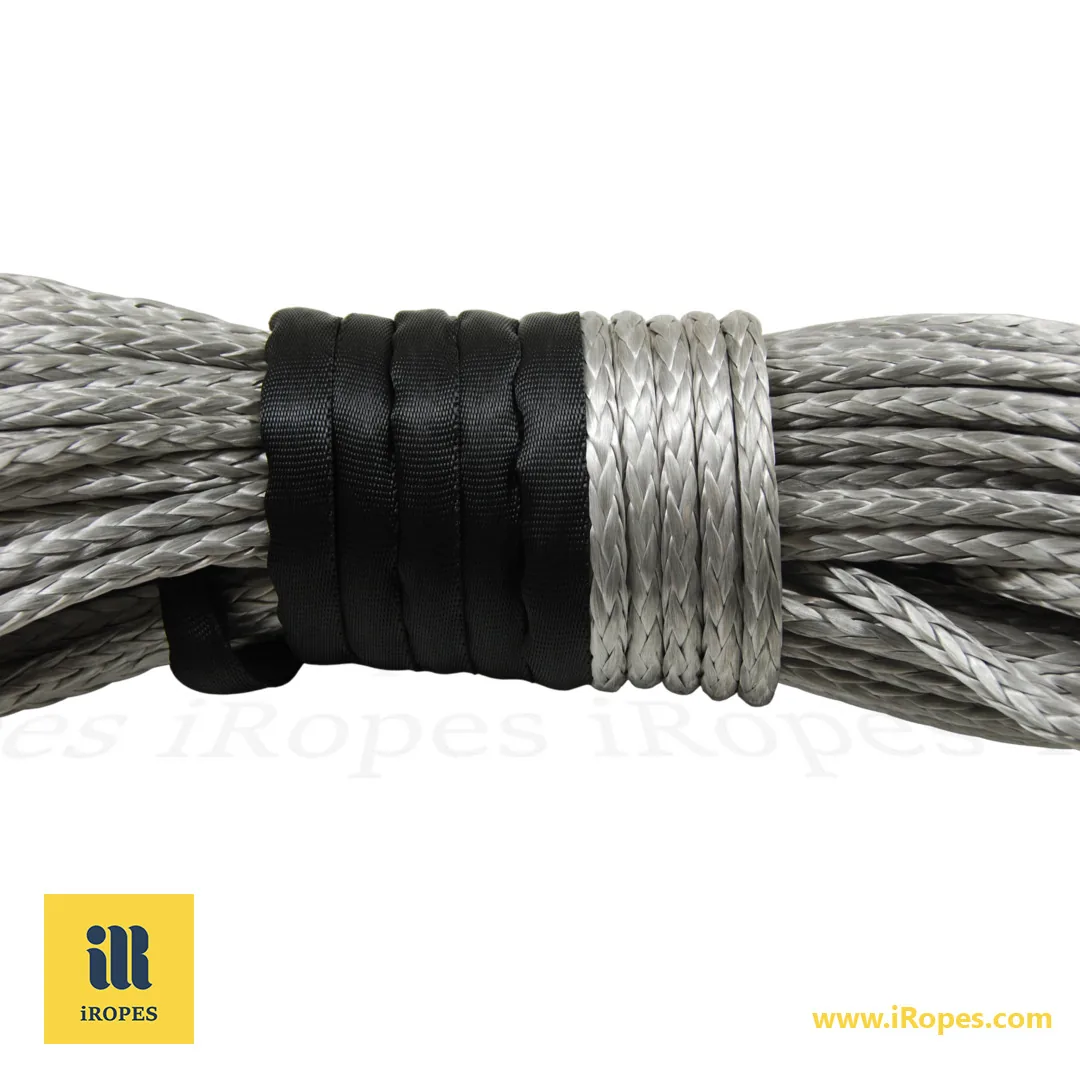
A double‑braided nylon eye splice keeps 94 % of a 1‑inch rope’s 30‑tonne strength—knots reduce this to 45 %.
Your gains (≈5‑min read)
- ✓ Preserve 94 % strength → +15 tonnes safety on 1‑inch rope
- ✓ Cut bulk 60 % vs knots → no snag on winches
- ✓ Finish splice in ≤7 min with iRopes tools → faster field work
Are you still knotting your rope and losing almost half its strength? Discover the splice that saves 94 % of your rope's power and learn about iRopes’ custom solutions for off‑road and marine applications.
Understanding the double braided rope splice and its advantages
When a rope must bear heavy loads during off‑road recoveries or marine moorings, the way you finish its end significantly impacts safety and performance. A double braided rope splice creates a permanent, load‑bearing loop, providing superior strength compared to knots.

Why should you choose a splice over a knot? Tests reveal that a well‑made splice retains 90‑95 % of the rope’s breaking strength. In contrast, common knots can reduce that capacity by 40‑60 %. Furthermore, a splice results in a low‑profile, smooth loop that won’t snag on winch drums or dock cleats.
- Strength retention – Splices maintain most of the rope’s original load‑bearing capability.
- Reduced bulk – The loop sits flush, minimising interference with equipment.
- Durability – Fewer stress concentrations lead to a longer service life.
Within double‑braided constructions, the eye splice is the most widely used. This is because the outer sheath can be pulled back over the inner core without damaging the fibres. This “Class I” splice works particularly well with double braided nylon rope, making it ideal for winch lines or dock lines.
The four common splice types include the eye splice, the end‑to‑end (short) splice, the back splice (also known as a sailmaker’s splice), and the long splice.
Understanding these options allows you to select the most efficient solution for your project. Whether you require a sturdy loop, a seamless join, or a finished rope end that prevents fraying, splicing offers a reliable choice. With the fundamentals of the double braided rope splice now clear, let’s explore how a 1‑inch double braided nylon rope excels in real‑world off‑road and marine applications.
Performance highlights of 1 inch double braided nylon rope for off‑road and marine use
Having explored how splicing preserves strength, it is now time to examine the rope itself. A 1‑inch double braided nylon rope features a tightly woven inner core with a protective outer sheath. This construction gives the rope its characteristic torque‑free, non‑kinking behaviour. This core‑within‑core architecture defines what the industry refers to when asking, “what does double braided rope mean?” The inner braid primarily carries the load, while the outer braid shields the core from abrasion and environmental elements.
Nylon, as a material, delivers three crucial performance pillars for challenging off‑road and marine environments. Firstly, its immense breaking strength—easily exceeding 30 tonnes—provides a generous safety margin for recovery pulls and heavy‑duty anchoring. Secondly, nylon’s elongation range of 20‑40 % at break acts as a natural shock absorber. This capability smoothly mitigates sudden loads, such as when a winch rapidly engages or a tide exerts force against a mooring line. Thirdly, the woven sheath offers remarkable resistance to surface wear, ensuring the rope maintains its integrity and grip even after repeated abrasion against vehicle racks, rock faces, or chain‑linked cleats.
Technical data for the standard 1‑inch configuration further highlights its suitability for demanding tasks. This rope weighs approximately 0.75 kg per foot, striking a balance between manageability and the strength associated with its mass. Manufacturers typically specify a Working Load Limit (WLL) of about 6 tonnes for this size. This rating aligns perfectly with the load capacities of most off‑road winches and commercial mooring systems. These figures directly translate into greater confidence in the field: an off‑road enthusiast can safely recover a stuck 4x4, and a sailor can secure a vessel without concern for sudden rope failure.
Practical applications demonstrate the rope’s remarkable versatility. In off‑road recovery, this rope forms the backbone of winch lines, offering sufficient stretch to cushion the vehicle’s surge while remaining robust enough to handle several tonnes of tension. On the water, the exact same rope becomes a dependable dock or mooring line. Its controlled stretch prevents the excessive "springy" motion that could damage fenders, yet its inherent elasticity effectively absorbs wave‑induced shocks. Even heavy‑duty anchoring projects benefit, as the rope can be securely attached to an anchor while retaining the necessary elongation to keep the anchor properly set under fluctuating loads.

Core Benefits
Why this rope stands out
Strength
Exceeds 30 tonnes breaking strength, providing a large safety margin for heavy loads.
Shock‑absorption
Its 20‑40 % elongation at break smoothly manages sudden pulls during winch recovery or mooring operations.
Abrasion resistance
The outer sheath protects the core from wear against rock, metal, and marine hardware, ensuring longevity.
Performance Specs
Numbers that matter
Breaking strength
Approximately 30 tonnes, ensuring reliable load‑bearing capacity for critical tasks.
Weight per foot
Around 0.75 kg, offering a good balance of handling ease and inherent durability.
Working load limit
Roughly 6 tonnes for the 1‑inch size, making it suitable for most recovery and mooring setups.
Typical Off‑road & Marine Uses
This rope is ideal for winch recovery lines requiring both high tensile strength and controlled stretch. It also excels as dock and mooring lines, given its abrasion‑resistant sheaths. Additionally, it suits heavy‑duty anchoring setups, where shock absorption protects gear from sudden wave impacts.
Step‑by‑step guide to creating a double braided nylon rope eye splice
Building on the technical data presented earlier, the challenge now lies in transforming a 1‑inch double braided nylon rope into a strong, permanent loop. A well‑executed eye splice preserves most of the rope’s capacity and delivers a low‑profile termination that won’t snag on winch drums or dock cleats.

When the goal is to join two pieces of nylon rope together, splicing is the preferred method because it retains up to 95 % of the rope’s original strength. This is far superior to any knot‑based solution.
- Mark the standing part – Use a permanent marker to place the “X”, “R”, “1”, and “T” marks at the distances specified in the manufacturer’s splice chart.
- Extract the core – Insert the fid into the rope, work it to the “X” mark, and gently pull the inner core out to the “R” point, ensuring the outer cover remains intact.
- Mark the core – Transfer the “1” and “T” marks onto the exposed core. This will guide the cover’s re‑entry and the final burying length.
- Re‑insert the cover – Carefully push the cover back over the core using the fid, aligning the “1” mark on the cover with the core’s “1” mark.
- Create the taper – Use a sharp knife to trim the outer sheath, forming a smooth taper that will facilitate the burying process.
- Bury the core tail – Slide the tapered cover over the core tail until the “T” mark on the cover meets the core’s “T” mark, then securely lock the tail in place.
- Lock stitch – Using a lock‑stitching needle, pass the thread through the burying zone three times, tightening each pass to secure the splice.
For a 1‑inch diameter rope, special consideration is required. Its larger sheath necessitates a longer fid (typically 300 mm) and a wider taping width. This prevents the core from slipping during the crucial burying stage.
Tip: When working with a 1‑inch double braided nylon rope, apply extra tape around the core before re‑inserting the cover. This simple step prevents the core strands from spreading, ensuring a smooth, uniform splice.
iRopes’ OEM/ODM solutions for custom double braided nylon rope
After mastering the eye splice, the next logical step involves sourcing a rope that perfectly matches your exact dimensions and performance requirements. At iRopes, we engineer each strand of double braided nylon rope precisely to the specifications needed for off‑road recovery rigs, marine dock lines, or any other specialised application you can envision.

Recognising that every project features its own unique load‑bearing calculations, environmental exposure, and branding guidelines, we offer a comprehensive menu of modular customisation choices. These options can be combined in any order to meet your specific needs.
- Diameter & Length – Choose from ½‑inch to 2‑inch cores; lengths can be precisely cut to your exact metre or foot count.
- Colour, Pattern & Branding – Select solid hues, high‑visibility stripes, or custom graphics; we can also print logos directly on the sheath or on the packaging.
- Accessories & Packaging – Add thimbles, loops, or reinforced terminations, and choose between bulk pallets, colour‑coded bags, or printed cartons.
Quality is never an afterthought at iRopes. Our production lines operate under ISO 9001 certification, meticulously tracking every batch from fibre extrusion to the final coil. This systematic oversight guarantees that the tensile characteristics you’ve specified are consistently delivered, ensuring superior performance and reliability.
“Our ISO 9001 framework ensures that every metre of double braided nylon rope meets the exact breaking strength and elongation limits declared in the data sheet, providing the confidence needed for critical winch and mooring applications.”
Beyond the factory floor, we meticulously manage worldwide logistics. This ensures that your customised coil arrives precisely on schedule, ready for immediate deployment in the field, wherever that may be.
Engineering Performance
Our engineers fine‑tune core braid count and sheath weave to deliver the exact shock‑absorption and abrasion resistance demanded by rugged off‑road recoveries.
Logistics Excellence
Direct pallet shipments, real‑time tracking, and optional custom‑branded cartons streamline your supply chain from our factory to your dock, ensuring timely delivery.
Marine Ready
Salt‑water‑resistant sheaths and UV‑stable dyes ensure long‑term performance for dock lines, mooring ropes, and anchor rodes in harsh marine environments.
Off‑Road Tough
High‑stretch cores absorb the sudden surge of a winch pull, while the rugged outer braid resists abrasion from rocks, sand, and metal hardware inherent in off-road use.
Whether you need a 1‑inch configuration robust enough for a 30‑tonne winch pull or a specialised colour‑coded line for a fleet of rescue boats, our OEM/ODM programme translates those specific requirements into a finished rope. This product then arrives ready for the intricate splice you’ve just learned to master, benefitting from the top benefits of nylon braid and double‑braid nylon rope.
Need a personalised rope solution?
This article has demonstrated how a double braided rope splice preserves up to 95% of a rope’s strength. We’ve also highlighted how the 1‑inch double braided nylon rope delivers over 30‑tonne breaking strength, coupled with controlled stretch and superior abrasion resistance, making it an ideal choice for both off‑road winch recoveries and marine moorings.
With iRopes’ comprehensive OEM/ODM expertise, you can order a double braided nylon rope built precisely to your exact specifications. This includes everything from colour and pattern to length, core construction, and branded packaging. You’ll receive ISO 9001‑certified quality, conveniently shipped directly to your site.
For a tailored recommendation that meets your unique needs, simply fill out the enquiry form above, and our rope specialists will contact you with customised advice.