⚠️ Improper 4-leg sling angles can slash working load limits by up to 50% at 30 degrees, contributing to marine lift failures such as vessel hull damage or dangerous tipping in marinas. Mastering these angles can restore full capacity and ensure stable lifts for boat cradles and irregular loads.
In 7 minutes, gain skills to prevent costly marine rigging mishaps:
- ✓ Calculate load distribution for uneven marine weights, reducing tipping risks during yacht haul-outs.
- ✓ Optimise sling angles to maintain full Working Load Limit (WLL), avoiding overload failures in shipyards.
- ✓ Apply safety protocols and inspections compliant with OSHA/ASME standards, crucial in saltwater environments.
- ✓ Customise 4-leg slings with iRopes for precise rigging plans, boosting lift efficiency for complex boat cradles.
You might assume vertical rigging always maximises strength, but in marine lifts, shallow angles can halve your capacity without warning. This can lead to scraped hulls or dropped keels that cost thousands in repairs. What if a simple angle adjustment could transform unstable hauls into rock-solid operations? Discover the exact calculations, diagrams, and iRopes custom solutions inside that reveal how to eliminate these hidden dangers and achieve flawless stability every time.
What is a 4 Leg Lifting Sling and Why is it Essential for Marine Applications
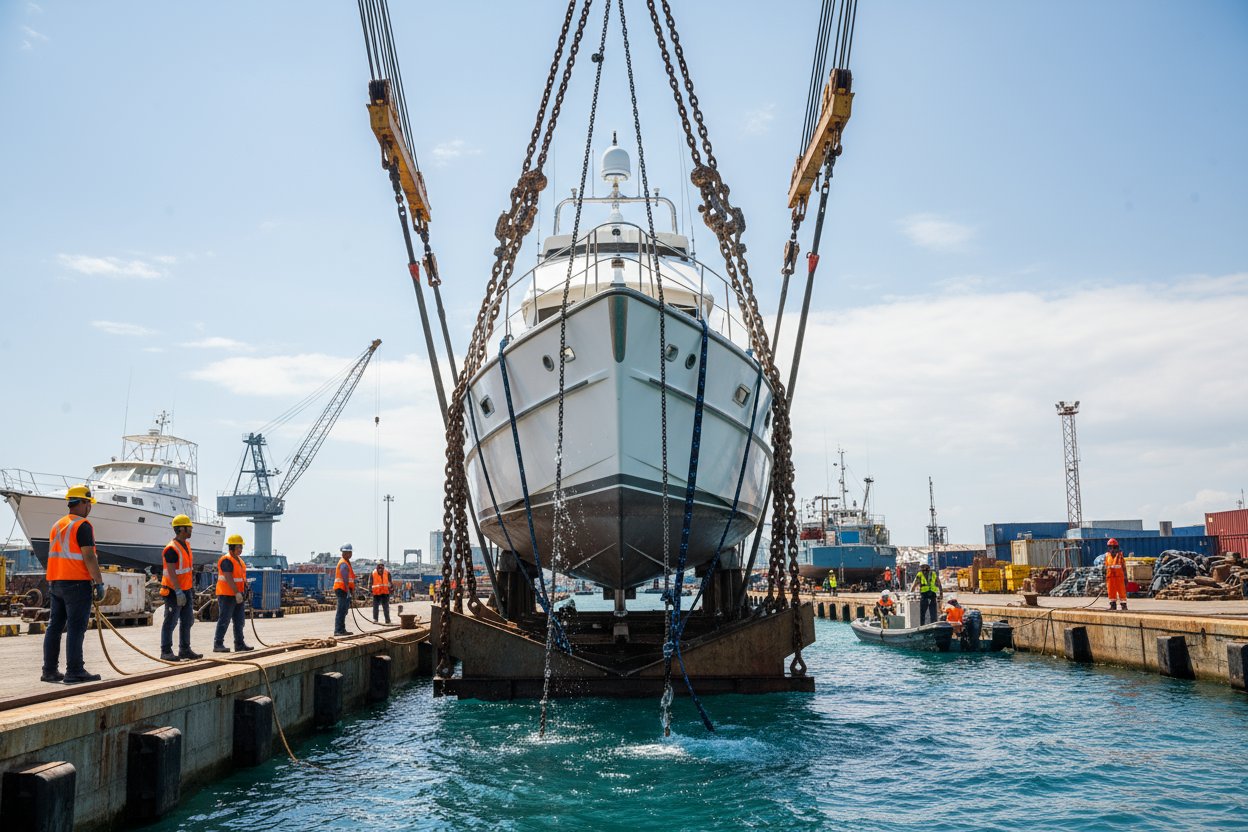
Imagine you're at a bustling marina, overseeing the careful lift of a sleek yacht out of the water. One wrong move, and that delicate hull could scrape against the cradle or worse. This is precisely where a 4 leg lifting sling comes into play—it acts as the steady hand that keeps everything balanced. Sometimes called a 4 way sling or quad leg sling, it's a rigging assembly designed for secure, multi-point lifts.
At its core, a 4 leg sling features a central master link—the hub where all the action starts. From there, four individual legs extend downwards, each typically ending in fittings like hooks, shackles, or thimbles that attach to your load's lifting points. This specific setup ensures even weight distribution across four distinct points, making it ideal for safely handling awkward or heavy items without tipping.
Have you ever wondered what distinguishes this configuration from simpler setups? The key lies in its superior stability. Unlike a single sling that might allow unpredictable swinging, these four legs work in concert to cradle irregular shapes, almost like four friends supporting a shared burden. In marine work, where loads such as boat cradles, engine blocks, or complex marine equipment are rarely perfectly symmetrical, this design is crucial for preventing dangerous shifts mid-lift.
- Superior Stability: The four legs minimise load swinging, providing confidence during precise manoeuvres, such as positioning a keel.
- Even Load Distribution: Weight spreads across multiple points, significantly reducing stress on any one area and thereby protecting sensitive marine gear.
- Enhanced Safety: A reduced risk of tipping means fewer accidents, which is especially vital when lifting high-value vessels in tight dock spaces.
- Versatility for Complex Loads: The design is ideal for oddly shaped items like masts or hull supports that single or dual slings might mishandle.
Now, let's compare this to slings with fewer legs. A two-leg version works perfectly for straightforward vertical lifts, but try it on a yacht cradle with uneven weight, and you'll quickly see the difference. It can tilt, forcing constant adjustments or risking a damaging drop. Three legs offer some balance, yet four truly excel at locking in stability, especially for boat handling where every degree of precision matters. Picture hauling out a sailboat: the extra legs keep the hull consistently level, avoiding those heart-stopping moments.
In the salty, sun-baked world of marinas and shipyards, these slings are indispensable. They excel at safeguarding fragile hulls from abrasions while helping operators meet tough compliance standards. Saltwater can rapidly corrode equipment, but choosing the right 4 leg sling — one built robustly against corrosion — keeps operations smooth and legally compliant. It's not just about lifting; it's about executing the lift correctly to protect your valuable assets.

Understanding these fundamental aspects sets the stage for selecting the best materials to tackle dynamic marine challenges head-on.
Types of 4 Way Sling: Material Matters for Marine Lifting Scenarios
Building on the stability that a 4 leg sling brings to your marine operations, the real game-changer often comes down to its materials. I've personally witnessed how the wrong material can transform a routine boat haul-out into a nightmare of unexpected corrosion or irreparable scratches on a prized fibreglass hull. So, let's explore this further: what types of materials are 4-leg slings made from, and why is this choice critical for your dockside or shipyard work? Selecting the correct material ensures your equipment endures the relentless saltwater spray and unpredictable waves.
Consider chain slings first, which are often the robust choice for demanding shipyard jobs. These are typically constructed from alloy steel links; Grade 100 is often preferred for its exceptional strength, offering up to 25% more durability than Grade 80 options. Chain slings are unbeatable for moving heavy engine blocks or securing hefty loads in tough conditions where abrasion is a constant threat. However, in a marine setting, saltwater is a significant adversary. To maintain their performance, rinse them thoroughly with fresh water after each use and apply a light coat of lubricant to prevent rust. I recall assisting a yard crew with a Grade 100 setup; a quick post-dip clean saved it from seizing up after a stormy week.
Then there are wire rope slings, which provide a balanced blend of strength and flexibility, making them ideal for smoothly launching boats. Galvanised options are particularly effective here, with their zinc coating acting as a protective barrier against corrosion. Their flexibility allows them to conform well around curved hulls or cradles. Unlike rigid chain slings, they adapt better to dynamic lifts, such as carefully easing a yacht into the water. However, it's essential to regularly check for broken wires, as these are often the first indicators of wear in salty air.
Chain & Wire Rope
Rugged Options for Heavy Duty
Grade 100 Chain
Offers extreme durability for shipyard abrasion, but requires consistent saltwater rinsing to prevent rust build-up.
Galvanised Wire Rope
Provides flexible strength for boat launches, with effective zinc protection against marine corrosion.
Maintenance Tip
Inspect links and strands weekly in humid marine environments to detect early signs of degradation.
Synthetic Slings
Gentle on Hulls
Polyester or Nylon
Lightweight and non-abrasive, making them perfect for protecting delicate yacht finishes during lifts.
UV-Resistant Choices
Opt for specially treated fibres to withstand prolonged dockside exposure without weakening.
Buoyancy Benefit
Low water absorption keeps them buoyant and quick-drying, ideal for wet operations.
For hull-sensitive work, synthetic slings truly shine. Crafted from polyester or nylon webbing, they are gentle on surfaces, preventing gouges on cherished paintwork. These slings are also lighter, making them easier to manoeuvre during a busy marina day. Have you ever concerned yourself with dings while lifting a sleek powerboat? Synthetics handle such tasks gracefully, offering good resistance to oils and greases commonly found around docks. However, remember they generally do not tolerate extreme heat or acids well, so store them shaded from direct sunlight.
Tailoring your 4 way sling to marine conditions necessitates prioritising UV resistance across all types; always look for coatings or treatments that prevent degradation from harsh sunlight. Buoyancy is also a factor: synthetics float better, reducing risks if a sling accidentally slips into the water. In dockside operations, where you're managing tides and confined spaces, these considerations help keep your lifts predictable and safe. What suits one boat may not suit another, so meticulously match the material to your specific operational demands.
Selecting the best material sets a strong foundation, but now it's important to consider how environmental factors and specific load characteristics influence your overall approach to safely using these slings.
Key Considerations for Using 4 Leg Sling in Marine Environments: Safety and Load Analysis
While choosing the right material for your 4 leg sling is a critical first step, you must also meticulously consider the actual load and the challenging marine environment. I've been on docks where an oversight in load planning turned a straightforward haul-out into hours of rework, simply because the weight wasn't evenly distributed. Proper load analysis ensures your setup doesn't just hold; it performs predictably, especially with unique marine items like keels or masts that are inherently difficult to balance.
Start with accurately calculating load distribution. For irregular loads, begin by locating the centre of gravity. Imagine your mast as an off-kilter beam: if one end weighs more, that side will naturally experience greater tension. Use basic formulas: for symmetrical cases, divide the total weight by the four legs. However, for uneven loads, you must adjust by measuring attachment points and estimating the individual share each leg will bear. Synchronization is also paramount—ensure all legs engage simultaneously to prevent one from taking the full impact initially. In a practical scenario, for a 5-tonne keel, you might initially assign 1.5 tonnes to two legs and 1 tonne each to the others, based on leverage. On-site tools like load cells can verify these calculations, preventing sudden snaps that could damage nearby boats.
Environmental factors add another layer of complexity in marinas. Saltwater splashes accelerate corrosion on metal parts, meaning even galvanised wire rope requires fresh-water rinses after every immersion. UV rays weaken synthetics over time, potentially reducing their strength by up to 20% annually if untreated; therefore, opting for UV-stabilised versions is essential. Job sites also vary: tight marina slips demand compact rigging to avoid swinging hazards, while open shipyards must account for wind gusts that can unexpectedly twist loads. These environmental elements influence your material choice, such as selecting buoyant synthetics for water-adjacent work to prevent submersion-related issues.
Saltwater Challenges
Rinse gear thoroughly post-exposure to halt rust; untreated corrosion can halve equipment lifespan in coastal operations.
UV Degradation
Shield synthetics from direct sunlight; degradation risks weakening fibres during long dockside storage periods.
Wind and Site Variability
Always account for sudden gusts in open yards; they significantly amplify swings on high loads like masts.
Marina Constraints
Plan for tight spaces; shorter legs reduce unwanted sway near berthed vessels, helping avoid accidental contact.
Strict safety protocols are essential to keep operations reliable, compliant, and accident-free. Explore essential market applications for cable sling and rope sling to see how these tools enhance safer, faster lifts across industries like marine rigging. You should always adhere to OSHA and ASME B30.9 standards. So, how do you properly inspect a 4-leg lifting sling? Make it a routine practice: visually scan for cuts, frays, or kinks before each use, then test all connections for secure fits. For more detailed checks, measure leg lengths quarterly to ensure evenness and accurately log any signs of wear, such as stretched chains.
- Examine the master link for any cracks or bends that could compromise its integrity under tension.
- Check each leg meticulously for signs of abrasion—worn spots on synthetics often signal that retirement is due.
- Test all hooks for deformation; bent hooks will not securely hold during dynamic marine swings.
- Verify tags for Working Load Limit (WLL) markings; faded labels mean recertification is absolutely needed.
Rigging techniques are paramount for boat cradles and haul-outs. Always attach legs to sturdy points, keeping them as vertical as possible to maximise capacity; any significant tilt here invites failures. For cradles, cross two legs underneath for added support, distributing pressure away from vulnerable hull weak spots. In haul-outs, synchronise with the crane's pace to glide vessels smoothly, thereby avoiding jolts that could crack fibreglass. Executed correctly, these steps transform potential mishaps into reliable, routine operations.

Aligning these various elements paves the way for tackling the nuances of sling angles and their direct correlation to safe working loads in your next lift plan.
Mastering 4 Leg Sling Angles: Calculations, WLL, and Rigging Plans to Prevent Failures
With your load analysis and safety checks firmly in place, the next crucial step is to precisely calibrate those sling angles. These angles prove to be the make-or-break detail that differentiates a solid plan from a flawless lift. I once witnessed a crew in a busy shipyard almost drop a propeller because they completely overlooked how a shallow angle significantly reduced their capacity. This close call underscored how vital this calculation truly is. For a 4 leg sling, the angle each leg forms with the vertical directly impacts the Working Load Limit (WLL), which represents the maximum safe weight under ideal conditions. Imagine the legs as vectors pulling upwards: when they are perfectly vertical (at 90 degrees to the horizontal, or 0 degrees from vertical), you achieve full capacity. However, as they spread out – for instance, to 60 degrees from horizontal – the tension in each leg dramatically increases, effectively halving the overall strength because you are then fighting gravity at an oblique angle.
So, how precisely does the sling angle affect the capacity of a 4-leg sling? It's all about the multiplier, or angle factor. At a 60-degree angle, each leg bears approximately 86% more load than if it were vertical, so the total WLL remains near full if the load is symmetrical. If the angle drops to 45 degrees, the effective capacity is reduced to around 70% of vertical capacity – which might still be workable for many marina jobs. However, at 30 degrees, you're looking at roughly a 50% reduction in WLL; that 10-tonne rated sling can suddenly safely handle only 5 tonnes, significantly increasing the risk of snaps on heavy keels. Always measure from the hook to the load points, and use the smallest angle across all legs to derate conservatively. This isn't merely theoretical; it's the practical application that keeps your yacht haul stable and free from unexpected incidents.
For accurate load distribution, begin with simple, symmetrical setups: divide the total weight by four, then apply the appropriate angle factor to each leg's share. For example, if you have a 4-tonne engine block, evenly supported at four points with a 60-degree angle, each leg nominally supports 1 tonne. However, due to the angle, the tension in each leg is higher. Uneven marine weights, such as a tilted mast, complicate things: you must calculate moments around the centre of gravity. A common formula for determining leg load is: leg load = (total weight × distance from CG) / (sum of all leg distances × cos(angle)). Using spreadsheets can simplify these calculations, ensuring no single leg becomes overloaded during a swing. I once manually adjusted sling lengths on-site for a lopsided cradle, achieving perfect balance using these fundamental mathematical principles.
Angle Factor Quick Reference
For 4 leg slings, derate WLL by: 60° = 100%, 45° = 141%, 30° = 200% of vertical leg load.
Translating these principles into practical rigging plans for shipyard scenarios is essential. For a standard 4-point boat cradle lift, attach the legs to corner eyes, aiming for spreads between 45 and 60 degrees to optimise balance. A wider spread risks overload, while a narrower spread may limit reach. In haul-outs, stagger attachments slightly for uneven hulls, maintaining uniform angles by carefully adjusting leg lengths. Optimise your plan by sketching it out first on paper: delineate the vertical drop from the hook and the horizontal spread to the attachment points. Such meticulous planning significantly reduces failure risks, especially in tight marinas where limited space often dictates permissible angles.
- Measure Load Points: Accurately map distances to ensure even cos(angle) distribution for maximum stability.
- Test Vertical First: Hoist slowly and cautiously to confirm all legs share weight effectively before engaging any angles.
- Adjust for Tilt: Shorten outer legs strategically for sloped loads, such as keels, to maintain a safe 45° minimum angle.
- Monitor in Motion: Utilise experienced spotters to diligently watch for any angle shifts during crane travel.
To achieve ultimate precision, consider iRopes' customization options. These can include adjustable lengths for perfect angle matching or reflective strips for enhanced low-light visibility during early morning operations. Such specific tweaks allow your 4 leg lifting sling to fit the job exactly, thereby significantly boosting confidence in every critical lift.

These strategies, when paired with expert tailoring, equip you for lifts that not only succeed but also significantly elevate the efficiency and safety of your entire operation.
Mastering the angles of a 4 leg lifting sling is paramount for preventing costly marine lift failures, ensuring even load distribution across irregular shapes like boat cradles and keels in marinas and shipyards. By comprehending angle factors that can reduce working load limits by up to 50% at shallower spreads, alongside precise calculations for symmetry and synchronisation, you can meticulously optimise rigging plans for stable, four-point lifts. Whether choosing durable chain for rugged tasks, flexible wire rope for launches, or non-abrasive synthetics for hull protection, a well-configured 4 way sling elevates both safety and efficiency in demanding saltwater environments. These insights empower confident handling of complex marine loads, meticulously minimising risks and robustly protecting valuable equipment.
For tailored solutions that precisely match your unique rigging needs, such as adjustable lengths or UV-resistant materials from iRopes, explore unrivaled polyester marine rope solutions to further refine your operations with ISO-9001 assured custom engineering for safer sailing.
Need Expert Guidance on Custom 4 Leg Sling Configurations?
If you're ready to apply these principles to your marine projects and require personalised advice on 4 leg sling designs, comprehensive load analysis, or intricate rigging plans, please complete the inquiry form above. Our dedicated team at iRopes is here to assist you in crafting bespoke solutions that precisely fit your exact requirements, supporting you with ISO 9001 certified quality and global delivery.
