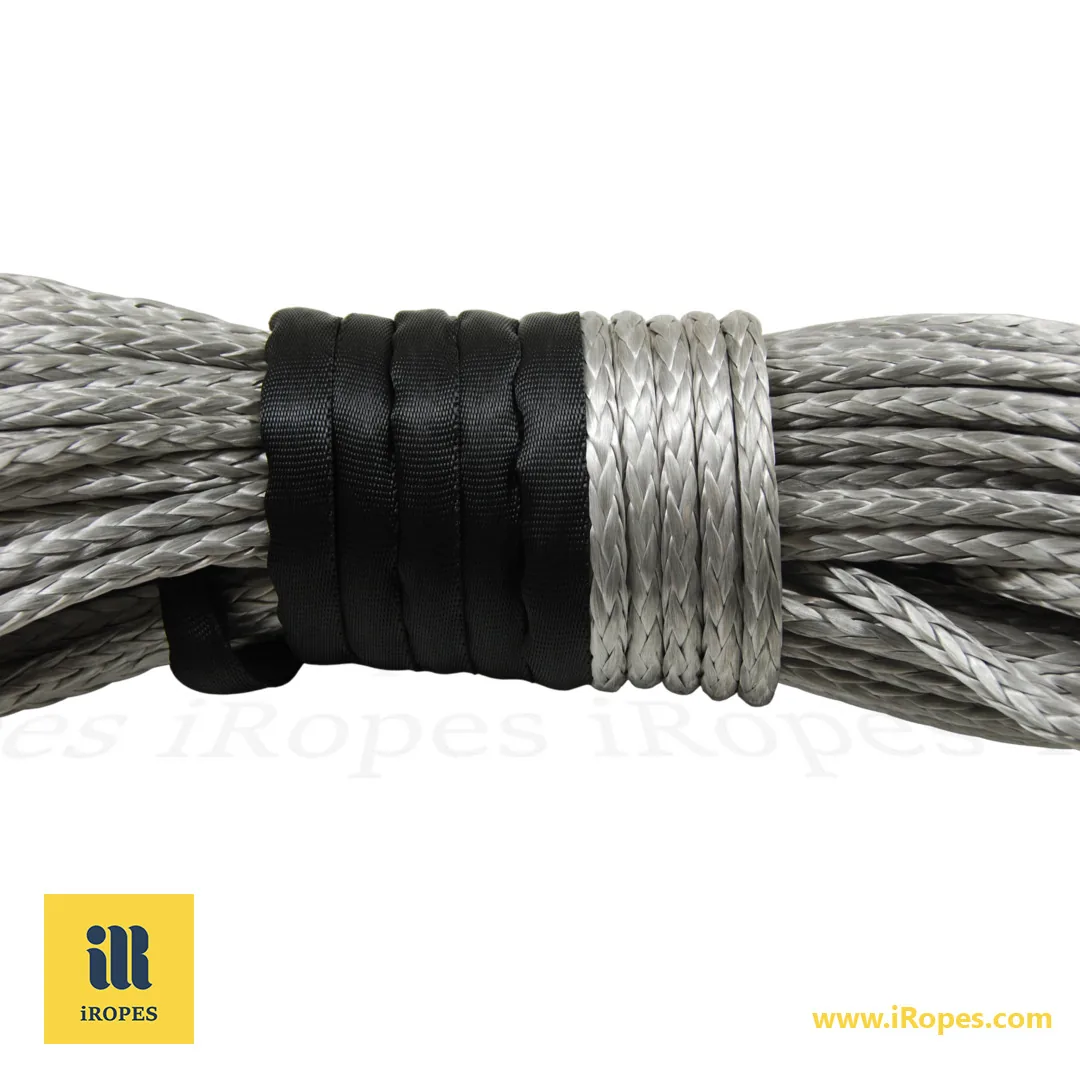
Counterintuitive truth: In marine loads, a nimble 16mm wire rope sling often outlifts bulkier 25mm (8.5-ton vertical WLL) and 32mm (13-ton vertical) options—delivering up to 3.5 tonnes safely while slashing handling drag by 60% in choppy waters. iRopes' custom designs make this flexibility your edge.
In 7 minutes, master why slimmer slings dominate marine lifting →
- ✓ Decode exact capacities like 16mm's 2.8-tonne choker limit vs. wider slings' stiffness pitfalls, preventing up to 20% strength loss from wet corrosion.
- ✓ Calculate SWL step-by-step for any hitch or angle, boosting your rigging accuracy by 40% in yachting or defence ops.
- ✓ Uncover handling advantages—lighter 16mm reduces wave-induced shock loads, improving safety for common 3-tonne marine tasks.
- ✓ Explore iRopes' OEM tweaks like IWRC cores, tailoring 16mm slings to your brand while ensuring ISO 9001 compliance.
You've always assumed bigger diameters mean bigger lifts, right? Yet in saltwater swells, rigid 25mm and 32mm slings can amplify shock loads by 30%, transforming reliable gear into a liability. Meanwhile, a 16mm sling strikes the perfect balance of strength and flexibility. What hidden factors flip this script for yachting hauls or spearfishing retrievals? Dive in to reveal the calculations and custom secrets that equip you for safer, smarter marine rigging with iRopes expertise.
The Role of Wire Rope Slings in Marine Lifting Safety
Imagine you're out on the water, securing a yacht's tender or retrieving heavy gear during a spearfishing expedition—the last thing you need is unreliable lifting equipment. Wire rope slings form the backbone of these operations. They are built from multiple strands of metal wires twisted around a core, creating a flexible yet robust tool. This construction, often featuring six outer strands wrapping an inner core like a coiled spring, provides the tensile strength essential for handling loads in harsh sea conditions. At iRopes, we've seen firsthand how these slings adapt to the unpredictable nature of marine work, from mooring lines in yachting to cargo handling in defence scenarios.
In yachting, slings hoist sails or anchor points with precision. In spearfishing, they pull in weighted traps without snapping under sudden pulls. Defence operations rely on them for rapid deployments, where every second counts amid rough waves. These applications demand slings that resist the constant battering of saltwater and motion. The core, for instance, acts as the sling's spine, being either fibre for added bend or independent wire for extra toughness against abrasion.

Why does grasping sling capacity matter so much here? Marine environments present dynamic challenges: waves create shock loads that spike tension suddenly, and corrosion from saltwater erodes metal over time. Misjudging how much a sling can safely handle—say, overlooking how wet conditions weaken the material—can lead to catastrophic failures, such as a snapped line during a defence manoeuvre. Understanding capacity isn't just technical; it's about preventing those heart-pounding accidents that could endanger lives or damage equipment. For instance, a sling rated for dry land might see its effective strength drop by up to 20% when soaked, forcing operators to factor in these variables for every lift.
That's where iRopes steps in. Our ISO 9001-certified facilities ensure every sling meets rigorous standards. We offer OEM and ODM services tailored for marine needs, customising everything from corrosion-resistant coatings to specific lengths for spearfishing retrievals. For those innovating unique designs, our IP protection safeguards your ideas from concept to shipment. We partner with wholesale clients worldwide, delivering pallets directly to docks, so you get reliable gear without the hassle.
- Yachting applications - Secure mooring and tender lifts, where flexibility prevents kinks in tight spaces.
- Spearfishing operations - Retrieve heavy gear from depths, balancing strength with lightweight handling to avoid fatigue.
- Defence scenarios - Rapid cargo slinging in choppy waters, emphasising quick-release fittings for efficiency.
Building this foundation helps us decode the real-world factors at play, such as how different setups influence safe limits in these demanding settings.
Key Terminology and Concepts Influencing Sling Capacity
Building on how wire rope slings tackle marine challenges, it's now time to unpack the terms that truly shape how much load they can handle safely. Think of this as the decoder ring for rigging decisions—getting these right means avoiding overloads when waves are tossing your setup around. Let's start with the basics that every operator needs to know.
The Working Load Limit (WLL) represents the maximum weight a sling can lift under normal conditions without risking failure—it's your go-to number for planning a lift. Often used interchangeably with Safe Working Load (SWL), though technically SWL factors in environmental tweaks like those saltwater dips we mentioned earlier. Then there's the Minimum Breaking Force (MBF), which is the brute strength point where the sling would snap if pushed that far—imagine it as the red line you never cross. Tying it all together is the design factor, typically set at 5:1 under ASME B30.9 standards. What does that mean exactly? It ensures the MBF is five times the WLL, building in a buffer against surprises like sudden jerks from choppy seas. For wire rope slings, this 5:1 ratio is non-negotiable, giving you peace of mind during a yacht tender hoist or defence cargo swing.

Now, consider how you rig the sling—that's where hitch types come in. A vertical hitch is straightforward, like dangling a load straight down for full WLL. But switch to a choker hitch, where the sling loops around the load and tightens, and capacity drops to about 80% because of the pinch point. Basket hitches cradle the load in a U-shape, potentially doubling capacity if the setup is even, though marine swells can complicate that balance. Angles play a huge role too; as the sling legs spread from 90 degrees vertical towards 60, 45, or even 30 degrees from horizontal, the load on each leg ramps up—at 30 degrees, it's roughly double what a straight vertical would demand. Have you ever watched a team adjust for a tilted deck? That's angle factors in action, multiplying tension just when precision matters most.
Don't overlook the D/d ratio either—what is it, you ask? It's the simple division of the load's diameter (D) by the sling's diameter (d), ensuring the bend isn't too sharp and weakening the rope. A low ratio, say below 1:1, can slash capacity by causing kinks, especially in basket setups over curved marine gear. Larger ratios, like 25:1 for braided slings, keep things smooth. Sling diameter ties directly into this: thicker ropes pack more strength but get stiffer, which might not flex well around odd-shaped loads in spearfishing hauls. Material thickness bolsters that—thicker wires resist saltwater pitting better. Construction matters too; an Independent Wire Rope Core (IWRC) adds about 7-10% more strength over a Fiber Core (FC) and holds up longer against corrosion, ideal for prolonged ocean exposure without losing integrity.
Hitch Types
Core Configurations
Vertical
Full WLL for direct pulls, simplest for stable marine anchors.
Choker
80% WLL with tightening, useful for gripping irregular defence loads.
Basket
Up to 2x WLL for cradling, but watch D/d on yacht gear.
Core Options
Durability Boosts
Fibre Core
Flexible for bending, suits lighter spearfishing tasks.
IWRC
Stronger against crush, enhances saltwater longevity.
D/d Ratio
Prevents damage; aim high for safe marine curves.
Grasping these elements allows you to tweak setups for real marine demands, such as factoring in a choker angle during a retrieval. SWL boils down to starting with vertical WLL and multiplying by your hitch and angle reductions. That precision opens the door to seeing how specific diameters shine in practice.
16mm Sling Capacity: Why It Outperforms in Marine Loads
That precision in terminology and setup really highlights how the right sling diameter can make all the difference in tough marine conditions. Now, let's zero in on the 16mm sling, where its balanced design often gives it an edge over bulkier options. You might wonder, how much load can a 16mm wire rope sling hold? In a straightforward vertical hitch, it typically handles up to 3.5 tonnes safely, based on the WLL with a 5:1 design factor. However, that number shifts depending on the hitch and angle—choker setups drop it to about 80% of vertical, or roughly 2.8 tonnes, while a basket hitch can double up to 7 tonnes if the load sits evenly. In marine scenarios, where angles often tilt due to waves, you adjust further: at 60 degrees, the effective capacity per leg might halve, so always double-check rigging angles in marine lifts to stay under the limit.
To make this quick reference even handier, here's a breakdown of typical 16mm sling capacities, drawn from standard wire rope specs for marine-grade materials. These assume an IWRC construction for better crush resistance in wet environments.
Hitch Types
Vertical: 3.5 tonnes full WLL for direct marine pulls.
Choker
2.8 tonnes (80% of vertical), ideal for gripping slick yacht gear.
Basket
7 tonnes (2x vertical), but verify even load in basket for defence hauls.
Angle Adjustments
At 45° in two-leg: ~2.5 tonnes per leg, factoring wave-induced tilts.
What sets the 16mm diameter apart in marine work is its sweet spot for performance. At just over half an inch thick, it's light enough to cut through water with minimal drag—imagine hauling a spearfishing net without the sling pulling you off balance amid currents. That reduced weight, around 1.5 kg per metre, eases handling on a rocking yacht deck, unlike heavier ropes that bog down operators during defence ops. Yet it packs enough punch for everyday loads like lifting 2-tonne anchors or 3-tonne tenders, avoiding the excess bulk that could snag on gear or complicate storage in tight cabins.

To see this in numbers, consider calculating the safe working load for a 16mm sling in a 45-degree choker hitch pulling up a 2-tonne spearfishing trap. Start with the vertical WLL of 3.5 tonnes. Apply the choker reduction: 80% gives 2.8 tonnes. Then factor the angle—for a two-leg setup at 45 degrees from horizontal, the load per leg multiplies by about 1.4, so divide the total allowable by that: 2.8 tonnes divided by 1.4 equals roughly 2 tonnes safe per leg. If using an IWRC core, it holds up better against the trap's sudden jerks, but always inspect for saltwater wear first. This method ensures you're not guessing in real conditions.
- Identify vertical WLL: 3.5 tonnes for 16mm.
- Adjust for choker: Multiply by 0.8 to get 2.8 tonnes.
- Account for 45° angle: Divide by load factor of 1.4 for ~2 tonnes safe load.
At iRopes, we take this further with custom tweaks to boost that 16mm sling capacity just right for your setup. Add reflective strips for low-light yacht manoeuvres, or swap in a specialised core that resists marine abrasion, all while keeping the diameter's natural flexibility. These options allow you to tailor for spearfishing depths or defence precision without compromising on handling.
Of course, while 16mm excels in many marine tasks, wider slings like 25mm bring their own strengths for heavier duties—but their added stiffness can sometimes work against you in choppy waters.
25mm Sling Capacity and 32mm Sling Capacity: Limitations in Marine Applications
That added stiffness in wider slings like 25mm and 32mm can indeed turn into a real drawback when you're dealing with the unpredictable sway of ocean waves or the need for quick adjustments on a heaving deck. While these larger diameters pack more raw power for heavy industrial lifts, their performance in marine settings often falls short compared to the nimble 16mm option we just explored. Let's break down the specifics of 25mm sling capacity and 32mm sling capacity, focusing on how they behave—or sometimes struggle—in wet, dynamic environments like yachting moorings or defence cargo shifts.
First off, what is the capacity of a 25mm wire rope sling? In a basic vertical hitch, it typically reaches a WLL of around 8.5 tonnes, assuming standard IWRC construction and the 5:1 design factor. But things change fast in marine use: a choker hitch cuts that to about 6.8 tonnes due to the tightening pinch, and basket setups could push to 17 tonnes if balanced perfectly. Angles complicate it further—at 60 degrees in a two-leg bridle common for angled yacht lifts, the per-leg capacity drops to roughly 6 tonnes. For 32mm sling capacity, the numbers scale up: vertical WLL hits about 13 tonnes, choker at 10.4 tonnes, and basket up to 26 tonnes. Yet, at 45 degrees amid wave motion, you're looking at just 9.2 tonnes per leg. These figures come straight from ASME B30.9 guidelines, adjusted for saltwater realities where even slight corrosion nibbles at edges.
25mm Sling Quick Reference
Vertical: 8.5 tonnes; Choker: 6.8 tonnes (80%); Basket: 17 tonnes; 60° Angle (per leg): 6 tonnes. Ideal for mid-range marine hauls but watch for stiffness in turns.
32mm Sling Quick Reference
Vertical: 13 tonnes; Choker: 10.4 tonnes (80%); Basket: 26 tonnes; 45° Angle (per leg): 9.2 tonnes. Suited for heavy defence loads, yet bulk hinders agility on water.
So why don't these wider slings always outlift the 16mm in marine scenarios? The extra thickness—25mm is over an inch across, 32mm even more—brings rigidity that transfers shock loads from waves directly into the rigging, potentially spiking tension beyond safe limits during sudden rolls. Heavier at 3-5 kg per metre, they drag in currents, impacting marine sling capacity through added weight, interfering with buoyancy on submerged spearfishing gear or making yacht manoeuvres feel like wrestling a beast. I've seen teams on coastal ops swap out a stiff 25mm for something slimmer just to regain control when swells pick up; it's that difference in feel that keeps things steady.
Safety factors amplify these issues too. The standard 5:1 buffer holds, but thicker materials corrode unevenly in saltwater, with outer strands pitting faster and reducing overall integrity over time—up to 15% strength loss after prolonged exposure without coatings. Material thickness helps resist crush but invites more surface area for rust if not galvanised correctly. To calculate the capacity of a sling like this, start with the vertical WLL, multiply by hitch efficiency (say 0.8 for choker), then divide by the angle factor (1.7 for 30 degrees). For a 25mm in a 60-degree choker on a defence crate: 8.5 tonnes x 0.8 = 6.8 tonnes, divided by 2 for the angle gives 3.4 tonnes safe per leg. Simple, but always verify with inspections to catch early wear.

That said, reach for 25mm or 32mm when facing loads over 10 tonnes, such as massive anchors in industrial yachting, where their brute strength excels despite the trade-offs. But for most flexible marine lifting—adapting off-road recovery techniques to boat decks or tree work-inspired rigging in coastal ops—iRopes' custom 16mm solutions deliver cost savings and ease without compromising on safety. Our tweaks, like enhanced coatings, keep things reliable while cutting bulk.
These contrasts really underscore the smart choices needed for marine work, pointing towards guidelines that tie it all together for safer, smoother operations.
Discovering that a 16mm sling capacity of up to 3.5 tonnes in vertical hitches often surpasses the bulkier 25mm sling capacity around 8.5 tonnes and 32mm sling capacity nearing 13 tonnes in marine loads reveals the power of balance. Thinner diameters like 16mm offer superior flexibility and reduced drag in dynamic saltwater conditions, minimising shock loads and enhancing handling for yachting, spearfishing, and defence tasks—while thicker options risk stiffness and corrosion despite higher raw strength. Material thickness bolsters durability, but safety factors under ASME B30.9 standards demand precise calculations for hitches and angles to prevent failures. iRopes' custom solutions optimise these factors for your needs, ensuring reliable performance without excess weight.
Building on these insights, imagine tailoring adjustable slings that perfectly fit your marine operations, incorporating IWRC cores or reflective elements for added safety. For personalised guidance on capacities and customisations, our experts at iRopes can help elevate your lifting efficiency.
Customise Your Ideal Marine Wire Rope Sling Today
If you need expert advice on selecting or customising slings for your specific marine applications, complete the inquiry form above to get in touch with iRopes—we're here to provide tailored solutions that match your wholesale requirements.