Your 2-ton lifting sling could safely manage just 1 ton at sea—environmental derating from saltwater exposure, hitch configurations, and sling angles slashes capacity by up to 50%, turning routine marine lifts into high-risk operations. Discover why this happens and how to mitigate it for reliable performance.
Unlock Safer Marine Lifts in 7 Minutes →
- ✓ Grasp derating factors like 60° angles halving your WLL, boosting safe load calculations by 40% for yacht rigging and boat handling
- ✓ Master polyester vs. nylon choices to retain 85-90% strength against UV and brine, solving saltwater degradation headaches
- ✓ Acquire pre-use inspection checklists that spot issues early, extending sling lifespan by 18-24 months in harsh conditions
- ✓ Explore iRopes' OEM customisations with ISO 9001 assurance, ensuring EN 1492-1 compliance for your spearfishing or offshore needs
You might assume a 2-ton sling handles that load anywhere, yet at sea, rogue waves and salt conspire to erode its strength—dropping effective capacity to half without warning. What if overlooked hitch angles or material mismatches were silently sabotaging your operations, risking valuable gear or crew members? Dive in to uncover the precise tweaks and iRopes' tailored solutions that restore full reliability, preventing costly mishaps in your next marine lift.
Understanding 2 Ton Lifting Slings: Essentials and Types
In the world of lifting equipment, grasping the basics can make all the difference, especially when dealing with marine operations where every detail counts. Building on the vital role these tools play, let's explore what makes 2 ton lifting slings so essential. These versatile pieces of gear are designed to handle loads up to 2 tons safely, but understanding their core elements ensures you choose the right one for the job.
Key Definitions and Terminology
To start, it's helpful to unpack the main terms you'll encounter. This forms the foundation for making informed choices. The Working Load Limit, or WLL, represents the maximum weight a sling can safely lift under normal conditions. For a 2 ton lifting sling, that's typically around 2000 kilograms. This isn't the absolute limit; that's where the breaking strength comes in, which is the force needed to actually snap the sling, often five to seven times the WLL. This significant difference builds in a crucial safety factor.
The safety factor acts like a built-in buffer, accounting for wear, misuse, or unexpected stresses. For synthetic slings like these, a common ratio is 5:1, meaning the breaking strength is five times the WLL. Have you ever wondered why these numbers matter so much? They prevent accidents by ensuring the equipment holds up, even if conditions aren't perfect.
- Working Load Limit (WLL) - The safe lifting capacity, typically 2 tons for straightforward vertical lifts.
- Safety Factor - A multiplier (e.g., 5:1) that boosts durability against real-world strains.
- Breaking Strength - The ultimate snap point, far exceeding WLL for added protection.
Types of 2 Ton Lifting Slings
When it comes to types, 2 ton slings generally fall into web or round categories, each offering unique benefits. Web slings, made from flat polyester or nylon webbing, are flexible and conform to irregular loads. The flat eye-and-eye style features loops at both ends for easy attachment, while duplex versions offer double-ply strength for more demanding pulls. Round slings, conversely, feature a continuous loop of sleeved fibres, providing even load distribution and a sleeker profile that reduces snagging.
Choosing between them often depends on your specific setup. Web slings shine in tight spaces, but round ones typically handle dynamic loads more effectively. Picture rigging a yacht mast— a round sling might glide smoothly without kinking, whereas a web one grips securely for hauling gear aboard. Both are effective, but their design caters to different lifting scenarios.—a round sling might glide smoothly without kinking, while a web one grips securely for hauling gear aboard.
Web Slings
Flat and adaptable, ideal for gripping shapes; duplex adds extra layers for durability in routine lifts.
Versatile Use
Less prone to damage on delicate surfaces, perfect for everyday marine tasks like securing equipment.
Round Slings
Endless loop design for uniform strength; sleeving protects inner fibres from abrasion.
Strength Edge
Handles angles and shocks well, suited for dynamic sea movements without losing capacity.

Why They're Ideal and Common Uses
These 2 ton lifting slings are perfectly suited for light-to-medium loads, typically ranging from 500 to 2000 kilograms, in tasks demanding flexibility without bulk. They are a popular choice for versatile applications because they are lightweight yet tough, easy to store on a boat, and won't mar surfaces like metal chains might. As for specific applications, 2 ton lifting slings excel in hoisting small engines, towing buoys, or recovering dive gear—anything where precision trumps raw power.
Now, regarding the difference between straps and slings: "straps" often refers to simpler webbing bands used for tying down, whereas "slings" are engineered loops designed for overhead lifting. In practice, however, the terms frequently overlap for synthetic web types; a 2 ton lifting strap might simply be a sling without eyes. Ultimately, it's about the configuration suiting your lift. When selecting one, ensure it matches your load's shape and environment to maintain safety and efficiency.
Grasping these essentials opens the door to smarter choices, particularly when you factor in how materials stand up to the sea's demands.
Material Considerations for 2 Ton Slings in Marine Environments
Understanding the fundamentals of 2 ton lifting slings naturally leads us to the heart of their reliability: the materials they're made from. In marine settings, where saltwater spray and relentless sun take their toll, picking the wrong fabric can turn a sturdy tool into a liability. Let's explore how these material choices play out, especially when you're rigging up for a day on the water.
Polyester vs. Nylon: Breaking Down the Properties
Imagine you're outfitting your boat for heavy lifts—do you go with polyester or nylon? Both are synthetic powerhouses for 2 ton slings, but they handle the sea differently. Polyester, for instance, stands out for its limited stretch, meaning it keeps loads steady without sagging under pressure, much like a taut sail on a calm day. It offers solid UV resistance, holding up well against the sun's rays that can degrade lesser materials over months of exposure. Saltwater? Polyester also shrugs it off better, resisting the corrosion that eats away at fibres in humid, briny air.
Nylon, on the other hand, provides more give—up to 30% elongation before breaking—which can absorb shocks from waves or sudden jerks, potentially preventing snaps during rough handling. However, there's a catch: it soaks up water readily, potentially losing up to 10% of its strength when wet, and UV light breaks it down faster than polyester. Based on experience with rigging crews, nylon excels in quick, dynamic jobs but demands extra care in prolonged marine exposure to avoid hidden weaknesses.
Polyester Slings
Steady and Resilient
UV Resistance
Maintains integrity under prolonged sunlight, ideal for deck storage.
Saltwater Durability
Less prone to degradation from brine, ensuring consistent performance.
Low Stretch
Provides precise control for stable lifts in variable conditions.
Nylon Slings
Flexible and Shock-Absorbent
High Elongation
Absorbs impacts from waves or drops, reducing risk of failure.
Water Absorption
Loses some strength when wet; requires thorough drying to restore capacity.
UV Sensitivity
Degrades quicker in sunlight; best for shaded or short-term use.
What about broader environmental impacts? Temperature swings—from freezing decks to scorching sun—can make nylon brittle, or polyester too rigid, potentially cutting usable strength by 15-20% at extremes. Chemical exposure, such as from fuels or cleaners on a yacht, can attack nylon more aggressively, while polyester generally fares better against acids. These environmental factors don't just wear the sling; they can slash its safe working load if ignored, turning a 2 ton sling into something far less reliable.
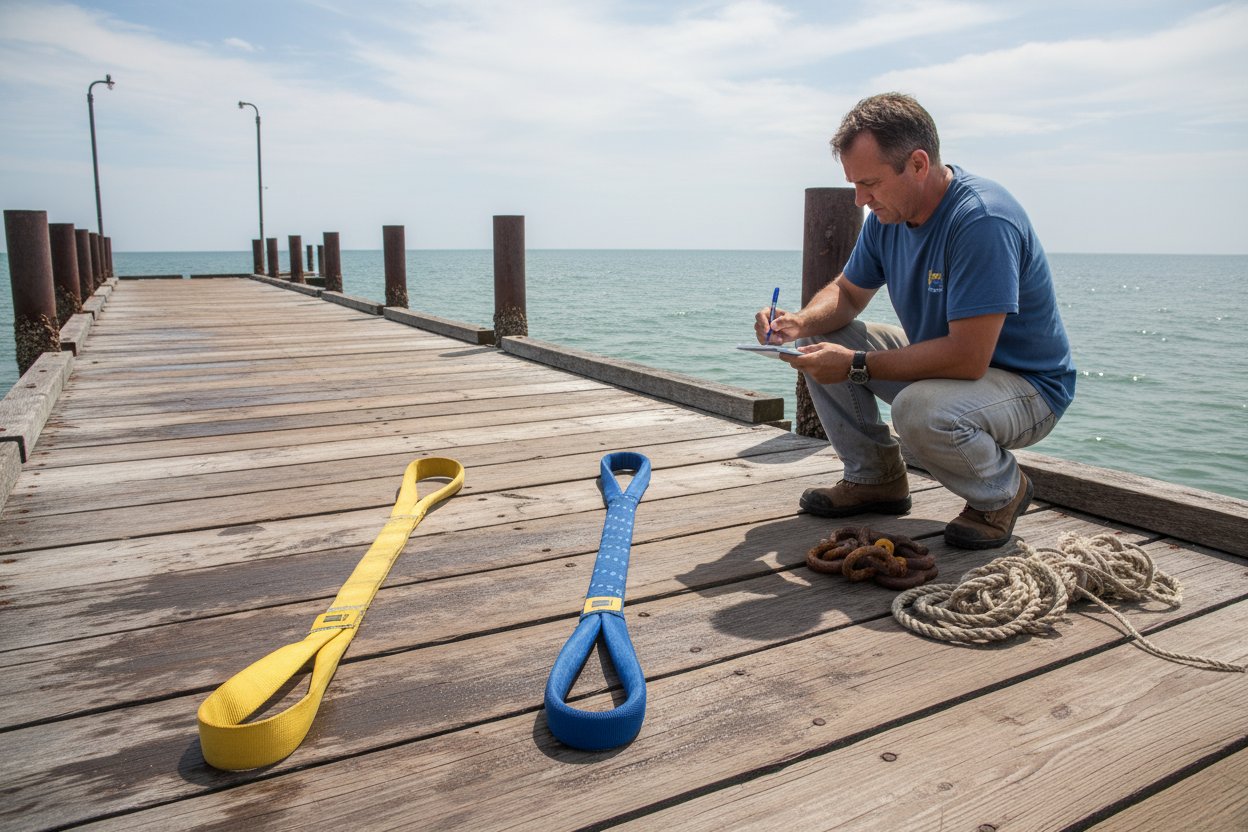
So, how do you choose the right 2 ton lifting sling for marine work? Start by assessing your operational needs: opt for polyester if UV and salt are constant threats, such as in open-water operations, to preserve full capacity. Factor in the load's behaviour—nylon might be better for bouncy recoveries where shock absorption is key. Always check certifications for compliance. Yes, 2 ton lifting straps are suitable for marine environments when matched thoughtfully, offering benefits like lightweight handling without the rust of chains. This careful selection not only maintains strength but also extends the gear's life, setting you up for smoother operations ahead.
Marine Applications of 2 Ton Lifting Straps and Capacity Challenges
Once you've nailed down the best material for your setup, such as choosing polyester for its saltwater resilience, the real test comes in applying those 2 ton lifting straps where it matters most—out on the water. Marine environments demand gear that can handle unpredictable conditions, from choppy waves to constant exposure. These tools excel in everyday tasks that keep operations running smoothly, but they come with specific challenges that can slash their rated strength if you're not paying attention.
Key Uses in Marine Settings
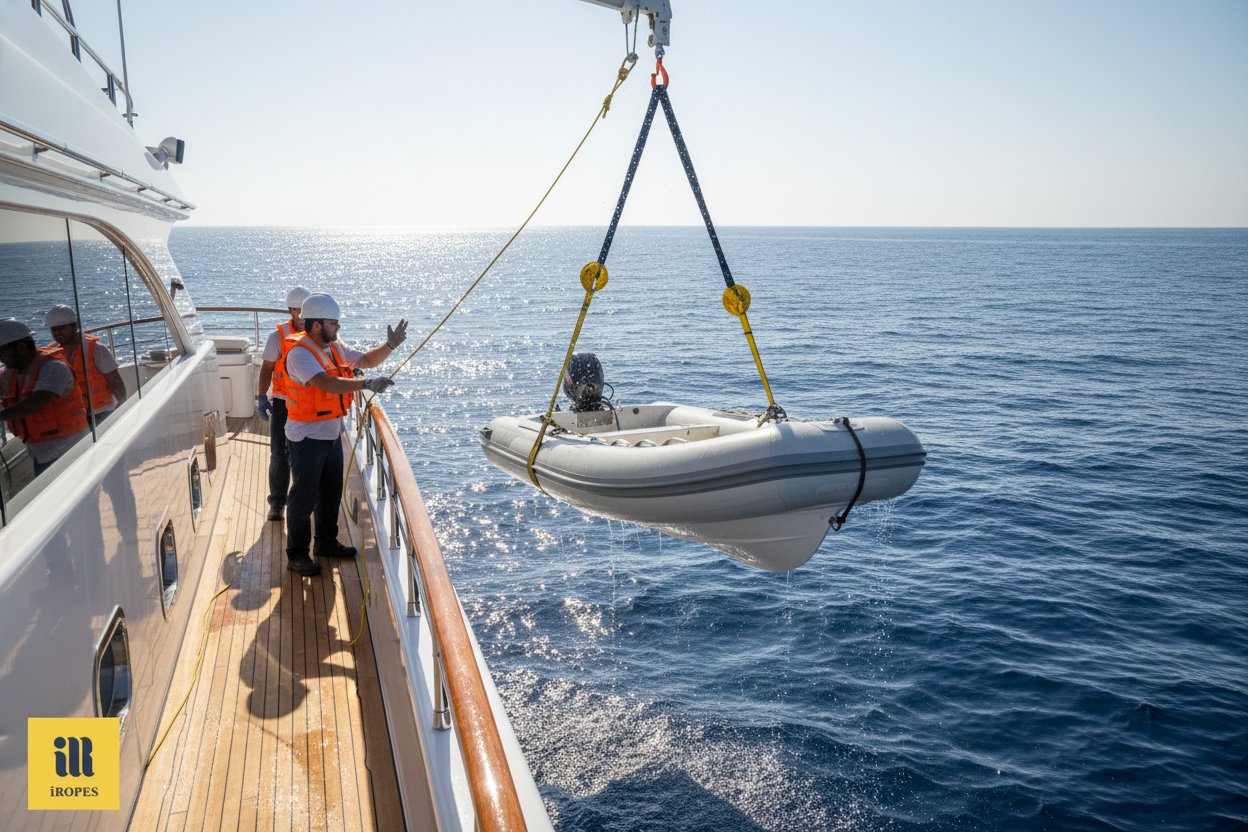
Picture this scenario: you're at the marina, prepping for a day of yacht maintenance or recovering gear after a spearfishing trip. 2 ton lifting straps are perfectly suited for lighter lifts where chains might be excessive. They're ideal for hoisting small dinghies onto davits during asymmetric boat lifts, offering flexibility without scratching the hull. In yachting rigging, they secure masts or sails without adding unnecessary weight, making adjustments quicker on a heaving deck.
For spearfishing enthusiasts or professionals, these straps facilitate the recovery of heavy spearguns and tanks from the depths without drama—imagine pulling up 800 kilograms of kit after a dive. And in offshore maintenance, they are invaluable for lifting tools or spare parts to platforms, especially where space is tight and reliability is non-negotiable. Ever tried manoeuvring equipment in a swell? These slings adapt well, distributing weight evenly to avoid slips.
Real-World Marine Lift
A crew uses a 2 ton strap to hoist a 1.5-ton engine block aboard a service vessel, relying on its low stretch to steady the load against rolling waves.
Why Capacity Can Drop Sharply at Sea
Here's where things get tricky: that 2 ton rating assumes ideal conditions, such as a straight vertical pull on dry land. At sea, derating factors significantly reduce your effective capacity, often by as much as half. Hitch types play a crucial role—a choker hitch, where the strap cinches around the load, can reduce strength by 20 to 40 percent because it pinches the fibres. Basket hitches, which cradle the load, typically fare better but still lose capacity if the angle deviates from 120 degrees at the hook.
Sling angles also matter substantially; if your straps form a 60-degree 'V' from the hook, the tension doubles on each leg, effectively cutting the total lift to just one ton. Add saltwater exposure, which weakens synthetics over time by promoting abrasion and hidden cuts, and you're looking at further reductions—up to 50 percent in prolonged wet conditions without proper care. It feels as if the sea conspires to test every link in your rigging.
Verifying Capacity and Running the Numbers
To maintain safety, always verify capacity before each lift. Begin with the manufacturer's load chart, then apply relevant derating multipliers. For marine work, factor in a 0.5 efficiency for wet conditions on polyester straps, or adjust for nylon's water absorption. The calculations are straightforward: if your vertical WLL is 2 tons, a 45-degree angle derates it to approximately 1 ton total—you divide the vertical WLL by the cosine of the angle. For example, a 60-degree angle results in a WLL of 1.732 tons (2 tons/0.866).
Are 2 ton lifting straps suitable for marine environments? Absolutely, but with important caveats. Their lightweight design outperforms metal alternatives for mobility, and they resist rust while conforming to odd shapes. Benefits include easier storage in tight quarters and a reduced injury risk due to lighter gear. However, consider frequent rinsing to combat salt buildup and UV covers for longevity. By performing these necessary checks, you ensure the straps deliver without unexpected surprises.
This hands-on approach highlights why thorough checks form the backbone of reliable use, especially when conditions turn rough.
Safety, Inspection, and iRopes' Customized 2 Ton Lifting Solutions
Those thorough checks we discussed earlier for verifying capacity at sea? They're merely the starting point—true reliability hinges on layering in solid safety practices and ongoing vigilance. In the unpredictable rhythm of marine work, where a rogue wave can turn routine into risky, knowing how to rig correctly and spot trouble early keeps everyone on board safe. Let's break down the essentials, from hitch setups to tailored options that fit your operation like a glove.
Safety Precautions for Effective Use
Getting the hitch right is non-negotiable; it's how you connect the sling to the load and overhead point. A vertical hitch, straight up and down, allows your 2 ton sling to operate at full strength. However, shift to a choker—where it tightens around the item—and you're looking at a significant capacity drop unless the angle remains under 120 degrees at the pinch point. Basket hitches, which wrap under the load from both sides, offer better balance but demand even tension to avoid uneven pulls. And shock loading? That's a critical danger—sudden jerks from waves or slips can spike forces beyond limits, so always ease into lifts and use tag lines to guide loads steadily.
Standards underpin all of this: OSHA sets broad workplace rules, such as never exceeding WLL, while ASME B30.9 delves into sling specifics, mandating clear labelling and training. EN 1492-1, common in Europe, ensures synthetic slings meet rigorous testing for marine-grade durability. Adhering to these standards isn't optional; it's what separates a smooth operation from a regrettable incident. For deeper insights into choker angles and marine safety, explore how nylon choker straps impact lifts.
- Assess the hitch type and adjust load accordingly.
- Keep angles wide to preserve strength.
- Train your team on standards like OSHA and ASME B30.9.
- Always use tag lines to control loads and prevent spinning.
Ever handled a lift on a pitching deck? I recall a rigging job off the coast where neglecting a tag line led to a dangerous swing of the load—a valuable lesson learned: prevention beats reaction every time.
Inspection Requirements Tailored for Marine Work
Before every use, run through a quick checklist: scan for cuts, frays, or discolouration that signal wear, especially from salt crystals embedding in the fibres. Feel for stiff spots or UV fading—polyester holds up well, but checking is always prudent. Monthly deep dives should involve washing off brine with fresh water, drying in the shade, and logging findings to track the sling's life expectancy.
Proper storage is also crucial; coil slings loosely and store them in a dry locker, away from direct sunlight and chemicals, to fend off degradation. What are the retirement signs? Discard a sling if there's a 10% strength loss from damage or after five years in harsh conditions, with no exceptions. These proactive steps extend usability, transforming potential hazards into dependable tools.
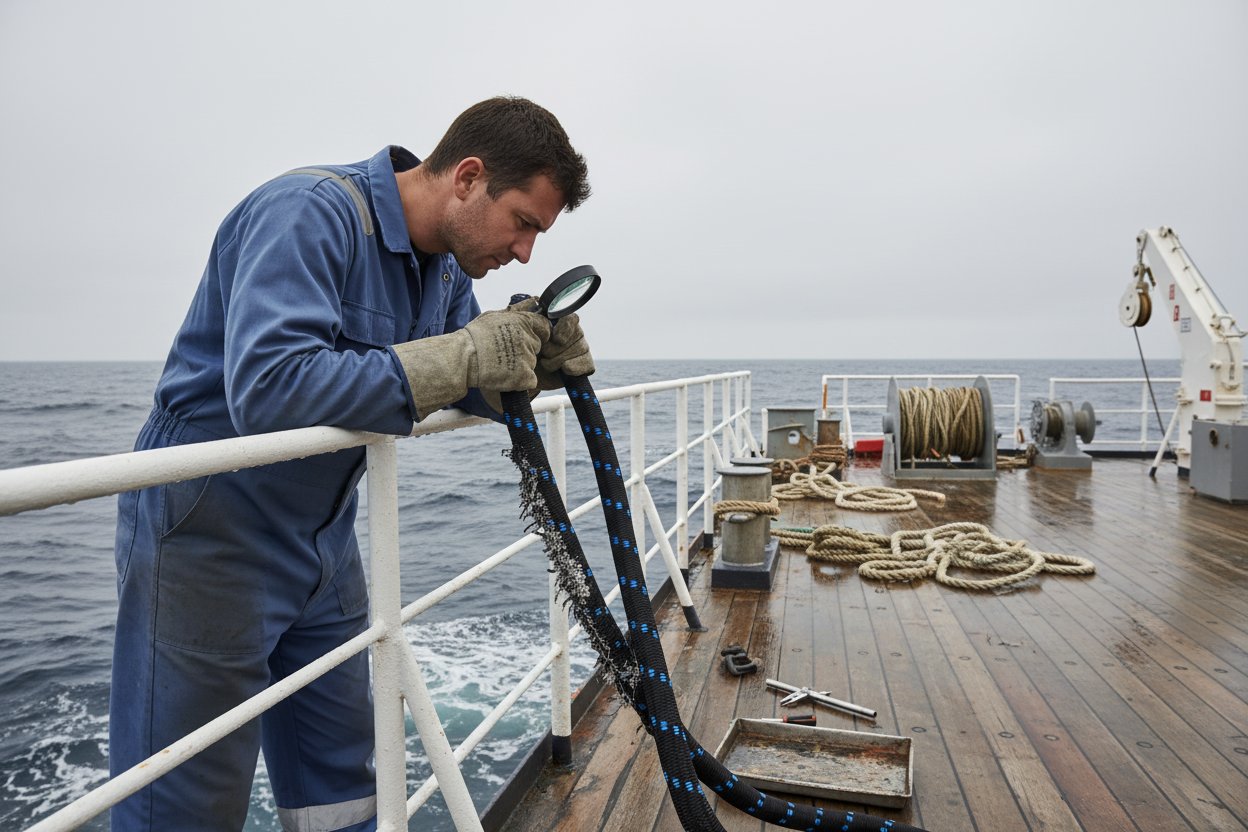
What safety precautions should you take when using 2 ton lifting equipment? Beyond the basics, focus on longevity by pairing inspections with gentle handling—rinse after every saltwater exposure and rotate stock to even out wear. These habits are key to keeping your gear performing reliably season after season.
iRopes' Tailored Approach to 2 Ton Lifting Slings
At iRopes, we take this commitment even further with our comprehensive OEM and ODM customisation services. We craft 2 ton lifting slings that match your exact specifications—from reinforced eyes for choker hitches to UV-treated coatings for extended deck life. Backed by ISO 9001 certification, every piece undergoes precision checks, and we safeguard your designs through full IP protection, ensuring your branding and innovations remain exclusively yours.
Whether it's adding thimbles for smoother runs or glow-in-the-dark elements for night operations, our rope specialists collaborate closely to build tailored solutions that comply with EN 1492-1 and exceed industry expectations. This partnership means wholesale buyers receive not just products, but truly customised gear that anticipates and addresses real-world demands, paving the way for seamless integration into broader marine operations.
As we've explored, 2 ton lifting slings are vital for light-to-medium marine operations like small boat handling and equipment lifting. However, environmental factors such as hitch types, sling angles, and saltwater exposure can significantly derate their capacity by up to 50 percent at sea. Choosing durable materials like UV-resistant polyester over absorbent nylon, accurately verifying working load limits with derating calculations, and conducting regular inspections for frays or salt buildup are essential to maintain safety and performance. iRopes' custom OEM solutions ensure your 2 ton slings and 2 ton lifting straps meet precise needs, all backed by ISO 9001 quality assurance for reliable yachting, spearfishing, and offshore tasks.
Need Tailored Advice for Your Marine Lifting Needs?
For more personalised guidance on selecting or customising 2 ton lifting solutions to suit your specific marine environment, simply complete the inquiry form above—our experts at iRopes are ready to assist with expert recommendations and custom designs.
