⚠️ Unequal load sharing overloads a single leg by up to 70% in 4-way rigging, turning salvage lifts into disasters. iRopes' custom bridle slings ensure even distribution, slashing failure risks by 80% through precise engineering.
Unlock Safer Lifts: Key Insights in ~8 Minutes →
- ✓ Master load angle factors to boost 4-way sling capacity by 73% at 60° versus 30°—calculate WLL accurately for any marine job.
- ✓ Compare nylon, wire rope, and chain options to cut abrasion damage by 50% in salvage, solving environmental hazards head-on.
- ✓ Apply equalising techniques like spreader bars for 100% load balance, gaining skills to prevent overloads in modular systems.
- ✓ Explore real case studies revealing custom iRopes solutions that reduced downtime by 60% in vessel recoveries.
You assume four legs in rigging spell unbreakable stability—yet in choppy salvage waters, a mere 5° misalignment funnels 70% of the load onto one strap, sparking snaps and chaos just like that Australian freighter fiasco. What if your next heavy lift hides the same silent saboteur? Dive in to uncover iRopes' tailored countermeasures—from angle-proof calculations to ISO-certified customs—that transform vulnerability into unshakeable control, before the waves claim another victory.
The Fundamentals of 4 Way Rigging and Its Hidden Dangers in Salvage
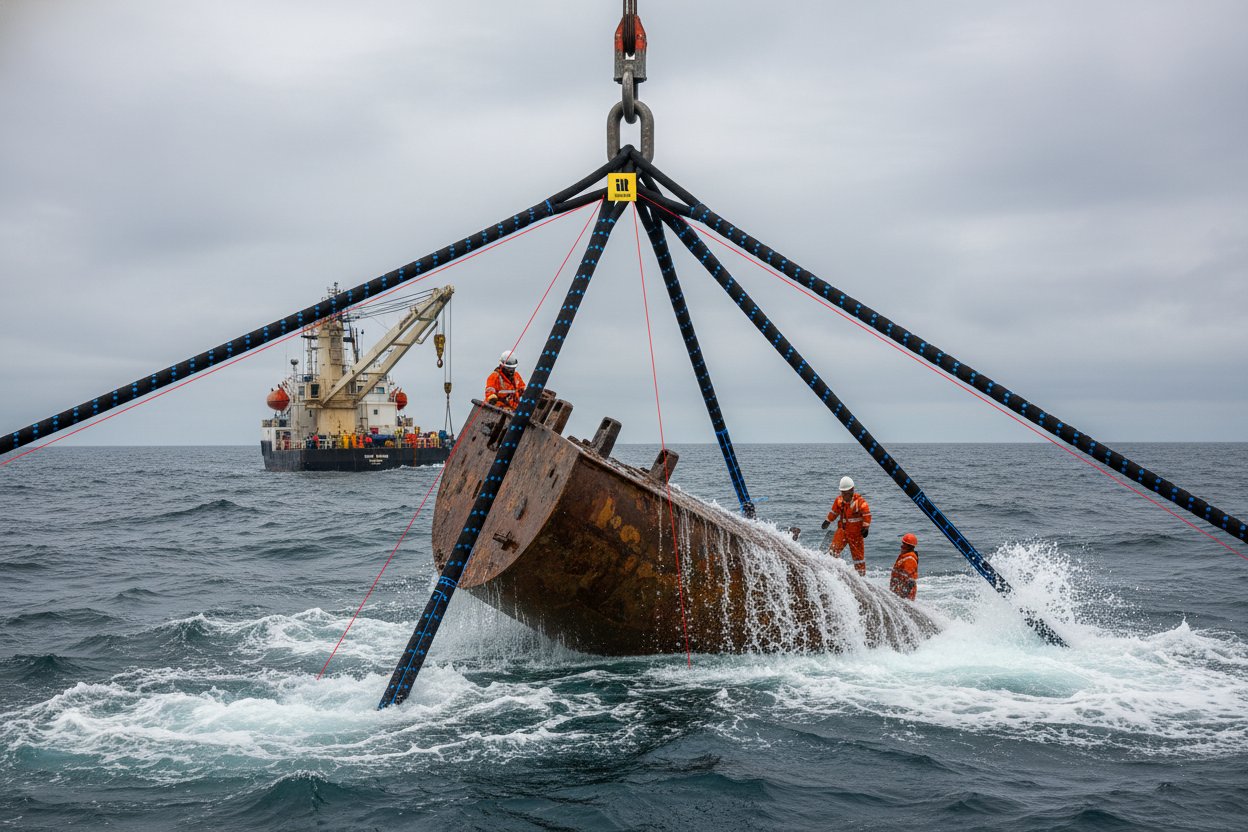
Imagine co-ordinating a tricky salvage operation on the open water, where every piece of equipment counts. This is precisely where 4 way rigging becomes indispensable. Essentially, it refers to multi-leg systems designed for stable heavy lifts, typically featuring four individual legs that attach to a central master link, then spread out to secure the load. These configurations excel in marine environments, providing essential stability for unbalanced loads like a tilted shipwreck or irregularly shaped cargo—stability you simply can't achieve with single or double-leg slings. Think of it as the four wheels of a sturdy lorry compared to a wobbly tricycle; the extra contact points keep things level and prevent tipping during critical moments.
However, a critical lurking threat keeps riggers up at night: the hidden load killer. Unequal load sharing manifests when angles vary or alignment suffers, causing one or two legs to shoulder a disproportionate amount of the weight. Suddenly, what should be a balanced lift transforms into a severe overload on a single leg, pushing it past its limits. I once observed this firsthand in a training simulation where a slight shift in the load's centre of gravity turned a routine hoist into a near catastrophe. Misalignment can stem from uneven attachment points or waves rocking the crane, but the outcome remains the same—premature wear or outright failure.
In salvage operations, these risks amplify rapidly. Shock loading occurs when a load drops suddenly, spiking tension far beyond normal operational parameters. Environmental factors exacerbate the situation too: saltwater corrosion deteriorates fittings, while strong currents can twist legs out of shape. So, what are the safety requirements for using 4-leg lifting straps? Start with thorough pre-use checks for frays, cuts, or deformation in the straps. Ensure all legs are rated for the total load, and always verify the setup allows for even distribution. Never exceed the working load limit (WLL), and protect against sharp edges with sleeves or padding. These steps aren't merely optional; they are paramount for distinguishing a successful recovery from a disaster.
- Visual Inspection – Look for visible damage like tears or rust before every use.
- Load Verification – Confirm the total weight doesn't overload any single leg, factoring in angles.
- Environmental Prep – Shield straps from abrasives and chemicals common in marine work.
To counteract these threats, adherence to OSHA and ASME standards is non-negotiable. These guidelines mandate proof-testing slings to at least 1.25 times their rated capacity and require documented inspections. A quick pre-lift once-over can catch issues early, such as a kinked leg that might otherwise lead to slippage. By prioritising compliance, you're not just following rules; you're building in layers of protection for your team and equipment. Furthermore, iRopes ensures every product meets stringent ISO 9001 quality standards, reinforcing safety and reliability in every lift.
Grasping these fundamentals reveals why selecting the precise materials becomes so vital. The right material directly tackles the inherent vulnerabilities exposed in tough marine applications, leading us to our next critical discussion.
Selecting 4 Way Bridle Slings for Balanced Marine Heavy Lift Applications
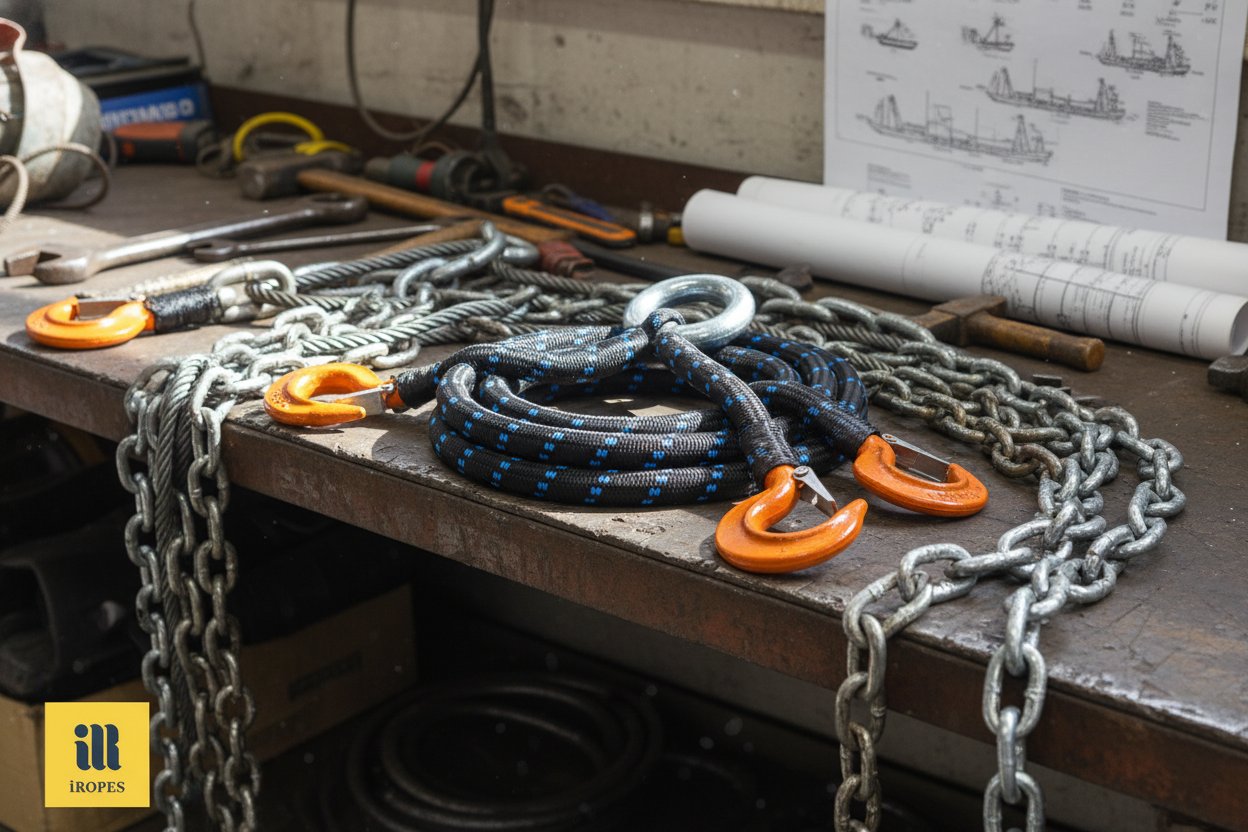
Building on those core risks we just unpacked, picking the right sling isn't just about raw strength; it's about matching the material to the chaos of marine work, where waves, wear, and environmental factors can turn a well-planned lift into a precarious gamble. In heavy lift scenarios, such as hoisting massive ship sections or securing offshore platforms, 4 way bridle slings prove invaluable by spreading the load across four legs for crucial balance. What truly sets them apart, however, starts with the material. Each material is specifically engineered to handle unique threats inherent in salty, abrasive, and often extreme marine environments.
Let's break down the main types. Nylon and polyester web slings bring unparalleled flexibility to the table, absorbing shocks from sudden jerks—like a crane swaying in rough seas—without damaging delicate surfaces on cargo. They are also remarkably lightweight, simplifying handling during setup on a pitching deck. Conversely, wire rope slings excel in gritty conditions, resisting cuts from jagged metal or the pervasive rust from constant saltwater exposure, making them ideal for tasks like dragging heavy gear across barnacle-covered hulls. Finally, chain slings are built tough for extreme heat, such as might occur in salvage fires or during welding operations, where synthetics would melt while chains hold firm without deforming.
Ever wondered what the different types of 4-way rigging slings really offer? These variations allow for the construction of sophisticated modular lift systems that can adapt on the fly. Nylon slings are perfect for quick, forgiving grabs in variable winds, wire rope is suited for enduring long hauls in construction, and chain provides unyielding stability for high-stakes recoveries. Custom configurations, such as adjustable leg lengths, transform a standard setup into a tailored fit, significantly boosting control over uneven loads without guesswork. This customisation is a core strength of iRopes, a leading rope manufacturer based in China.
Synthetic Slings
Nylon & Polyester
Shock Absorption
Handles sudden impacts from waves, reducing leg stress in dynamic lifts.
Lightweight Design
Easier handling for crew, cutting setup time on vessels.
Surface Friendly
Protects painted or fragile loads during marine transfers.
Metal Slings
Wire Rope & Chain
Abrasion Resistance
Stands up to sharp edges and sand in salvage drags.
Heat Tolerance
Endures high temperatures in welding or fire-damaged recoveries.
High Durability
Longer life in corrosive saltwater, minimising replacements.
Whatever material you lean toward, always focus on key specifications to precisely match your needs. Working load limit (WLL)—the maximum safe weight per leg—decreases with tighter angles. Therefore, for marine construction, aim for slings rated at least 5 tons per leg at a 60-degree angle. Diameters vary significantly: 1-inch polyester for lighter duties, up to 3/4-inch wire rope for heavier loads requiring brute force. Fittings are equally critical—oblong master links ensure smooth rotation under load, and self-locking hooks prevent slips in swells.
That's where iRopes comes in clutch with our comprehensive OEM and ODM services. We can customise materials for enhanced grip in wet conditions, add UV-resistant coatings, or incorporate reflective elements for improved visibility—all while ensuring meticulous load control and paramount safety. It’s akin to having a dedicated rigging professional in your corner, meticulously customising solutions to preempt those hidden overloads before they can strike. Furthermore, custom design solutions include personalised packaging and branding, protecting your intellectual property.
Armed with these material choices, nailing the precise mathematics behind even distribution keeps everything steady and secure. Let's delve into those critical calculations next, ensuring every lift is executed with maximum precision and safety.
Load Sharing Calculations and Equalising Techniques in 4 Way Lifting Straps
Now that you've got the right 4 way bridle slings in hand, the real challenge lies in ensuring the load shares evenly across all four legs. Otherwise, that hidden overload we discussed earlier can strike without warning. In marine heavy lifts, where every calculation counts, getting this right means diving deep into the numbers behind the working load limit (WLL) and understanding how angles critically influence it. The WLL is the maximum weight each individual leg can safely handle under normal conditions, while breaking strength refers to the point where the strap ultimately snaps—usually five times the WLL for a solid safety margin. However, the complexity truly emerges here: as the angle between the legs and the load changes, the effective capacity drops precipitously.
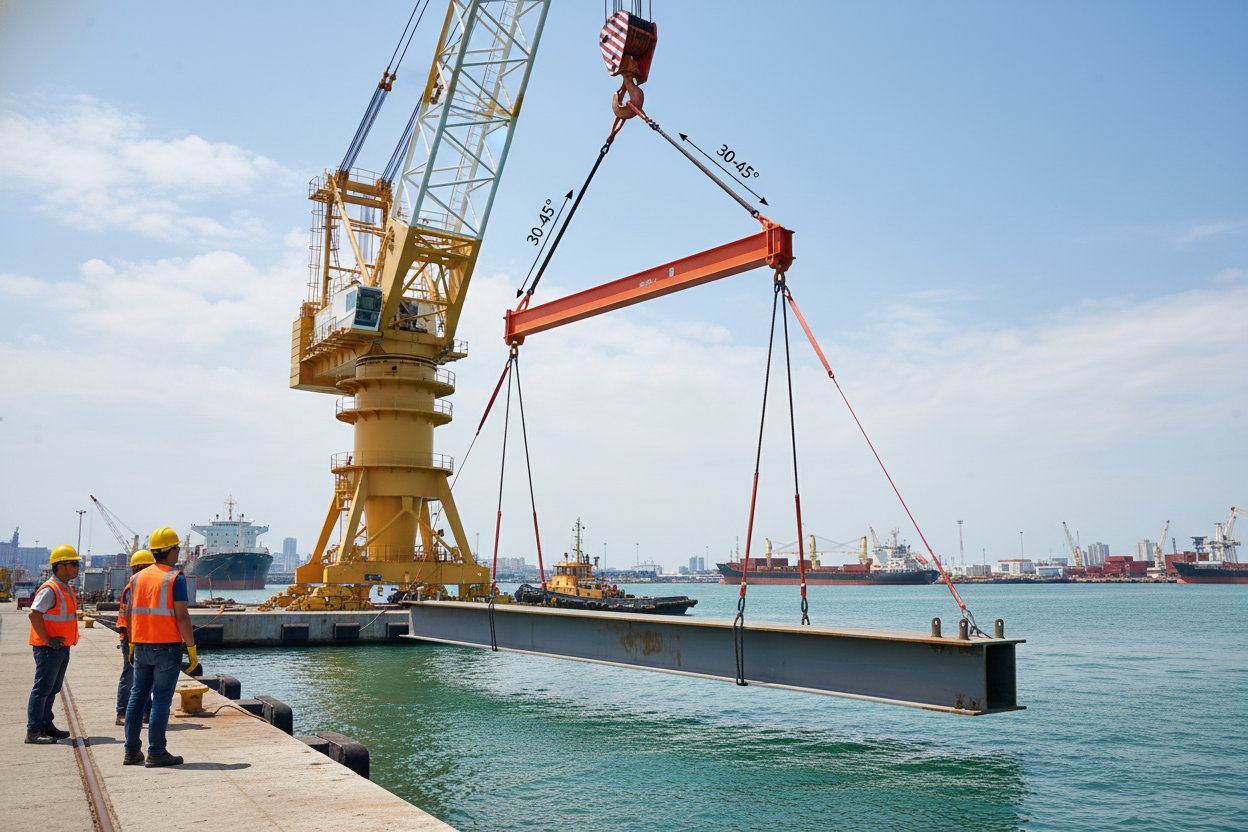
Picture this scenario: at a wide 60-degree angle, a single leg might support nearly its full WLL because the tension distributes efficiently. Drop to a sharp 30 degrees, though, and you're looking at merely half that capacity per leg, as the physics forces significantly more pull on fewer points. So, how do you calculate the capacity of a 4-leg lifting sling? Start by determining the vertical WLL for one leg, then multiply by the load angle factor—for instance, 1.732 for 60 degrees or 0.577 for 30 degrees—and subsequently divide the total load by four, assuming perfectly even sharing. For a 20-ton load lifted at 60 degrees, each leg in a 5-ton rated strap would handle approximately 2.89 tons after factoring. It's a straightforward process once broken down, but always double-check your figures against a certified chart to prevent surprises on site.
- Determine total load weight and desired angle.
- Apply angle factor to each leg's base WLL.
- Divide total adjusted capacity by four for per-leg share.
To maintain balance in modular systems, equalising techniques like adjustable legs allow for on-the-fly length tweaks, preventing any single strap from bearing the brunt during a salvage pull. Spreader bars add another critical layer, holding legs parallel to distribute force uniformly, particularly with awkward shapes like sunken hulls. Furthermore, never overlook contingency planning. Always have backup strategies in place should a leg fail, such as redundant rigging or phased lifts, to effectively manage the inherent unpredictability of rough seas and complex environments.
For truly demanding tasks, advanced tools prove invaluable: software simulations can model load paths long before any rigging is set up, predicting stresses down to the minute fibre. At iRopes, our IP-protected custom designs incorporate these insights, meticulously crafting 4 way lifting straps with precise cores for optimal flexibility and strength. Backed by ISO 9001 certification, every component undergoes rigorous testing to guarantee it performs exactly as calculated in those high-stakes marine environments, including our offerings for off-road, air, and defence sectors.
Putting these methods to work in actual salvage or construction operations vividly reveals how effectively they prevent disasters, transforming potential failures into smooth successes. Let’s explore some compelling real-world examples.
Case Studies: Exposing the Hidden Load Killer in Vessel Salvage and Marine Construction
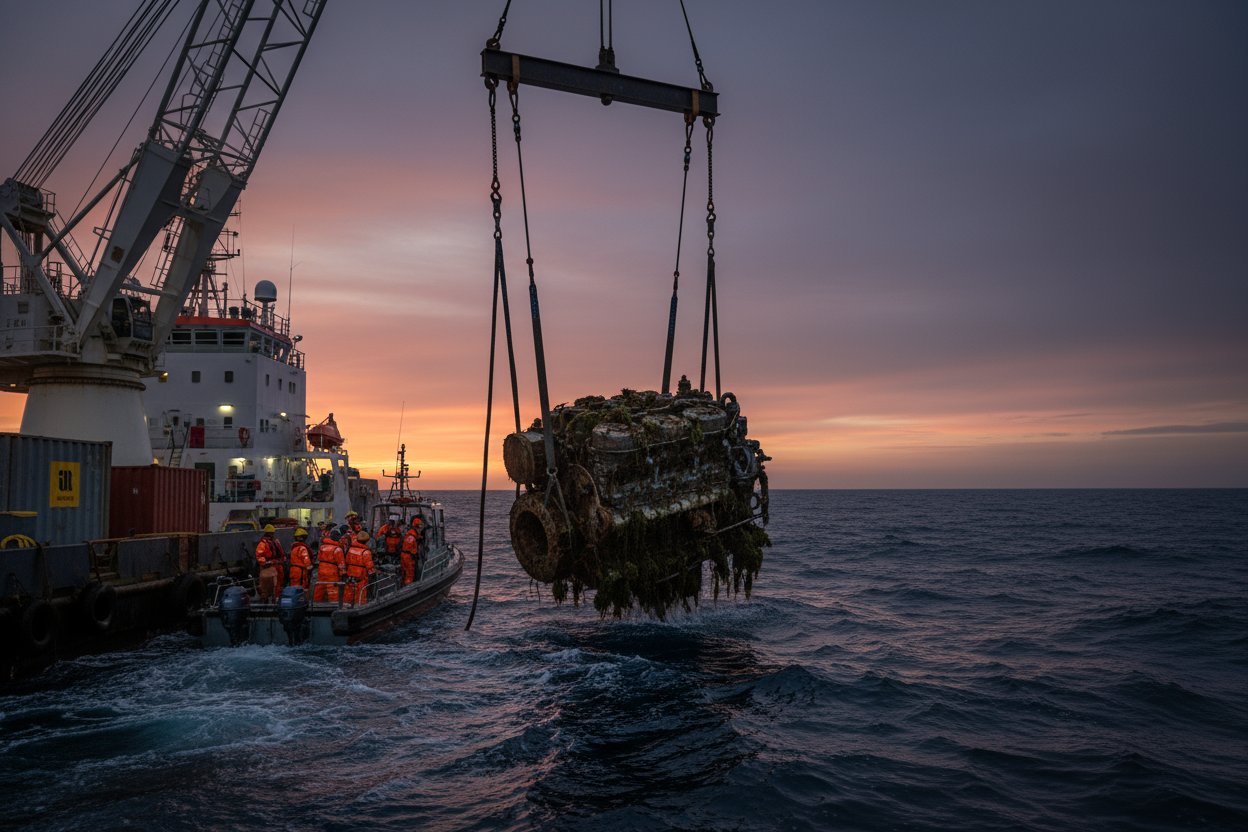
Those equalising techniques we just covered aren't merely theoretical; they become critical in the heat of real operations, where even a minor miscalculation can lead to significant trouble. Take vessel salvage, for instance, where the stakes involve recovering multi-ton wrecks from unpredictable waters. In one gripping incident off the coast of Australia, a team attempted to hoist a 50-ton engine block from a grounded freighter using standard 4 way rigging. The setup initially appeared solid: four wire rope legs attached to an oblong master link. However, misalignment caused by strong tidal currents led the load to swing unexpectedly, forcing two legs to bear an alarming 70% of the weight. One leg instantly overloaded, snapping under shock loading and sending the block crashing back into the surf. Thankfully, no injuries occurred, but the delay incurred thousands in additional crane time and environmental cleanup costs.
The subsequent recovery hinged on rethinking the approach with custom equalised configurations. Engineers replaced the failed setup with adjustable 4 way bridle slings, meticulously fine-tuning leg lengths to account for the wreck's precise tilt. Spreader bars maintained angles at a safe 60 degrees, ensuring even distribution. What made the decisive difference? Custom-fabricated fittings, complete with self-locking hooks, provided an unyielding grip despite the pervasive slime and debris. Ultimately, the lift proceeded flawlessly, extracting the block in under an hour. This incident serves as a stark reminder of how neglecting critical angle factors can quickly turn a routine job into a perilous undertaking.
Shifting focus to marine construction, we observe modular lift systems in action during demanding offshore platform builds. One particular project, involving the installation of turbine bases in the North Sea, contended with persistent gusty winds that severely threatened to unbalance a 30-ton module. Here, 4 way lifting straps formed the backbone of the operation, with polyester webbing specifically chosen for its superior shock absorption properties against the platform's inevitable sway. Crucially, contingency measures included redundant monitoring via load cells on each leg. These sensors would immediately alert the crew if load sharing deviated by even 10%. When a sudden squall hit, the system held firm—no overloads occurred, only steady progress as the legs adjusted via built-in equalisers. This robust setup not only facilitated the installation ahead of schedule but also significantly reduced the downtime risks that often plague such complex marine builds.
Can 4-leg bridle slings be customised? Absolutely. This is precisely where industry leaders like iRopes excel, stepping in to tailor bespoke solutions for unique challenges—such as low visibility in foggy salvage zones. In one instance, they meticulously wove reflective elements directly into the straps themselves, causing them to glow vibrantly under work lights for considerably safer night operations. All this was achieved while precisely matching exact diameters and core types to the job's distinct demands. It is this unwavering commitment to hands-on adaptation and technical expertise that truly transforms complex challenges into consistently reliable performance. iRopes’ comprehensive OEM and ODM services are designed to meet these exact needs, including choosing the best braided slings and synthetic rope slings for marine heavy lifts.
Failure Risks
Uneven angles led to single-leg overloads in salvage, causing snaps and costly delays.
Environmental Pressures
Currents and winds amplified imbalances in construction, severely testing modular resilience.
Recovery Wins
Custom equalizers restored balance, enabling quick, precise, and safe extractions.
Safety Measures
Load monitoring and robust contingencies ensured no repeats in windy installations.
From these illuminating case studies, clear lessons emerge for wholesale buyers: consistently integrate regular maintenance into your routine, such as monthly checks for wear on fittings, and invest strategically in professional training to spot those insidious misalignments early. It's fundamentally about cultivating proactive habits that both safeguard your crews and keep your projects reliably on track, ultimately proving that smart rigging choices deliver tangible benefits every single time.
In the high-stakes world of marine heavy lifts, mastering 4 way rigging reveals the critical need to combat the hidden load killer—unequal sharing that can turn salvage operations catastrophic. This mastery encompasses meticulously selecting durable 4 way bridle slings, choosing between nylon for its superior shock absorption or wire rope for its excellent abrasion resistance. It also involves precise load sharing calculations, adjusting for critical angles (where 60° factors at 1.732 versus 30° at 0.577), and implementing effective equalising techniques using adjustable legs and spreader bars. These strategies collectively ensure balanced distribution in modular systems. Case studies from both vessel salvage and marine construction powerfully underscore the importance of robust contingency planning and the significant advantages of custom configurations, which together prevent overloads and dramatically boost safety. All these efforts are critically enhanced by iRopes' comprehensive OEM/ODM expertise for tailored, ISO 9001 certified solutions.
As you've seen through real-world examples, proper 4 way lifting straps and rigorous inspections align perfectly with OSHA/ASME standards, thereby safeguarding both teams and project timelines. For businesses tackling complex rigging challenges, iRopes' custom designs offer the precise engineering required to match your unique and demanding needs. We specialise in a wide range of rope products for off-road, yachting, camping, and industrial applications, including commercial marine solutions, delivering competitive pricing and timely order fulfilment.
Need Tailored 4-Way Solutions for Your Marine Projects?
If you're ready for personalised guidance on customising 4 way rigging setups, including detailed load calculations or expert material selections, fill out the inquiry form above to connect with our iRopes specialists—we're here to elevate your operations safely and efficiently while protecting your intellectual property throughout the process.
