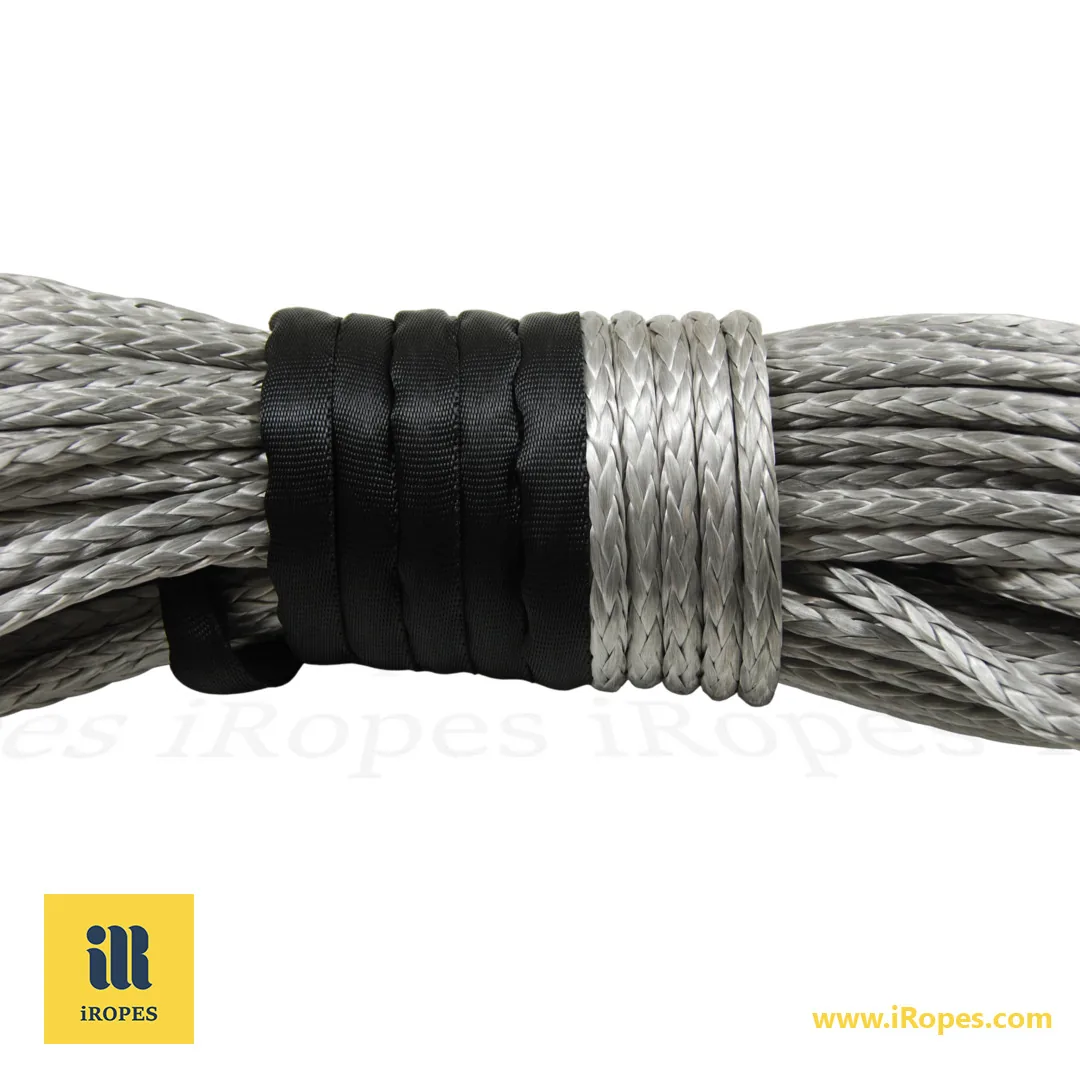
iRopes’ UHMWPE sling delivers up to 15× the strength of steel by weight at a fraction of the mass, manufactured under ISO 9001 with CE marking available where applicable.
What you’ll gain – 2 min read
- ✓ Reduce rigging weight while achieving industry‑leading strength‑to‑weight performance.
- ✓ Customise colour, branding and reflective strips to boost safety and visibility on‑site.
- ✓ ISO 9001 manufacturing, CE marking (where applicable) and OSHA/ASME‑aligned practices support safe WLL selection.
- ✓ Worldwide pallet delivery keeps projects on schedule.
Most riggers still reach for steel cables, assuming mass equals might – a habit that adds unnecessary weight and slows every lift. What if you could halve the rigging weight while gaining a superior strength‑to‑weight advantage? In the sections below, we unpack the key materials, show the essential safety‑factor formulas, and explain how iRopes’ custom UHMWPE slings turn that insight into daily productivity.
Choosing the right sling for lifting load: Materials and performance advantages
With demand growing for ultra‑light yet ultra‑strong lifting solutions, it’s natural to ask what makes a sling suitable for the toughest jobs. The answer lies in the fibres at its core and the finishes that protect them.
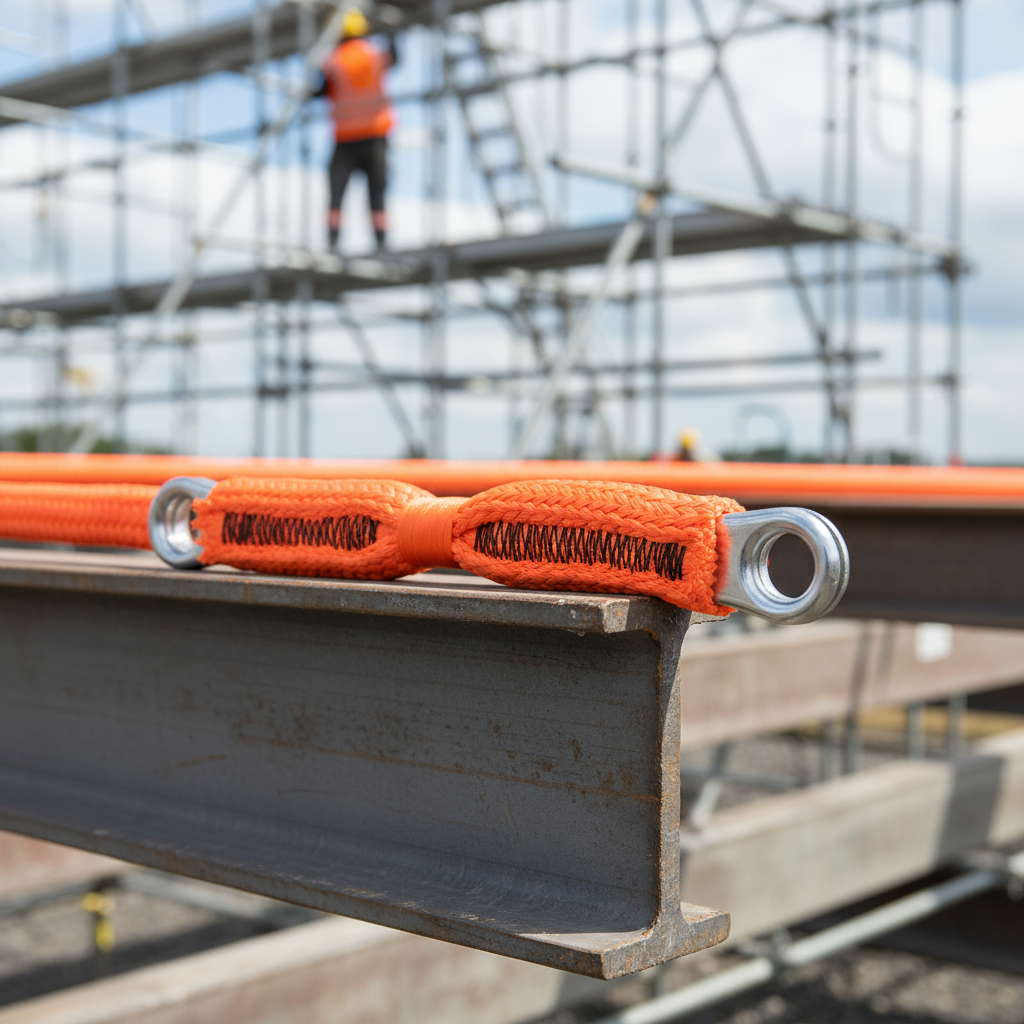
Let’s break down the most common high‑performance fibres you’ll encounter when selecting a sling for lifting load. UHMWPE (often branded as Dyneema®) leads with a strength‑to‑weight ratio of up to fifteen times that of steel and elongation under two percent. Technora™ and Kevlar® sit just behind in raw tensile metrics but excel in heat and cut resistance, making them ideal when temperatures run high. Vectran™ offers outstanding abrasion resistance and low creep for precision loads, while polyamide (nylon) and polyester balance cost, durability, and availability for everyday use.
Material Strength
Key performance metrics
UHMWPE
Up to 15× steel strength by weight, <2 % stretch, −40 °C to +80 °C range.
Technora™
High tensile strength, excellent cut resistance, heat tolerant to around +150 °C.
Kevlar®
Strong at elevated temperatures (to ~+150 °C), good impact resistance.
Everyday Fibres
Balanced options for routine lifts
Vectran™
Outstanding abrasion resistance, low creep, suited to moderate‑heat applications.
Nylon (Polyamide)
Cost‑effective, higher elongation (~6 %) for shock absorption.
Polyester
Low stretch, good UV stability, ideal for outdoor rigging.
Beyond the fibre itself, coatings can extend a sling’s service life. A UV‑resistant polymer jacket shields strands from sun‑induced degradation, while a wax‑type finish reduces abrasion against rough edges. Many customers add a reflective tape strip to improve visibility and safety during night‑time lifts.
When you need the best rope for lifting in a marine environment, UHMWPE’s 15× steel strength (by weight) and low stretch give confidence that the sling will hold, even after years of salt‑spray exposure.
So, what is the best rope for heavy lifting? In short, UHMWPE, because its tensile capacity far exceeds traditional fibres while remaining light enough to handle by hand. Pair the right material with a UV‑guarded, abrasion‑reducing finish and you get a rope for heavy lifting that resists wear, maintains performance, and keeps your crew safe.
With material fundamentals in place, the next step is to convert that strength into safe, calculable load capacities for your specific job.
Evaluating the best rope for lifting: Load ratings, safety factors, and calculations
Now that you understand the materials, let’s translate them into safe numbers. Whether you are rigging a construction crane or securing marine cargo, accurate ratings ensure each lift proceeds smoothly.

Minimum Breaking Load (MBL) is the tested breaking strength of the sling or rope. Working Load Limit (WLL)—also called Safe Working Load (SWL)—is the allowable load in service and is calculated by dividing MBL by a safety factor.
The safety factor depends on the standard and application. For heavy lifting, typical factors range from 5:1 for steady, well‑controlled lifts to 8:1 or 10:1 for dynamic conditions or harsher environments.
- Identify the sling’s MBL (breaking strength) from the data sheet.
- Choose an appropriate safety factor (e.g., 5 for steady lifts; 8–10 for dynamic).
- Divide MBL by the safety factor to obtain the WLL (also called SWL).
Example: If a UHMWPE sling’s MBL is 10 000 kg and you apply a 5:1 factor, the WLL becomes 2 000 kg. For a more dynamic lift using an 8:1 factor, the WLL would be 1 250 kg. (As a reference point, a 1‑inch UHMWPE rope often carries a WLL around 2 ton.)
Another variable that reduces capacity is sling angle. The flatter the legs, the higher the tension in each leg. A simple rule of thumb from rigging practice is that effective capacity scales with the sine of the leg angle; at 30°, capacity is about 0.5× the vertical rating.
T = W / (2 × sin θ), where T is the tension in each leg, W is the load weight, and θ is the angle each leg makes with the horizontal.
For a quick illustration, picture a 1 000 kg load lifted with a 30° leg angle from the horizontal. Since sin 30° = 0.5, each leg sees 1 000 kg of tension. Raising the angle to 60° (sin ≈ 0.866) reduces the tension to about 577 kg per leg, preserving more of the sling’s capacity.
- Dynamic loads – sudden forces such as impact or wind gusts; require higher safety factors.
- Static loads – steady, predictable forces; allow lower safety factors.
- Angle impact – the smaller the leg angle (flatter legs), the greater the tension multiplier.
How do you calculate sling angle in practice? Measure the angle of one leg from the horizontal using an inclinometer, or measure span and height and compute θ with basic trigonometry. Then use T = W / (2 × sin θ) to confirm the selected sling’s WLL can handle the resulting tension.
By keeping the three pillars—WLL calculation, safety‑factor selection, and angle‑adjusted tension—front and centre, you can confidently choose a sling for lifting load that stays within its rated limits, even when the job gets tough.
With the calculations in hand, the next part of our guide explores sling constructions you can order—eye‑to‑eye loops, continuous round slings—and how iRopes tailors each to meet the figures you just derived.
Implementing rope for heavy lifting: Sling types, customization, and compliance
Once your numbers are set, select a construction that distributes load effectively and suits the site conditions. Sling design influences handling, edge protection, and compatibility with your rigging hardware.

Below is a quick reference that summarises common sling families and the scenarios where they shine. This guide helps you answer “which sling for lifting load fits my project?” at a glance.
- Eye‑to‑eye & round slings – flat or continuous loops; versatile for balanced loads and quick attachment.
- Web (belt) slings – fabric‑woven; great surface contact and abrasion resistance for broader, delicate loads.
- Chain‑mesh slings – metal links; withstand high temperatures and sharp edges for hot‑work or abrasive environments.
iRopes can turn any of those base designs into a branded, job‑specific solution. Choose colour‑coding to match your safety palette, add reflective inserts for night‑time visibility, and select terminations—spliced eyes, protective thimbles, hooks or soft shackles—to suit your hardware. Because every millimetre of length and each finishing detail is engineered in our ISO 9001‑certified facilities in China, you get a rope for heavy lifting that carries your brand without compromising performance.
Key certifications and guidance: ISO 9001 (quality management), CE marking (EU compliance, where applicable), OSHA 1926.251 (US safety regulations), and ASME B30.9 (rigging standards). Follow the inspection checklist—visual check, measure wear, verify terminations—every six months for static lifts and quarterly for dynamic loads.
Real‑world proof comes from an offshore wind‑farm project where a 2.5‑ton turbine blade needed to travel 30 metres from the dock to the installation vessel. iRopes supplied a custom‑cut UHMWPE sling, 12 m long, with a reflective orange jacket and a protected eye termination. The sling was ~70 % lighter than a comparable steel‑chain alternative, cutting handling time by half and saving the contractor roughly $12 k in labour. The client praised the “best rope for lifting” that maintained stiffness even after weeks of salty sea breezes. For more insight on why synthetic ropes outperform traditional steel lifting cables, see our comparison of synthetic vs. steel lifting solutions.
When you combine the right sling geometry, iRopes’ OEM/ODM flexibility, and a rigorous certification routine, the final package delivers both performance and peace of mind. The next step is to match those capabilities to your project’s load chart and order a sample that meets your exact safety factor and branding needs.
Need a tailor‑made solution? Get expert advice now
By now you’ve seen why UHMWPE is often the best rope for lifting demanding jobs, how choosing the right sling for lifting load depends on fibre type, load calculations and angle, and how iRopes – a leading rope maker in China – can customise the rope for heavy lifting with coatings, colour‑coding and branding, all backed by ISO 9001 quality and the trusted standard of “Made in China.” We focus on strong synthetic fibres including UHMWPE, Technora™, Kevlar®, Vectran™, polyamide and polyester. For a deeper dive into customizing UHMWPE fibers, check out our guide to UHMWPE fiber customization. Contact us for details and for customising your own rope.
If you need a bespoke solution or further clarification, simply fill out the enquiry form above and our specialists will tailor a proposal to your exact specifications.
Looking for more examples of durable, high‑performance slings? Explore our article on industrial ropes and slings for superior durability to see how our products meet the toughest industry demands.