Your 2‑inch or 1.5‑inch nylon rope can lift up to 30 000 lb (break) and safely handle 6 000 lb, while staying UV‑protected and abrasion‑proof.
≈2 min Read – What You’ll Gain
- ✓ Tailored colour, length & branding for your fleet.
- ✓ Double‑braid adds ≈32.5 % more break strength vs twisted.
- ✓ ISO 9001 ensures every metre meets exact specifications.
You might believe a 2‑inch nylon rope is heavy and clumsy. However, it’s surprisingly light yet ultra‑strong. We’ll show why that matters for your costs, safety, and maintenance.
Nylon Rope – Overview of Properties and Applications
When you need a rope that can endure harsh conditions while delivering consistent performance, nylon rope stands out as a reliable workhorse. Its blend of high tensile strength and flexible elasticity means it absorbs sudden shocks without snapping. This makes it ideal for demanding environments, ranging from bustling ports to rugged construction sites. Whether you are anchoring a vessel or lifting heavy equipment, the material’s inherent resilience helps keep operations safe and efficient.
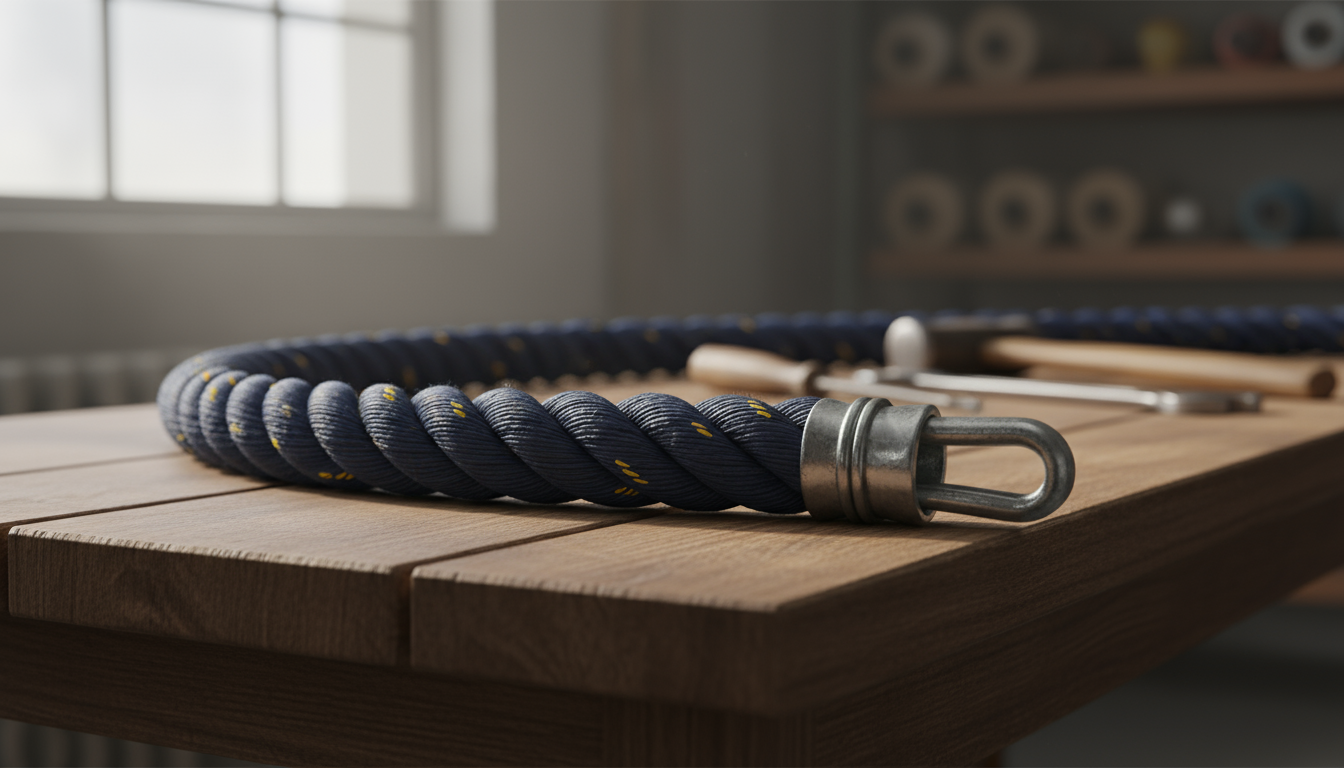
Beyond raw strength, nylon rope offers a suite of durability traits that protect it from the elements you encounter daily. Its resistance to abrasion means the fibres stay intact even when dragged over rough surfaces, while UV‑stabilised compounds prevent sun‑induced degradation. Furthermore, the polymer’s natural resistance to rot, mildew, and many chemicals reduces maintenance costs and extends service life. This allows you to rely on a single rope for multiple projects.
- High‑strength filament – engineered to deliver exceptional tensile capacity and shock absorption.
- Durability features – abrasion‑resistant, UV‑protected, rot‑and chemical‑resistant for long‑term use.
- Industry applications – marine docking, industrial rigging, towing, construction, and utility tasks.
These attributes translate into real‑world advantages across several sectors. In marine docking, the rope’s elasticity cushions wave‑induced loads, while its UV‑proof finish survives endless sunshine. On construction sites, the same rope can secure scaffolding or lift materials, benefiting from its abrasion resistance against concrete and steel. For towing operations—whether pulling a trailer or a disabled vessel—the shock‑absorbing nature reduces stress on both the rope and the load, thereby enhancing safety.
“Choosing nylon rope means you’re investing in a material that combines strength, flexibility, and longevity—qualities that keep your operations moving smoothly even under the toughest conditions.”
Understanding these core properties helps you decide when a 2-inch nylon rope or a 1.5-inch nylon rope is the right fit. Larger diameters provide higher breaking strengths for extreme loads, while the 1.5‑inch option balances capacity with easier handling. In the next part of our guide, we’ll explore how the 2‑inch variant maximises strength and construction for the most demanding load scenarios.
2 Nylon Rope – Strength, Construction, and Use Cases
Building on the durability fundamentals you just explored, let’s dive into the powerhouse that is the 2‑inch diameter version. This size is the go‑to choice when you need to move massive loads safely, whether you’re anchoring a vessel or pulling industrial equipment across a dock.

The 2‑inch nylon rope typically breaks at roughly 30,000 lb. This translates to a safe working load (SWL) of about 6,000 lb when you apply a standard safety factor. These figures give you a clear benchmark. When a client asks “what is a 2‑inch nylon rope rated for?” you can answer confidently. You’ll also know the rope stays well within industry safety margins, even under sudden shock loads.
- Breaking strength & SWL – Approximately 30,000 lb break and 6,000 lb safe working load for the 2‑inch diameter.
- Construction comparison – Double‑braided cores pack more fibres per inch, giving a higher tensile capacity and smoother handling. This contrasts with a 3‑strand twisted build, which is lighter but less resistant to kinking.
- Ideal applications – Heavy‑duty industrial towing, large‑ship mooring, defence‑grade equipment rigging, and any high‑load scenario where reliability can’t be compromised.
Construction Insight
When you compare a double‑braided 2‑inch rope with a twisted counterpart, the braid delivers roughly 32.5% more breaking strength per inch of diameter. It also resists hockling, making it the preferred choice for demanding marine and defence projects.
Choosing the right construction often hinges on optimising cost versus longevity. If your operation values long‑term durability and minimal maintenance, the double‑braided option quickly pays off. Conversely, a twisted 2‑inch rope can serve well in budget‑sensitive tasks where occasional replacement is acceptable.
Now that you understand how the 2‑inch version maximises strength and construction, the next step is to see how the slightly smaller 1.5‑inch model can be customised for a broader range of projects while still delivering impressive performance.
1.5 Nylon Rope – Specifications, Customisation, and Buying Guide
Having explored how the 2‑inch variant delivers extreme power, you’ll now see why the 1.5‑inch option often becomes the sweet spot for projects. It offers high capacity without the bulk of a larger line.

A standard 1.5‑inch nylon rope breaks at roughly 18,000 lb. This translates to a safe working load (SWL) of about 3,600 lb when you apply a conventional safety factor. These numbers provide a clear benchmark for sizing your equipment, whether you’re rigging a mid‑size vessel or lifting heavy components on a construction site.
- Colour & branding – Choose from a palette of standard colours or request custom dyes that match your corporate identity.
- Length & packaging – Order spools of any length, from 50 ft rolls to 1,000 ft bulk coils, with optional branded bags or colour‑coded cartons.
- Accessories & terminations – Add loops, thimbles, eye splices or specialised end fittings to suit your rigging system.
- Reflective or glow‑in‑the‑dark elements – Enhance night‑time visibility with high‑visibility strips or phosphorescent fibres.
- OEM/ODM options – Let iRopes handle the full design‑to‑delivery process, ensuring compliance with ISO 9001 and protecting your intellectual property.
Every custom detail you select is manufactured in our state‑of‑the‑art facility, then inspected against strict quality checkpoints before it leaves the factory. The result is a rope that not only meets your performance criteria but also carries your brand forward.
When comparing constructions, a double‑braided nylon rope typically outperforms a twisted (3‑strand) rope of the same diameter, delivering higher tensile strength and smoother handling while resisting kinks.
To choose the right 1.5‑inch nylon rope for your operation, start by confirming the maximum load you expect to handle. Then, decide whether the added strength and handling smoothness of a double‑braid justify the modest cost premium over a twisted build. Finally, reach out to our sales team with your colour, length, and accessory requirements. We’ll provide a detailed quote, sample, and lead‑time estimate within 24 hours.
Why Choose iRopes – Quality Assurance, Pricing, and Global Support
After exploring the custom options for 1.5‑inch and 2‑inch lines, the next question is—what makes the supplier itself trustworthy? iRopes backs every nylon rope with processes that turn specifications into reliable performance.

Our ISO 9001 certification is more than a badge; it governs every step from high‑strength nylon industrial filament extrusion to the final splice. Independent audits verify that each batch of 2‑inch nylon rope and 1.5‑inch nylon rope conforms to the advertised tensile‑strength figures. Concurrently, a layered inspection system catches surface defects before they reach the customer.
Quality Assurance
Built on Standards
ISO 9001
Our processes are audited to guarantee consistent tensile strength and durability.
Inspection
Multiple checkpoints detect defects before any rope leaves the line.
Testing
Break tests confirm that 2‑inch nylon rope and 1.5‑inch nylon rope meet rated loads.
Global Support
Fast and Reliable
Pricing
Wholesale rates are structured for volume, keeping cost per metre competitive.
Delivery
Strategic logistics enable on‑time shipment to ports worldwide.
IP Safety
Your designs are protected throughout production, with optional private‑brand packaging.
iRopes safeguards your intellectual property and offers bespoke branding, so your rope line reflects your corporate identity without compromise.
When you pair that level of assurance with transparent, volume‑based pricing and a logistics network that ships pallets directly to your dock, the decision becomes simple. Choose a partner that turns a high‑performing nylon rope into a seamless supply‑chain solution.
Get a Personalised Nylon Rope Quote
This guide has demonstrated how high‑strength industrial filament gives nylon rope exceptional tensile capacity, abrasion resistance and UV protection. This makes it the reliable choice for marine, construction and defence applications. The 2‑inch nylon rope delivers roughly 30,000 lb breaking strength for the toughest loads, while the 1.5‑inch nylon rope balances capacity with easier handling. Both are available with full OEM/ODM customisation, ISO 9001 quality assurance and IP protection.
If you’d like a personalised recommendation or a detailed quotation, simply complete the form above. Our specialists will get back to you promptly.
