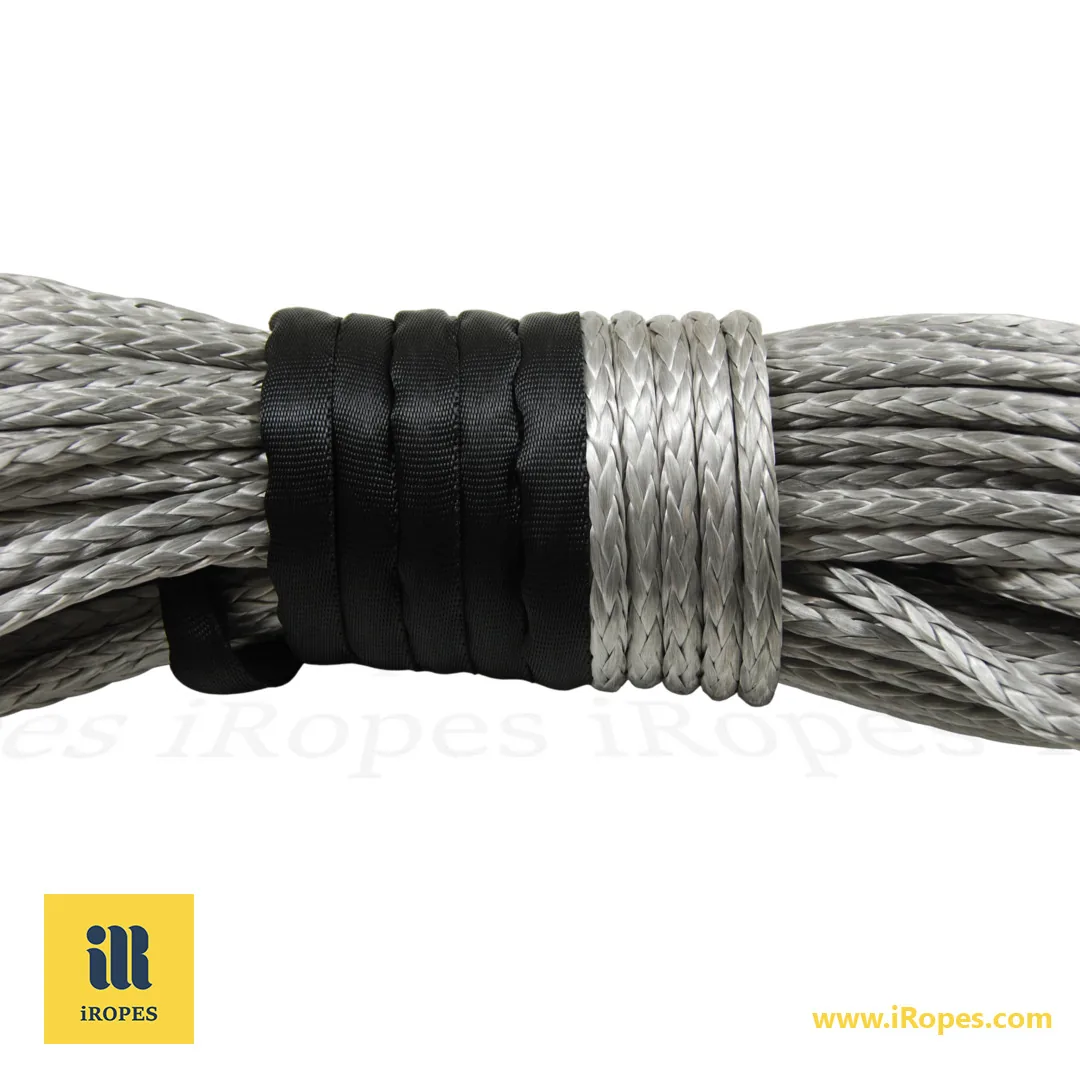
UHMWPE winch rope delivers up to 15× the strength of steel at just 1/8 the weight – a ½‑inch line lifts 32 000 lb while weighing only 8 lb per 100 ft, cutting handling load by 90 % and boosting safety.
Read in 2 min – What you’ll gain
- ✓ 15× stronger‑to‑weight ratio: lift heavier loads with a fraction of the mass.
- ✓ 1–3 % stretch: maintain precise winch control and minimise recoil.
- ✓ 3‑fold longer lifespan: abrasion, UV and chemical resistance reduce replacement cycles.
- ✓ Safety upgrade: linear, predictable breakage cuts injury risk compared with steel cable.
Imagine swapping a 70‑lb steel cable for a 9‑lb line that pulls the same 32 000 lb without the dangerous whip‑back when it snaps. This is now a reality when you choose UHMWPE winch rope. Yet, many engineers still default to steel out of habit. In the sections ahead, we’ll reveal the exact calculations, safety data and custom‑design options that let you cut weight, boost precision and slash total‑ownership cost – all while keeping your crew out of harm’s way.
Understanding UHMWPE: Material Basics and Benefits
Ultra‑High‑Molecular‑Weight Polyethylene, or UHMWPE, is a polymer with exceptionally long molecules. These molecules form a tightly packed crystal lattice. This unique molecular architecture creates a material that is both remarkably strong and surprisingly light, making it ideal for demanding rope applications.

So, what exactly is UHMWPE rope? It's a rope constructed from these high‑molecular‑weight polyethylene fibres. It delivers a combination of strength, durability and low mass that far exceeds traditional fibres. This makes UHMWPE rope a game-changer for many industries.
- Strength‑to‑weight ratio – up to 15 times stronger than steel of the same weight, allowing larger loads with a lighter line.
- Low stretch – elongation typically just 1‑3 % under working load, which keeps winching precise and significantly reduces recoil.
- Abrasion & chemical resistance – the polymer repels oils, solvents and UV radiation, extending service life in harsh environments.
Compared with polyester or nylon, UHMWPE rope offers markedly lower stretch and superior resistance to moisture and chemicals. For instance, polyester fibres typically elongate around 10‑15 % under load, while nylon can stretch 20‑25 %. These figures are significantly higher than UHMWPE’s modest 1‑3 %. Furthermore, the inert nature of the polymer means it doesn't absorb water. This ensures consistent performance whether it's used on a dusty construction site or a marine rig.
“The crystal‑aligned chains in UHMWPE give it a self‑lubricating surface, so the rope slides smoothly through sheaves without the heat build‑up you’d expect from steel cable.” – Dr. Lena Patel, polymer engineer.
These material advantages translate directly into tangible operational benefits. Businesses can expect lighter handling on job sites, reduced fatigue for workers, and a predictable performance curve. Engineers can rely on this predictability when designing critical winch systems. Understanding these fundamentals helps us transition to the next important comparison: how UHMWPE measures up against conventional steel in challenging, real‑world scenarios.
Why UHMWPE rope Outperforms Traditional Steel
Building on that foundation, the contrast between UHMWPE rope and steel wire becomes stark once the numbers are laid out. Engineers quickly notice that a line delivering the same breaking load as a steel cable can weigh roughly one‑eighth as much. This shaves kilograms off every roll and greatly eases manual handling on site.
- Breaking strength – a ½‑inch UHMWPE winch rope reaches 32 000 lb, while a steel cable of equal diameter caps around 12 000 lb.
- Weight advantage – the same ½‑inch UHMWPE line is about 8 lb per 100 ft, versus 70 lb for steel, significantly cutting transport costs.
- Safety profile – on failure, the synthetic line snaps cleanly with a linear recoil, whereas steel can whip violently, posing a severe hazard to nearby personnel.
The modest elongation of UHMWPE rope is another game‑changer for operational efficiency. Under full working load, the line stretches less than three percent. This delivers a predictable pull that prevents winch drums from over‑spooling. This low‑creep behaviour translates into tighter control during delicate lifts, where even a small overshoot can lead to equipment damage.
Addressing a common query, “Does UHMWPE rope stretch?” the short answer is: it stretches, but only minimally. Typical elongation stays within the 1‑3 % range, far below the 10‑25 % seen in polyester or nylon alternatives. The result is a rope that feels firm in the hand yet remains forgiving enough to absorb shock without permanent deformation.
Lifecycle Savings
Because UHMWPE rope resists abrasion, UV radiation and most chemicals, it can outlast steel by a factor of three to four in harsh environments. Fewer replacements mean lower inventory costs, reduced downtime and a smaller carbon footprint for the operation.
When the rope is lighter, safer and lasts longer, the total cost of ownership drops sharply. Maintenance crews spend less time inspecting for corrosion, and the risk of accidental injury during cable replacement diminishes considerably. These advantages make UHMWPE rope a compelling alternative for any application that once relied on steel, from off‑road recovery winches to heavy‑duty industrial hoists.

With the performance gap now quantified, the next part of this guide will examine how iRopes tailors this high‑strength material into customised, winch‑ready solutions that meet exacting industry demands.
UHMWPE Winch Rope: Superior Strength for Winching Applications
Having quantified the performance gap between synthetic and steel lines, the next logical step is to examine how that advantage translates into real‑world winching scenarios. The data shows that a 5/16‑inch UHMWPE winch rope delivers a breaking strength of roughly 14 500 lb while weighing just 5 lb per 100 ft. A 3/8‑inch line, on the other hand, reaches 21 600 lb at only 7 lb per 100 ft. These figures vividly illustrate why the material is often described as possessing “steel‑level strength at a fraction of the weight.”

Safety benefits are a direct result of this low‑mass construction. When a UHMWPE winch rope fails, it snaps cleanly with a linear recoil that can be anticipated and managed. This is a crucial distinction from the violent whipping of a steel cable, which often endangers nearby personnel. The reduced elongation—typically 1‑3 % under working load—also prevents the winch drum from overspinning, granting operators finer control during delicate lifts.
Choosing the right material matters. Industry consensus ranks UHMWPE as the premier option for winch ropes because it couples an unmatched strength‑to‑weight ratio with superior durability.
Answering the common query, “What is the best material for a winch rope?”—the consensus among engineers and safety specialists is clear. High‑modulus UHMWPE rope, often marketed under brand names such as Dyneema, provides the optimal blend of tensile strength, low stretch, abrasion resistance, and buoyancy. These attributes significantly outweigh the heavier, corrosion‑prone nature of steel and the higher elongation characteristics of polyester or nylon alternatives.
Lightweight
Operators can handle and store the rope with ease, reducing fatigue and speeding up deployment on site.
Predictable Breakage
The linear recoil pattern allows crews to maintain a safe distance, minimising injury risk during unexpected failures.
Marine Buoyancy
Because the polymer floats, the rope remains visible and functional even after prolonged water exposure.
Industrial Durability
Resistance to abrasion, oils, and UV radiation extends service life in harsh construction or off‑road environments.
Practical deployments demonstrate the versatility of UHMWPE winch rope across various sectors. In off‑road recovery, for instance, a bright orange line allows a 4×4 driver to extract a stuck vehicle without the bulk of a steel cable, significantly cutting rig‑up time. Industrial winches on manufacturing floors benefit from the rope’s low stretch, ensuring precise positioning of heavy machinery during maintenance. Furthermore, marine operators rely on the rope’s inherent buoyancy and chemical resistance when towing disabled vessels or securing mooring lines in corrosive saltwater conditions.
Customisation, Safety, and Ordering with iRopes
After seeing how UHMWPE winch rope outperforms steel, the next logical step is to determine how you can obtain a line that precisely matches your workflow. At iRopes, we transform the material’s inherent advantages into a tailor‑made solution, ensuring every roll arrives ready to boost your productivity and protect your crew.

Tailored Specifications
From fibre to finish
Material Grades
Select the exact UHMWPE formulation – high‑modulus for maximum strength or blended grades for specific elasticity.
Diameter & Length
Choose diameters from 3 mm up to 50 mm and lengths that suit your winch drum or bulk storage needs.
Colours & Accessories
Brand‑specific hues, reflective strips, loops, thimbles, or custom terminations can be integrated directly.
Quality & Delivery
Reliability you can count on
ISO 9001 Assurance
Our certified processes guarantee repeatable performance across every batch of UHMWPE rope.
IP Protection
Designs, colours, and proprietary specifications are safeguarded throughout production.
Global Logistics
Direct pallet shipping, on‑time dispatch and dedicated wholesale support keep your supply chain moving.
- Request a custom quote – our engineers will refine your specifications and return a detailed proposal.
- Explore the catalogue – view standard diameters, colour options and accessory kits online.
- Partner with iRopes – benefit from OEM/ODM expertise, ongoing technical support and a single point of contact for every order.
Looking for real‑world examples of winch rope upgrades? Read our guide on replacing 4‑wheeler winch cables with new synthetic rope to see the benefits in action.
Throughout this article, we’ve highlighted how the ultra‑high‑molecular‑weight polyethylene material—UHMWPE—offers a strength‑to‑weight ratio up to fifteen times that of steel. Its minimal stretch and excellent abrasion, chemical, and UV resistance make it an ideal choice for demanding winch applications.
When you select a UHMWPE rope from iRopes, you gain ISO‑9001‑certified quality, comprehensive OEM/ODM customisation, and reliable worldwide logistics. Rest assured, our UHMWPE winch rope delivers the lightweight, safe performance needed for off‑road recovery, industrial lifts, and marine towing applications.
To understand how synthetic ropes outperform steel, check out our analysis of advantages of synthetic ropes over traditional wire.
If you need a high‑performance, lightweight winch line, our article on 10 mm Spectra winch rope provides detailed specifications and customization options.
Request a personalised solution
If you’d like expert guidance to specify the optimal diameter, colour, or accessories for your project, simply complete the enquiry form above and our engineers will craft a tailored solution for you.