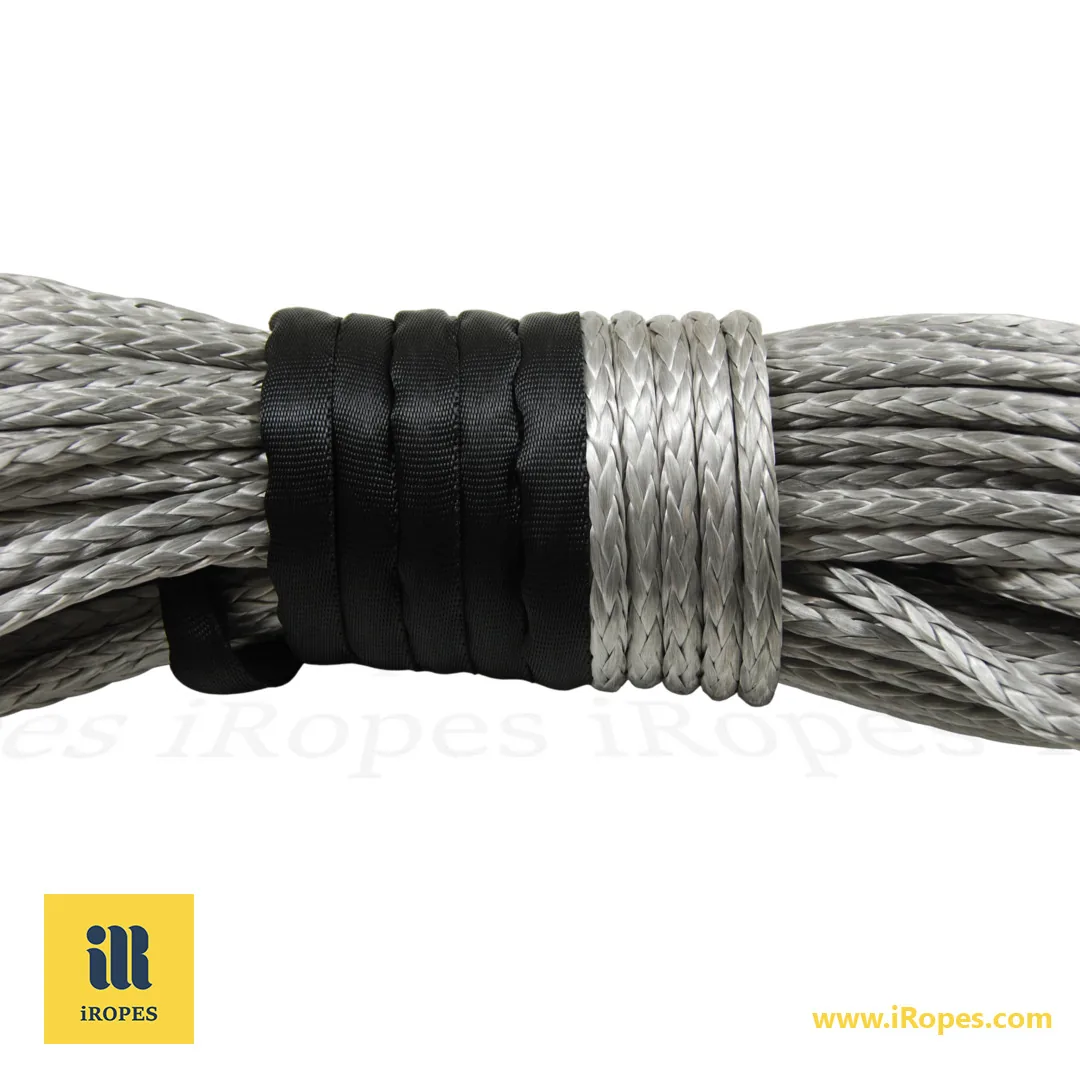
Dyneema UHMWPE offers up to 15× the strength-to-weight ratio of steel, with a 5/8″ line breaking at 51,400 lb. It stands as the definitive strongest synthetic rope, ideal for applications from winches and spearfishing to kite-surfing and paragliding.
What you’ll gain – 2 min read
- ✓ Cut winch weight by up to 85% while boosting pull capacity – achieve a lighter rig and safer handling.
- ✓ Ensure a safety margin of 1.5× GVWR with a 3/8″ line, eliminating the dangerous snap-back risk associated with steel cables.
- ✓ Choose custom colours, reflective, or glow-in-the-dark finishes – perfect for branding and enhanced visibility in low-light conditions.
- ✓ Benefit from ISO 9001-tested production, guaranteeing a precision ±2% tensile tolerance for consistently repeatable performance.
For years, steel cable was the go-to for heavy-duty applications. But as any seasoned recovery professional knows, it presents significant liabilities when factoring in its weight. Can you imagine a 5/8″ Dyneema line that lifts twice the load of a comparable steel cable, all while floating, drastically reducing snap-back risk, and taking up half the space? Continue reading to uncover the precise calculations, smart protective coatings, and iRopes’ custom manufacturing process that transform this undeniable advantage into a reliable, daily-ready winch solution.
Understanding the Strength of the Strongest Ropes for Extreme Applications
When engineers discuss the strongest ropes, they focus on two critical metrics: the material's tensile strength and the practical safety factor applied during real-world use. Tensile strength measures the maximum load a rope can withstand before failing. The safety factor, typically a multiple of the anticipated load, ensures operational reliability. A rope engineered to handle a 12,000 lb breaking load with a 1.5× safety margin truly qualifies as robust for demanding recovery or lifting tasks.

Historically, steel cables and nylon ropes were prevalent. Steel offered immense raw pulling power but came with considerable weight and the hazardous potential for violent snap-back in case of failure. Nylon, while lighter, suffered from elasticity, which diminished its effective breaking strength and made it unsuitable for precise winching. However, modern high-performance fibres, particularly UHMWPE, have fundamentally redefined these limitations. This advancement has opened new possibilities for safety and efficiency across various industries.
- Steel cable: Offers high tensile strength but is exceptionally heavy, susceptible to corrosion, and poses a significant danger from snap-back.
- Nylon rope: Lighter than steel, yet its considerable stretch under load substantially limits its practical breaking strength.
- Modern UHMWPE (Dyneema): Provides up to 15 times the strength of steel by weight, boasts minimal stretch, and offers excellent abrasion resistance.
To directly answer the common question, "Which synthetic rope is the strongest?", the leading material in the market today is Dyneema. This advanced synthetic fibre is a brand of ultra-high-molecular-weight polyethylene (UHMWPE). Its unique molecular structure, formed through a precise heat-setting process, aligns its polymer chains. This alignment results in extraordinary tensile strength, far surpassing competing fibres while maintaining an incredibly light weight.
“When you measure strength per kilogram, UHMWPE consistently outperforms steel and nylon, making it the logical choice for any application where weight and safety matter.” – iRopes rope specialist
The strongest synthetic winch rope not only needs immense pulling power but must also endure extreme conditions like abrasion, UV exposure, and occasional chemical contact. To address this, manufacturers apply polymeric coatings to the Dyneema core, acting as a protective skin. The result is a rope that not only surpasses steel equivalents in strength but also remains flexible, floats on water, and resists environmental degradation. This combination makes it perfectly suited for demanding off-road, marine, and industrial scenarios, where reliability is paramount.
Why the Strongest Synthetic Rope (UHMWPE/Dyneema) Leads the Market
Building on the understanding of how Dyneema-based lines surpass steel and nylon, it's essential to explore what specifically grants UHMWPE its exceptional strength. The secret lies in its molecular architecture: ultra-high-molecular-weight polyethylene features incredibly long polymer chains. These chains are meticulously drawn and heat-set, aligning them almost perfectly parallel. This precise alignment produces a fibre capable of bearing 10 to 15 times the load of steel by weight, while exhibiting less than 2% stretch under maximum tension.

To concisely answer the common query: "What is the strongest synthetic winch rope?", the definitive response is Dyneema SK99 Max. This advanced grade pushes performance boundaries, boasting a tensile strength exceeding 4,000 MPa. For a 5/8″ line, it achieves a remarkable minimum breaking strength of approximately 51,400 lb. Furthermore, its low-stretch characteristics ensure precise and predictable control for winch drum operations, even under heavy loads.
- Boasts a tensile strength up to 4,000 MPa – far exceeding conventional fibres.
- Achieves a breaking strength of 51,400 lb for a 5/8″ rope – more than sufficient for heavy-duty winches.
- Exhibits stretch under full load of less than 2% – ensuring precise and predictable pull.
Beyond impressive numerical metrics, Dyneema's superior performance stems from its engineered coatings and polymeric sleeves. These protective layers safeguard the core from destructive elements like abrasion, UV radiation, and chemical exposure. This comprehensive protection ensures the rope maintains its structural integrity and remains reliable, even in the most unforgiving environments. It's this combination of inherent strength and robust protection that makes Dyneema the preferred choice for critical applications.
Dyneema (UHMWPE)
Why it dominates
Strength-to-Weight
10-15 times stronger than steel per kilogram, significantly reducing load-handling fatigue and improving efficiency.
Low Stretch
Less than 2% elongation under maximum load, resulting in smoother, more controlled winch operation and greater precision.
Environmental Resistance
Highly UV-stable, chemical-resistant, and buoyant – making it truly ideal for rigorous off-road and demanding marine use.
Steel & Nylon
Traditional alternatives
Weight
Steel is significantly heavier, increasing vehicle load and complicating handling; nylon also adds considerable bulk.
Stretch
Nylon significantly elongates under load, which substantially reduces its effective pulling power and introduces unpredictability.
Durability Issues
Steel corrodes readily, and nylon degrades under UV exposure; both materials also present snap-back hazards, unlike modern synthetics.
When selecting a winch line for a 6,000 lb vehicle, the standard guideline is to choose a rope with a breaking strength of at least 1.5 times the vehicle's gross weight. This means the rope should be capable of withstanding a minimum of 9,000 lb MTS. A 5/8″ Dyneema SK99 Max line comfortably surpasses this 9,000 lb requirement. Crucially, it does so while adding only a fraction of the mass that a comparable steel cable would, significantly improving safety and handling.
Understanding these material advantages is key to appreciating how the strongest synthetic rope transforms performance in real-world winch systems. This knowledge paves the way for informed selection and safe, efficient operation across all demanding applications.
Selecting the Strongest Synthetic Winch Rope: Performance and Safety
Once you understand why UHMWPE leads the material landscape, the next critical step is translating that inherent strength into a practical winch line that can safely manage the loads you anticipate. This involves more than just raw numbers; it’s about precision and application.

Industry best practices advise selecting a rope with a breaking strength of at least 1.5 times the vehicle’s gross vehicle weight rating (GVWR). For example, a 4,000 lb truck requires a winch line to survive a minimum of 6,000 lb MTS. Manufacturers provide detailed tables correlating rope diameter with load capacity; a 3/8″ Dyneema line typically offers around 20,000 lb MTS, while a 5/8″ version exceeds 50,000 lb. By carefully matching the appropriate diameter to your calculated requirement, you ensure the line operates well within its safety margin, maximising both performance and safety.
Always choose a rope whose minimum breaking strength is 1.5 × the maximum load you expect to pull.
The durability of these ropes is significantly enhanced through protective sleeves and advanced coatings. Polyurethane or PVC jackets are highly effective at resisting abrasion from rough surfaces like rock faces and sand. Simultaneously, UV-inhibiting additives prevent degradation caused by prolonged sun exposure. Some users further bolster protection by adding a removable chafe guard. This guard slides over the rope at contact points with the fairlead, extending its service life without adding unnecessary weight or bulk.
Termination options are diverse, tailored to specific applications. Soft-eye splices are preferred for maintaining the rope’s low-stretch characteristics, providing a clean and secure loop. In contrast, stainless-steel thimbles offer a rigid attachment point for hooks in high-impact situations, protecting the rope from excessive wear. For marine applications, corrosion-resistant eye-and-eye splices are the optimal choice; they remain buoyant and are impervious to rust, ensuring longevity and reliability in saltwater environments.
To provide a direct, data-driven answer to the question, “Is synthetic winch rope stronger than cable?”, the answer is a resounding yes. On a weight-for-weight basis, a Dyneema line can deliver up to 15 times the tensile strength of a steel cable. Crucially, it eliminates the extremely dangerous snap-back effect that can occur when steel fibres fracture, making it significantly safer for all winching operations.
Match Diameter to Load
First, calculate 1.5 × GVWR, then carefully select the smallest rope diameter that meets or exceeds that essential breaking strength.
Customizing High-Performance Ropes Across Industries with iRopes
Now that you’ve grasped the power of the right winch line, the logical next step is to leverage iRopes’ extensive OEM/ODM expertise. This capability transforms a single fibre into a bespoke solution, perfectly tailored for diverse applications such as off-road recovery, marine sailing, spearfishing, kite-surfing, and paragliding winch systems. Our customisation ensures optimal performance, no matter the challenge.

Every project at iRopes commences with a comprehensive brief, meticulously detailing load requirements, environmental conditions, and specific branding needs. Following this, our specialists precisely select the optimal fibre grade, diameter, and construction. We then integrate any desired reflective or glow-in-the-dark elements and meticulously finish the rope with all requested accessories, ensuring a perfectly customized product.
Off-road & Spearfishing
Our rugged Dyneema lines are engineered to survive severe rock-face abrasion, navigate sand-filled chafe zones, and resist corrosive saltwater environments while remaining light enough for effortless transport on any recovery rig.
Sailing & Kite-surfing
Experience low-stretch, UV-stable halyards and kite-lines that maintain precise sail shape and react instantly to gusts. This eliminates the sluggish response often found with traditional fibres, ensuring peak performance.
ISO 9001 Quality
Every batch undergoes stringent tensile-strength testing and dimensional checks under ISO 9001 standards. This guarantees that each strongest synthetic rope meets exact specifications, ensuring consistent, high-quality performance.
IP & Global Logistics
Our dedicated IP protection safeguards your proprietary designs, while our worldwide pallet-shipping network delivers products punctually, ensuring timely arrival regardless of the destination.
For wholesale partners seeking a truly bespoke rope solution, our request process is designed for simplicity and efficiency:
- Submit a detailed brief via our online portal, clearly specifying your load requirements, desired length, preferred colour, and any special accessories.
- Our expert engineers meticulously review your specifications, then propose a prototype and conduct virtual tensile simulations to ensure optimal performance.
- Once you approve the sample and confirm branding details and the delivery schedule, production swiftly commences under stringent ISO-controlled conditions, guaranteeing quality and precision.
Because every custom line is meticulously crafted using the strongest synthetic winch rope grade available, you can confidently trust that your final product will significantly outperform traditional steel cable. Furthermore, it will integrate seamlessly into any winch drum or fairlead, ensuring superior performance and compatibility.
Get a personalised UHMWPE rope solution
You now understand how UHMWPE (Dyneema) delivers the world’s highest tensile performance, giving the strongest ropes a remarkable 10-15× strength-to-weight advantage over both steel and nylon. This advanced fibre powers the strongest synthetic rope for winch lines, and excels in specialised applications such as spearfishing, kite-surfing, paragliding winch systems, and sailing rigs, where minimal stretch, superior UV resistance, and buoyancy are absolutely critical.
iRopes offers comprehensive OEM and ODM services, allowing us to translate these inherent benefits into the strongest synthetic winch rope specifically tailored to your exact load, length, colour, and branding requirements. This bespoke approach is backed by our stringent ISO 9001 quality certification and full intellectual property protection, ensuring both performance and peace of mind.
If you require personalised guidance on selecting or custom-designing the ideal rope for your extreme application, simply complete the form above, and one of our dedicated specialists will promptly contact you.