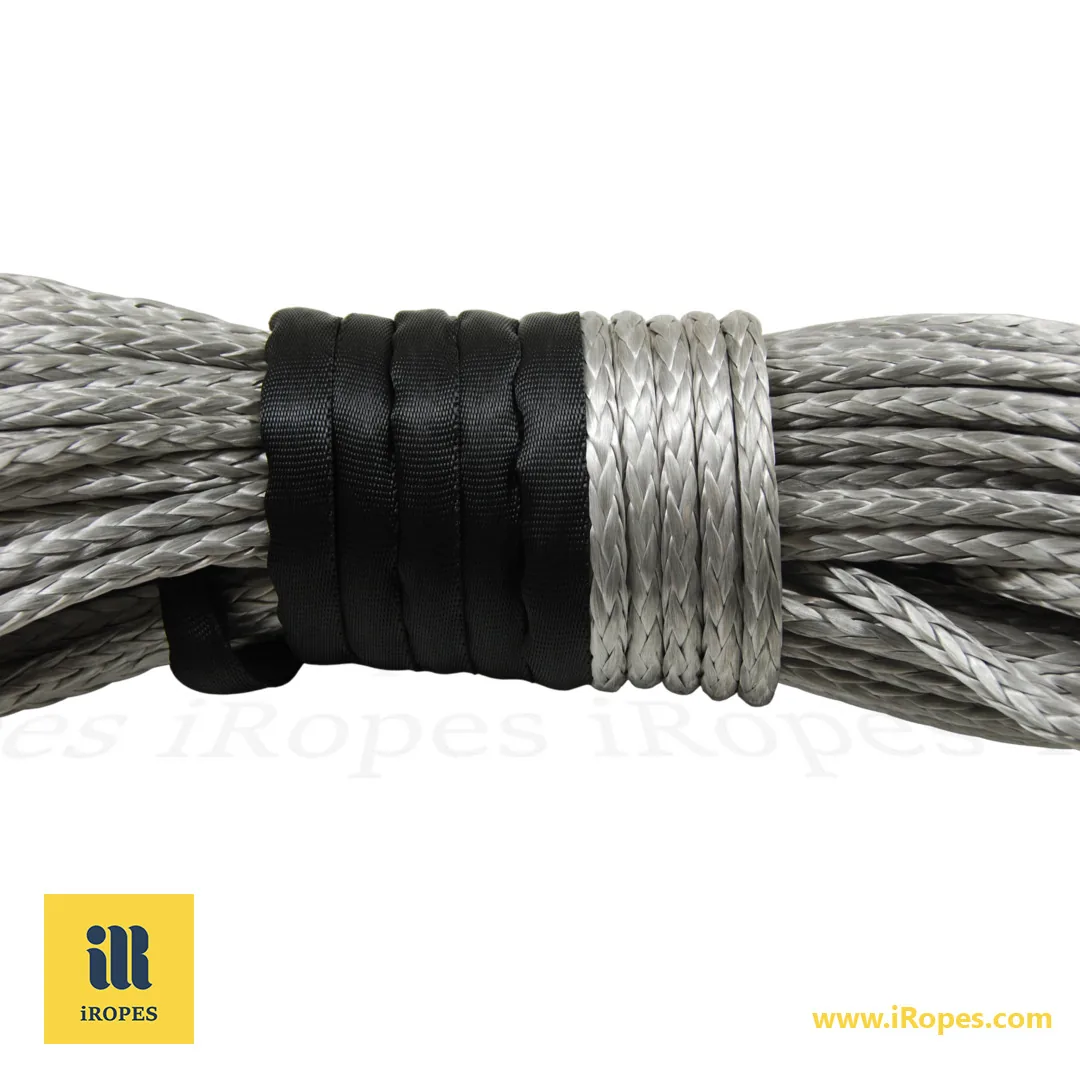
UHMWPE hoist rope delivers up to 1.4 × the tensile strength of steel wire rope while being 7.6 × lighter. This cuts motor energy consumption by approximately 30 % and extends service life to 15 years. The result is roughly a 40 % reduction in the total cost of ownership for heavy‑industry lifts.
Read in 2 min: What you gain
- ✓ 7.6× weight reduction → Lighter hoists and faster acceleration.
- ✓ 1.4× tensile strength → Higher load capacity without oversizing.
- ✓ 30 % motor energy saving → Lower electricity bills.
- ✓ 15‑year lifespan vs 5‑7 years for steel → Fewer replacements and less downtime.
You might assume that only steel wire rope can handle the heaviest lifting tasks. Yet, the latest data for Ultra-High Molecular Weight Polyethylene (UHMWPE) completely redefines this notion. UHMWPE delivers 1.4 × the tensile strength of steel while shedding 7.6 × the weight. Imagine a 20‑tonne hoist where the rope weighs a mere fraction of the load, significantly cutting motor draw by up to 30 % and extending maintenance cycles. In the following sections, we will dissect the numbers, the chemistry, and precisely how iRopes tailors this breakthrough technology for demanding applications in mining, marine, and cranes.
hoist rope: Understanding Definitions and Core Functions
Before diving into material performance, it's helpful to clarify what a hoist rope is and its role within a complete lifting system. In industrial settings, this term often gets conflated with the entire machine. However, the rope itself is a distinct component primarily responsible for bearing the load, while the surrounding machinery handles the movement.

Fundamentally, a hoist rope is a flexible, high‑strength line—traditionally steel‑based—that connects the load hook to the hoist drum. The rope's primary function is to transmit tensile force; it does not incorporate gears, brakes, or motors. These components belong to the broader wire rope hoist assembly.
What is a wire rope hoist? A wire rope hoist is a complete lifting unit consisting of a drum, the hoist rope (or wire rope), a power source—which can be electric, pneumatic, or hydraulic—a gearbox, a braking system, and a control panel. The drum winds the rope, the motor provides torque, and the brake secures the load when power is disengaged.
- Definition of a hoist rope: A tensile element that carries the suspended load between the hook and the drum.
- Difference from a full hoist system: The rope is only one part; the drum, motor, and brake form the surrounding machinery.
- Typical industrial applications: Overhead cranes in steel mills, shipyard gantries, mining shaft lifts, and heavy‑duty assembly lines.
The basic mechanism operates as follows: the motor drives a gearbox, which in turn rotates the drum. As the drum turns, the hoist rope winds onto it, lifting the load. When the rope is reeved through one or more sheaves (pulleys), the mechanical advantage can be doubled, effectively halving the force required from the motor. This principle enables a compact hoist to lift several tonnes with smooth, controlled motion.
Understanding the rope’s role clarifies why choosing the right material is paramount—if the line fails, even the most advanced drum and motor cannot prevent a hazardous drop.
In practice, a hoist rope must precisely match the capacity of the entire hoist system. Engineers meticulously calculate the required diameter and strand count based on the maximum load, safety factors, and the number of reeve passes. Selecting a rope that is too thin risks fatigue and premature failure, while an oversized rope adds unnecessary weight and may necessitate a larger, more cumbersome drum.
With the fundamentals of definition, mechanism, and application now clear, the next step is to examine the material characteristics that distinguish traditional steel ropes from emerging synthetic alternatives.
hoist wire rope: Performance Factors and Traditional Limitations
When steel strands wind around a drum, the raw material’s inherent traits immediately influence a lifting system's behaviour. Understanding these traits allows engineers to anticipate the operational limits they will encounter on the shop floor.

The first crucial performance factor is tensile strength. High‑carbon steel delivers a predictable breaking load, but this value scales directly with diameter and strand count. For instance, a 12 mm rope with six strands will typically hold roughly half the load of a 20 mm, twelve‑strand equivalent.
Secondly, fatigue resistance dictates how long the line can withstand repeated bending cycles. Each pass around a sheave induces microscopic cracks that propagate over time, eventually leading to sudden material failure.
Lastly, corrosion significantly impacts maintenance frequency. In demanding marine or mining environments, exposure to salt and moisture accelerates rust formation, eroding the steel surface and diminishing both strength and the reliability of visual inspections.
- Strength – Directly linked to diameter and strand layout.
- Fatigue – Cumulative damage resulting from repeated bending cycles.
- Corrosion – Environmental deterioration that shortens service life.
These three attributes translate into everyday operational challenges. The rope’s sheer mass can add up quickly: a steel line with a 20‑tonne capacity can weigh over 40 kg per metre. This increases motor load and overall lifting energy consumption. Metal fatigue necessitates routine visual inspections, often requiring specialised tools and incurring costly downtime. Furthermore, corrosion not only weakens the core but also obscures early crack detection, thereby increasing safety concerns for operators.
From a safety perspective, industry standards mandate a safety factor of at least five for most hoisting applications. This means a rope rated for 10 tonnes must never be regularly loaded beyond 2 tonnes, providing a substantial margin for unforeseen defects or degradation.
Addressing a common query, the capacity limits for wire rope hoists typically range from 1/8 tonne up to 55 tonnes for standard models, with specialised units capable of lifting beyond 250 tonnes. The exact rating depends on the rope diameter, construction, and the number of reeve passes; a larger diameter or additional strands will increase the permissible load, while a single‑sheave arrangement reduces it.
Given the interconnected issues of weight, fatigue, and corrosion, maintenance schedules become a significant cost driver. Regular lubrication, strand replacement, and periodic non-destructive testing are essential. However, these activities also interrupt production cycles and inflate operational budgets.
rope hoist manufacturers: Why UHMWPE Is the Superior Alternative
Having seen how traditional steel hoist wire rope contributes to mass and susceptibility to fatigue, the logical progression is to examine what a modern synthetic line like UHMWPE can achieve when transferring the same load.

Consider this: a steel rope with a 20‑tonne capacity can weigh over 40 kg per metre. A UHMWPE counterpart, engineered for the equivalent breaking load, can be up to eight times lighter. This substantial weight reduction leads to a lower moment of inertia on the hoist drum, which means the motor consumes less energy. Consequently, the entire hoist system can potentially be downsized without sacrificing lifting capacity. Furthermore, UHMWPE polymer does not rust; exposure to salt water or abrasive slurry leaves the line unaffected, eliminating the routine lubrication and rust‑removal cycles that are so prevalent in steel rope maintenance programmes. Because UHMWPE fibres inherently resist fatigue crack propagation, their service life in harsh environments often exceeds fifteen years, a significant extension compared to the typical five‑to‑seven‑year lifespan of conventional wire rope.
Custom Solutions
iRopes converts client specifications into a finished UHMWPE hoist rope that precisely meets exact diameter, length, and colour requirements. Optional accessories such as thimbles, eye loops, or custom terminations are seamlessly integrated on the production line. Every batch is produced under ISO 9001‑certified quality management, and all design data are protected through comprehensive Intellectual Property (IP) safeguards.
For operators asking, “Where can I find reliable hoist rope manufacturers?” the answer lies with partners that combine global logistics, rigorous testing, and a proven track record of OEM/ODM delivery. iRopes exports to North America, Europe, and Oceania, offering direct pallet shipping and non‑branded or customer‑branded packaging to meet any supply‑chain requirement. Their long‑standing relationships with crane manufacturers and mining contractors demonstrate a depth of industry experience that few competitors can match.
Choosing a supplier with ISO 9001 certification, robust IP protection, and proven export capability ensures your UHMWPE hoist rope arrives on time, meets exact specifications, and is backed by a partner that understands the rigorous demands of heavy‑industry lifting.
In practical terms, the lighter UHMWPE rope significantly reduces the dynamic load on the hoist drum, which can lead to lower motor heating and extend bearing life. The corrosion‑free nature of UHMWPE eliminates the hidden costs associated with rust‑related inspections and repairs. Moreover, the extended lifespan means fewer rope replacements and less production downtime. When these factors are considered cumulatively, the total cost of ownership for a UHMWPE hoist rope often falls well below that of a traditional steel hoist wire rope, even when accounting for a higher initial material price.
With the performance edge clearly established, the next consideration involves aligning the rope’s specifications with your particular lifting environment. This naturally leads to practical guidance on selecting the right partner and maintaining optimal hoist performance across your operations.
Compared with traditional hoist wire rope, UHMWPE rope delivers up to eight times the strength‑to‑weight ratio. It also eliminates corrosion and resists fatigue, providing a service life that can exceed fifteen years. Choosing the appropriate hoist rope is critical, and iRopes’ UHMWPE solutions are already trusted in mining, marine, crane, and lifting equipment applications, making them the premier alternative to conventional wire rope.
Get a personalised UHMWPE hoist rope solution
If you want expert guidance on selecting the right product or need a custom quote, simply fill out the form above. Our team of rope hoist manufacturers will work diligently with you to design a solution that meets your exact specifications and integrates seamlessly with your operations.