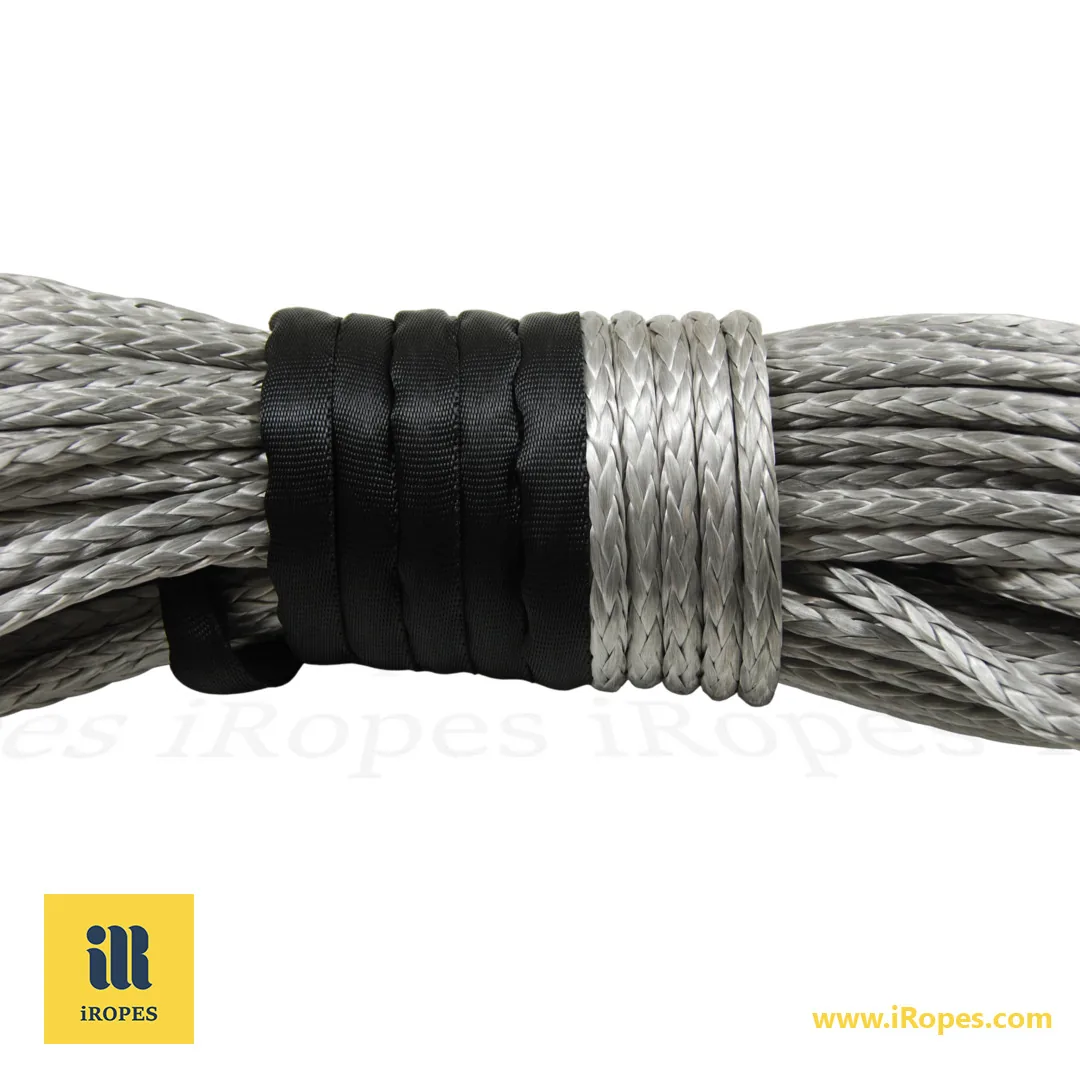
UHMWPE SK78 slings with PU‑impregnated coating deliver roughly 15–20% higher sling capacity than comparable steel slings of the same diameter—and they are significantly lighter to handle.
What you’ll gain – ~4 min read
- ✓ Boost sling rope capacity by 15–20% compared with steel slings.
- ✓ Cut handling weight significantly → lower manual handling and shipping costs.
- ✓ Improve abrasion resistance and service life with PU‑impregnated coating.
- ✓ Stay compliant with OSHA 1910.184 & ASME B30.9, backed by ISO 9001 quality assurance.
Most engineers still base their lift plans on steel‑wire tables, assuming the same weight and safety margin for every job. Yet a PU‑impregnated UHMWPE SK78 sling can deliver higher sling rope capacity at far lower mass. iRopes manufactures UHMWPE SK78 slings impregnated with PU coating to improve resistance and endurance. In the sections below, we outline the exact calculation steps, the angle‑reduction factors many overlook, and how iRopes tailors each sling to squeeze every extra tonne out of your rig.
Understanding sling rope capacity
Having highlighted why accurate capacity calculations can save time and money, it’s essential to start with a clear definition. Sling capacity is the maximum load a sling can safely support under defined conditions, expressed as the working load limit (WLL). The industry‑standard design factor of 5 converts a rope’s minimum breaking load (MBL) into this usable limit by division. Distinguishing between the MBL and the WLL (often called the rated capacity) helps prevent over‑loading and ensures compliance with safety regulations. This foundational concept underpins every subsequent calculation of rope sling capacity.

When a sling is selected for a lift, engineers first consult the relevant codes. OSHA 1910.184 and ASME B30.9 both reference a five‑fold design factor and prescribe specific testing methods. These standards also define how to treat different hitch configurations—vertical, choker, or basket—so that the calculated rope sling capacity reflects real‑world usage.
“The design factor of five is the industry‑standard safety margin that turns a rope’s tensile strength into a usable working load limit, ensuring lifts stay within safe bounds.”
- OSHA 1910.184 – references a minimum design factor of 5 for general‑purpose rigging.
- ASME B30.9 – outlines calculation methods for vertical, choker and basket hitches.
- Wire Rope Technical Board – provides recommended D/d ratios and angle‑reduction factors.
The choice of material dramatically shifts the achievable sling rope capacity. UHMWPE SK78 fibres deliver tensile strengths roughly nine times that of comparable steel, allowing a lighter‑weight sling to meet or exceed the same WLL. Conversely, traditional steel wire slings, while robust, are heavier and more susceptible to corrosion. Adding a PU‑impregnated coating to SK78 enhances abrasion resistance and endurance in harsh environments, making rope sling capacity calculations more favourable for demanding applications.
With these definitions and standards clarified, the next step is to translate them into a practical, step‑by‑step calculation that shows exactly how angle, construction and diameter combine to determine the final capacity.
Calculating rope sling capacity step‑by‑step
Building on the definitions and standards outlined earlier, the calculation phase translates those concepts into a practical figure that engineers can trust on site.
- Identify the actual load and decide whether the sling will operate as a vertical, choker or basket hitch.
- Select the rope diameter and construction (e.g., 1‑inch 6×19 SK78) and check the required D/d ratio (e.g., ≥ 25 for basket hitches).
- Determine the hitch and angle reduction factors for the planned configuration (e.g., 30°, 45°, 60°).
- Convert strength to WLL: divide the minimum breaking load by the design factor of 5, or use the manufacturer’s published vertical WLL.
- Apply the hitch/angle factor(s) to the vertical WLL to obtain the safe sling rope capacity for that configuration.
For illustration, consider a 1‑inch 6×19 sling at 45°. A typical steel vertical WLL is about 9.8 tonnes. An equivalent UHMWPE SK78 sling delivers roughly +15–20%, or around 11.3–11.8 tonnes vertical. Applying the 45° reduction factor of 0.7 yields approximately 7.9–8.3 tonnes WLL for that arrangement. Always confirm with the manufacturer’s chart for your exact rope, termination and hitch.
30°
Reduction factor = 0.5 → capacity halves compared with a vertical lift.
60°
Reduction factor = 0.9 → capacity remains close to the vertical rating.
45°
Reduction factor = 0.7 → capacity reduced by about 30% versus a vertical configuration.
Impact
Increasing the sling angle from the horizontal (e.g., towards 60°) improves capacity and reduces leg tension.
Engineers can repeat this sequence for any diameter or construction, adjusting only the WLL value and the angle‑reduction factor. The method remains the same, ensuring consistent and reliable rope sling capacity assessments across projects.

The next section will explore how the same calculations feed into capacity tables, revealing why SK78 constructions often outperform traditional steel slings.
Optimizing sling capacity with UHMWPE SK78 ropes
With the calculation method now clear, the next logical step is to see how different diameters, constructions and angles translate into real‑world sling capacity. The tables below illustrate the performance of 6×19 and 6×37 UHMWPE SK78 slings compared with conventional steel wire slings of the same size.

For a 1‑inch (25 mm) 6×19 steel sling, many industry charts list a vertical WLL around 9.8 tonnes. An equivalent UHMWPE SK78 sling of the same diameter typically delivers +15–20% on that figure. A 6×37 construction offers greater flexibility; capacity differences are generally small, so always follow the manufacturer’s table. At 45°, the 0.7 reduction factor applies proportionally—the SK78 still outperforms steel by roughly 15–20%.
1.25‑inch Wire Rope Sling
Typical vertical WLLs for 1.25‑inch steel slings fall in the low‑ to mid‑teens (tonnes), depending on construction, D/d ratio and terminations. Apply the 0.7 factor at 45° to estimate angled configurations. A matching UHMWPE SK78 PU‑coated sling generally adds about +15–20% to the vertical WLL. Always verify against the manufacturer’s chart.
The angle at which the sling legs converge has a pronounced effect. A 30° configuration halves the capacity, while a 60° angle retains roughly 90% of the vertical rating. Leg count matters too; however, ratings for multi‑leg slings are often based on only two legs in tension. Do not assume proportional increases—apply the correct angle and leg factors per ASME B30.9.
6×19 Construction
Standard flexibility
Vertical
Highest rating for the selected diameter and termination. Use the manufacturer’s vertical WLL.
Choker 45°
Typically about 30% lower once the 0.7 angle factor is applied.
Basket 30°
Most conservative at shallow angles; ensure D/d ≥ 25 for basket hitches.
6×37 Construction
Higher strand count, more flexibility
Vertical
Similar WLL to 6×19 for the same diameter; follow the product‑specific table.
Choker 45°
Apply the 0.7 factor; UHMWPE SK78 retains a clear advantage over steel.
Basket 30°
Angle and D/d limits govern capacity; consult ASME B30.9 and the manufacturer.
Summarising the numbers: a PU‑impregnated UHMWPE SK78 sling of identical diameter consistently delivers a 15–20% higher rope sling capacity than its steel counterpart, while offering dramatically lower handling weight and superior abrasion resistance. The next logical topic explores how these gains translate into safety‑focused inspection routines and custom branding options for demanding projects.
Safety, inspection, and customization for high‑performance slings
Building on the capacity advantages of SK78 PU‑impregnated ropes, the next step is to keep those advantages reliable on site. Regular inspection safeguards the sling rope capacity and prevents hidden damage from turning a safe lift into a hazard.

The industry‑standard inspection checklist focuses on four critical items. Missing any of them can reduce the advertised sling capacity and invalidate the design factor.
- Wear & abrasion – look for frayed fibres, surface cuts or thinning that compromise tensile strength.
- Corrosion & chemical exposure – even PU‑coated ropes can suffer from aggressive chemicals; any discolouration warrants removal.
- Temperature & angle limits – verify the sling has not been used above 150 °C or at sling angles less than 30° from the horizontal, both of which reduce safe load.
- Identification & tagging – ensure legible WLL, manufacturer details and traceability are present and intact.
PU coating is more than a colour finish. It creates a barrier that resists abrasion from rough edges and shields fibres from moisture, which in turn preserves the calculated rope sling capacity. For a broader comparison of how synthetic rope slings perform against traditional steel slings, see our synthetic rope sling vs steel sling analysis. The polymer, however, has a thermal ceiling.
PU coating adds abrasion resistance but its temperature rating tops out around 150 °C; above this limit the polymer softens and capacity can drop.
Can PU‑coated UHMWPE slings be used in high‑temperature environments? They perform reliably up to roughly 150 °C, after which the coating degrades and the safe load must be derated. For lifts above that range, a heat‑stable variant or a traditional steel sling is advisable.
Custom OEM/ODM options
Choose diameter, colour, branding and packaging to match your project requirements while retaining the engineered sling capacity.
By following the checklist, respecting temperature limits, and leveraging iRopes’ custom‑design services, users keep the sling capacity at its intended level and set the stage for the final safety‑first recommendations that follow.
Ready for a customised sling solution?
If you’d like personalised advice on selecting or designing the optimal SK78 sling for your specific lift requirements, just fill out the enquiry form above and our experts will contact you.
By applying the five‑step method and the angle‑reduction tables, engineers can unlock the full potential of UHMWPE SK78 ropes, whose PU‑impregnated coating adds abrasion resistance while preserving the calculated sling rope capacity. Across common diameters, the data shows a consistent 15–20% uplift in rope sling capacity over comparable steel, and the iRopes OEM/ODM service lets you tailor diameter, colour and branding to match any lift scenario, as explained in our UHMWPE ropes surpass wire rope for hoist applications guide. With ISO 9001‑certified quality, timely delivery and dedicated IP protection, you can trust that each custom sling remains within safe limits for every application.