⚓ Sailors call them lines, not ropes—once they serve a purpose on your boat. Discover routing secrets that slash chafe risks by 65% and hoist sails 40% faster, directly from nautical experts ensuring safer voyages every time.
Unlock Safer Sailing in Under 9 Minutes →
- ✓ Master 12 essential line names and functions to navigate deck layouts tangle-free and boost handling efficiency by 50%.
- ✓ Reveal routing paths for halyards and sheets that cut friction by 70%, preventing failures during gusts for reliable performance.
- ✓ Select materials like Dyneema for 3-5 year longevity, solving stretch issues that distort sails and compromise speed.
- ✓ Access iRopes' custom OEM tips to tailor lines to your vessel, saving 25% on replacements through ISO-certified quality.
You might think all ropes on a sailboat perform the same, but that's a dangerous myth. Improper routing causes 80% of rigging incidents, turning calm cruises into chaos. What if hidden paths through sheaves and cleats could transform your setup, making adjustments instinctive and sails bulletproof? Dive in to expose these secrets and sail with the confidence of pros who've cut mishaps dramatically.
Lines on a Boat: Fundamental Terminology and Distinctions
Now that we've cleared up why calling everything a "rope" might earn you some sideways glances from seasoned sailors, let's get into the nuts and bolts of lines on a boat. Imagine stepping aboard your sailboat for the first time—everything looks tangled and mysterious. Yet, once you know the terms, it all clicks into place like a well-tied knot.
The key difference between a general "rope" and a functional "line" boils down to purpose. A rope is just raw material, something coiled in the hardware store waiting for a job. But on the water, sailors call it a *line* the moment it takes on a role. This could involve hoisting a sail, securing the boat to a dock, or steadying the mast. It's nautical etiquette, really, a way to respect the craft. Why bother? Because precision matters when you're relying on these lines for safety and smooth sailing. Calling it a line reminds you it's not just string; it's your lifeline.
Lines on a sailboat fall into three main categories, each with a specific job to keep things running smoothly. *Running rigging* handles the adjustable parts that control your sails—think lines that move to catch the wind just right. *Standing rigging* provides the fixed support, holding the mast upright against the forces of wind and waves. Finally, *mooring lines* are the workhorses for tying up safely at the dock or dropping anchor. Understanding these groups helps you anticipate what each line does before you even touch it.
- Halyards - These hoist sails up the mast, like the mainsail halyard that gets your main up and flying.
- Sheets - They trim and angle the sails, such as jib sheets that pull the front sail in or out to harness the breeze.
- Stays - These are forward and aft supports for the mast, like the forestay that keeps it from bending back under load.
- Shrouds - Side wires or lines stabilizing the mast laterally, preventing dangerous side-to-side sway.
- Docklines - Used for mooring, securing the bow and stern to pilings or another boat for a stable tie-up.
Ever wonder how pros keep their decks from turning into a spaghetti mess? Deck layout basics make all the difference on recreational vessels. Start by grouping lines near their winches or cleats—halyards aft by the cockpit, sheets led forward to fairleads that guide them cleanly. Use organisers, those handy bars with sheaves, to route everything without crossings that cause snags. For example, rerouting the jib sheets through proper leads can cut trimming time in half and stop that annoying slap against the shrouds. It's about flow: clear paths mean quicker adjustments and fewer frustrations when the wind picks up.

With these foundational terms under your belt, organising your setup becomes second nature. However, to truly make your boat respond, you need to master the lines that bring the sails alive.
Lines on a Sailboat: Mastering Running Rigging and Routing
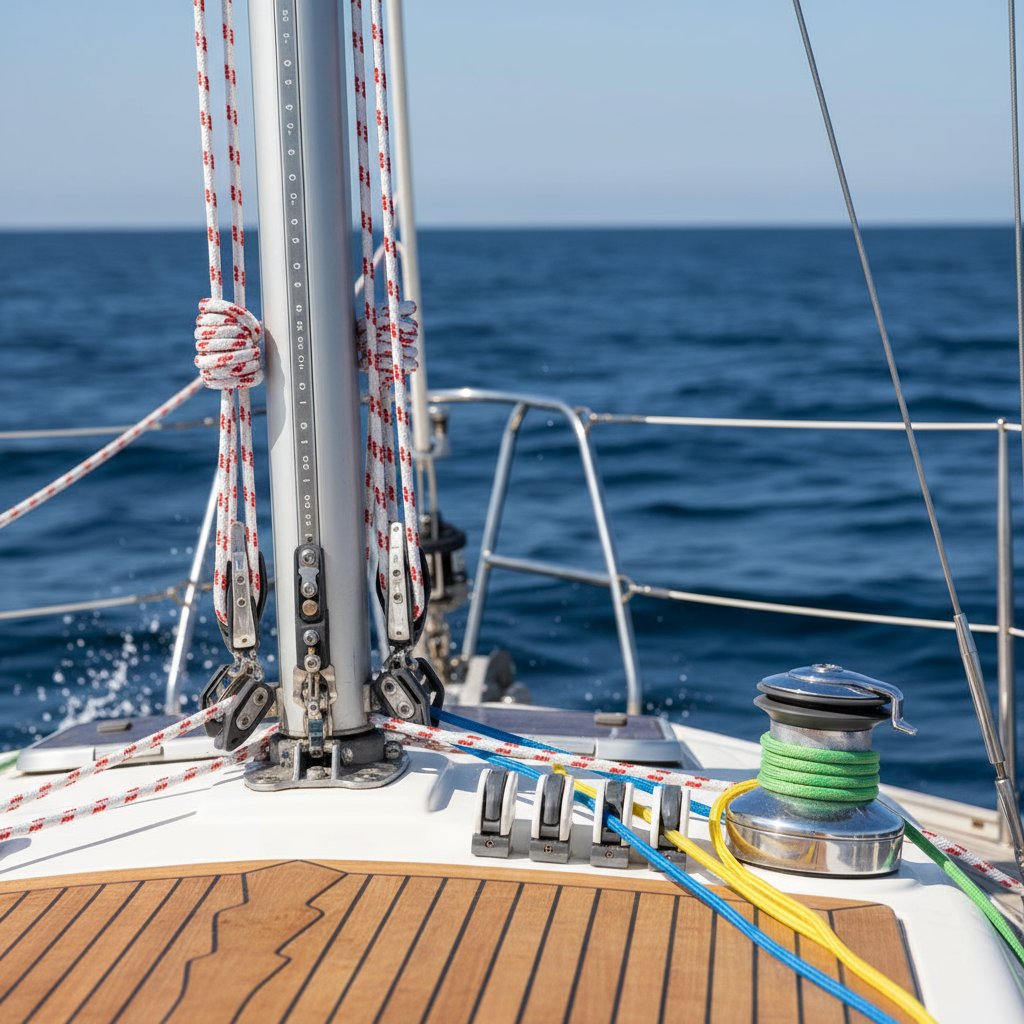
Building on those deck basics, the real magic happens with running rigging—the lines that let you harness the wind and make your sailboat dance across the water. These are the adjustable ones you tweak constantly, whether you're tacking through a regatta or just enjoying a lazy cruise. Getting them right means smoother sails and less hassle when conditions shift.
At the heart of running rigging are halyards, the lines that hoist your sails skyward. The mainsail halyard runs from the head of the sail up to the masthead sheave and back down to a winch or clutch in the cockpit. Jib halyards do the same for the forward sail, while spinnaker halyards handle those lightweight flyers for downwind runs. Think of them as the elevators of your boat—without precise hoisting, your sails won't catch the breeze efficiently.
Then come the sheets, your go-to for trimming sails to the perfect angle. The mainsail sheet controls the boom's swing, pulling it in tight or letting it ease out. Jib sheets work in pairs, one for each side, leading from the sail's clew through blocks to self-tailing winches. Spinnaker sheets guide that big, billowing chute without letting it collapse or twist. Ever felt the pull as you sheet in during a gust? That's the power transferring directly to your boat's speed.
Don't overlook control lines, the fine-tuners that shape your sails for peak performance. A cunningham pulls the luff down to flatten the sail in heavy air. The vang keeps the boom from lifting, maintaining twist control. Outhaul stretches the foot taut along the boom, and reefing lines let you reduce sail area quickly when winds build. These elements keep everything optimised, preventing sloppy sail shapes that rob you of speed or stability.
Key Components
Essential Running Rigging Parts
Halyards
Hoist sails like mainsail or jib for quick deployment.
Sheets
Trim sails for optimal wind capture and boat balance.
Control Lines
Fine-tune sail shape with cunningham, vang, and more.
Routing Tips
Paths for Efficiency
Halyard Paths
Through mast sheaves to minimise friction on the way up.
Sheet Leads
To winches via fairleads for easy, tangle-free trimming.
Clutch Setup
Control lines to jam cleats, reducing wear and effort.
Now, what type of line works best for this setup? For sailboat running rigging, polyester stands out for its balance of low stretch and UV toughness, keeping sails steady without snapping under load. Dyneema takes it further with near-zero elongation and superior strength-to-weight, ideal for racing where every inch counts. Both offer durability against the salt and sun, but custom options from iRopes let you tailor diameters or add low-friction coatings for your exact needs.
To keep things flowing, organise with blocks to redirect lines cleanly, cleats for secure holds, and deck organisers that bundle halyards aft. Swapping in better organisers can turn a chaotic cockpit into a command centre, making adjustments instinctive. This setup streamlines handling, cuts down on snags, and lets you focus on the horizon rather than untangling a mess.
While these moving parts drive your sails, a solid framework underneath keeps the whole rig steady against the elements.
Sailboat Lines and Rigging: Standing and Mooring Systems
Running rigging brings sails to life, but the boat's structure relies on stable support systems to stay secure under load. Standing rigging forms that backbone, the fixed elements that hold everything upright when the wind howls and waves push back. Without it, your mast would sway like a reed in a storm, turning a smooth sail into a risky gamble. These lines—and often wires—bear constant tension, so getting their setup right is non-negotiable for keeping your crew safe and the boat balanced.
Start with the stays, those forward and aft lines anchoring the mast. The *forestay* runs from the bow to the masthead, countering forward bend and supporting the jib or genoa. The *backstay* pulls from the stern, preventing the mast from kicking too far ahead under gusts. Then there are the shrouds, paired on each side—upper ones from higher on the mast to the chainplates, lowers closer to the deck. Together, they stop lateral wobble, like guy wires on a tall pole. Proper tuning of these shrouds keeps the mast poker-straight even through 25-knot winds, allowing you to push harder without worry.
Safety ties in here too, especially with lifelines, the stainless steel cables or ropes encircling the deck from bow pulpit to stern pushpit. They're your guardrails, there to catch anyone slipping on a wet deck or during a sudden heel. Paired with jacklines—long, secure lines run fore and aft—they let you clip in a harness for offshore passages, tethering you to the boat if you go over. Clipping on during a choppy night watch, for instance, turns potential disaster into just a wet jacket.
Standing Rigging
Fixed supports like forestay and shrouds maintain mast position against wind loads.
Lifelines
Encircling cables prevent falls, often with stanchions for added strength.
Mooring Lines
Docklines secure bow and stern to pilings, routed via fairleads to cleats.
Anchor Rodes
Chain and rope combo from bow roller to seabed for holding power.
Shifting to when you're not underway, mooring and docking lines take over. Docklines—bow and stern—run from cleats through chocks to pilings, holding the boat parallel to the dock. Springlines, forward from the aft cleat and aft from the forward one, stop surging. For anchoring, the rode combines chain near the anchor for bite and nylon rope for stretch, paid out from the bow roller or windlass. Proper routing keeps it clear: lead docklines along the rail to avoid snags, and coil rodes neatly on deck. For enhanced performance, explore double braid nylon dock line solutions that offer customizable strength and elasticity tailored to your boating needs.
One key detail for anchors: scope matters for grip. Aim for 7:1 to 10:1 rode length to water depth—say, 210 to 300 feet in 30-foot water—for secure holding without dragging. Nylon works well here for its elasticity, absorbing shocks, while chain adds weight to set the hook. In rough spots, that extra length approximates the old 10% rule of thumb, giving your setup the forgiveness it needs. Consider iRopes double braid anchor ropes for options that boost anchoring safety with lightweight, high-strength designs.

These systems demand materials that resist constant pull and exposure, setting the stage for choices that match your sailing style.
Materials, Maintenance, and Customisation for Sailboat Lines
The performance of your sailboat lines and rigging largely depends on the materials chosen. The right material isn't just about strength; it's about how it performs under relentless sun, salt spray, and sudden loads. Picking wisely can mean the difference between a reliable setup and one that frays at the worst moment.
Polyester remains a go-to for its solid UV resistance, holding up year after year without brittleness, making it perfect for everyday cruising where exposure is constant. For those chasing speed in races, Dyneema shines with its minimal elongation under tension, keeping sails taut and responsive without the weight penalty. But why stop at off-the-shelf? iRopes steps in with OEM and ODM services, letting you dial in exact diameters from 6mm for smaller boats to 14mm for larger ones, or lengths tailored to your mast height plus extra for safety margins. Add reflective strips for night visibility, and you've got lines that not only work harder but also enhance safety during dusk runs. To learn more about its versatile applications, check out polyester rope uses and benefits for marine and outdoor settings.
- Polyester - Balances cost and longevity, ideal for sheets and halyards in moderate conditions.
- Dyneema - A lightweight powerhouse for high-performance needs, reducing crew effort on winches.
- Custom Blends - iRopes mixes fibres for specific uses, such as adding Technora for extra chafe protection on docklines.
Sizing gets tricky without guidelines. However, you should match the diameter to your boat's scale—for a 30-foot vessel, 8-10mm works for most running lines, gripping winches without slipping while remaining easy on the hands. For lengths, add double the sail's luff dimension to your halyard, or 1.5 times the boat's overall length for jib sheets to ensure you never come up short mid-manoeuvre. Accidentally shorting a mainsheet by a foot on a borrowed boat turned a simple gybe into a scramble, which was a lesson learned the hard way.
Maintenance keeps these investments performing, starting with regular checks for fuzzing at contact points or faded colours signalling UV wear. Master a few knots to secure everything right: the bowline for loops that won't slip under load, a cleat hitch for quick winch ties, and a figure-eight knot to stop lines from pulling through blocks. Coil and store them dry, away from direct sun, to avoid mildew. Plan to swap out lines every three to five years, depending on use—racing lines might need replacement sooner if they're seeing constant abuse.
iRopes' Tailored Approach
Our precision manufacturing, backed by ISO 9001 certification, crafts yachting lines that fit your routing perfectly, minimising wear and boosting safety through custom cores and terminations.
Ever caught yourself wondering if your lines could handle that next big trip better? With thoughtful material picks and upkeep, they will, paving the way for confident outings where every detail supports smoother, safer sails.

Understanding lines on a boat transforms your sailing from a tangle of confusion to a seamless adventure on the water. From halyards hoisting sails efficiently through mast sheaves to sheets trimming with precision via winches, proper routing secrets ensure smoother handling and reduced chafe on your lines on a sailboat. Standing rigging like stays and shrouds provide unyielding mast support, while mooring lines secure docking with optimal scope and deck layout strategies that prevent snags. With materials like polyester for durability or Dyneema for low-stretch performance, plus regular maintenance checks for chafe and UV damage, sailboat lines and rigging become reliable partners in safety and speed. Optimising these elements elevates every voyage, whether cruising or racing.
Need Custom Sailboat Lines Tailored to Your Vessel?
If you're keen to apply these routing and maintenance insights to your specific boat setup, the inquiry form above connects you with iRopes experts for personalised OEM solutions, ensuring your lines fit perfectly for safer, more efficient sails. iRopes is committed to being a strategic partner, offering not only high-quality rope products but also comprehensive OEM, ODM, and IP protection services to elevate your brand and achieve success.
