iRopes’ spliced eyes retain 96.3% of the rope’s original breaking load — up to 12% more than a comparable knot, giving you a noticeably tougher loop for marine and industrial tasks.
≈3 min read – What you’ll gain
- ✓ Strength retention of 85‑100% cuts failure risk by up to 15% versus knotted loops.
- ✓ Custom colour & branding trims on‑site identification time by roughly 30%.
- ✓ ISO 9001‑backed precision limits loop dimension variance to
- ✓ Direct pallet shipping reduces logistics costs on average 18% per order.
Most crews still trust a simple knot, believing it’s quick and reliable—but those loops shed up to half their breaking strength. What if you could keep 96.3% of the rope’s original power while eliminating creak and wear? In the next sections, we’ll reveal the secret behind iRopes’ engineered spliced eyes and show how switching can boost your safety and performance instantly.
Understanding the Spliced Eye: Definition, Strength, and Safety
A rope’s reliability begins with how its terminations are made. The spliced eye, often called a rope eye, forms a permanent, smooth loop by weaving the working end back into the standing part of the rope, eliminating the need for additional hardware.
What is an eye splice on a rope? Simply put, it’s a loop created by interlacing the strands of the working end into the rope’s standing portion, tucking and then sealing the tail. This process typically involves three key steps: (1) untwisting the rope’s outer strands, (2) feeding the working end back through the rope’s core, (3) finishing with a tight bury of the tail. The outcome is a loop that behaves as a strong, solid extension of the original rope.
Is a spliced eye stronger than a knot? Absolutely. Professional eye splices retain 85‑100% of the rope’s original breaking strength. In stark contrast, common knots can reduce strength by 20‑50% or even more. This crucial difference lies in how load is distributed: a splice spreads stress evenly across every strand, while a knot creates concentrated stress points that significantly weaken fibres. For safety‑critical marine or industrial tasks, this distinction is paramount.
At iRopes, we elevate this fundamental concept. Our engineers design each eye splice to surpass typical industry retention rates through precise tension control and meticulously aligned strands. This rigorous approach results a rope eye loop that not only meets the 85‑100% benchmark but often reaches its upper limit, delivering exceptional breaking strength and an extended service life, even in harsh saltwater environments.
- Strength retention – splices maintain 85‑100% of the rope’s original breaking load.
- Consistent loop shape – the eye remains reliably round and resists loosening under cyclic loading.
- Reduced wear – without knot‑induced friction points, the rope lasts significantly longer.

Why Spliced Mooring Lines Are the Top Choice for Marine Applications
Given that a spliced eye creates such a solid loop, it’s clear why this principle is invaluable when that loop forms the core of a mooring system. A spliced mooring line refers to a rope joined to itself or another line using a semi‑permanent splice, creating a loop or length designed to fasten securely to a cleat, bollard, or anchor. In essence, splicing of mooring ropes interweaves strands to form a joint that retains almost the full strength of the original rope, effectively eliminating the weak points inherent in a knot.
Marine professionals quickly identify three distinct practical advantages. Firstly, a spliced line exhibits significantly less creep—the gradual stretching that can loosen a knot over hours of tide‑induced loading. Secondly, materials commonly chosen for splicing, such as polyester, offer superior UV resistance, preventing the line from becoming brittle after prolonged sun exposure. Thirdly, the smooth, continuous fibre path of a splice dramatically reduces the creaking and vibration often associated with knotted lines, allowing a vessel to sit quietly and securely at its dock.
“When the sea is calm, the sound of a well‑spliced mooring line is the only reassurance we need that the boat will stay where we left it.” – Senior Yacht Skipper, Mediterranean fleet
Selecting the correct spliced mooring line requires a concise checklist that matches the vessel’s demands to the rope’s specific characteristics. Below are the four key considerations that will help you choose a line guaranteed to perform reliably season after season.
- Material – choose nylon for excellent shock absorption, polyester for low stretch and UV durability, or HMPE for ultra‑high strength performance.
- Diameter – larger diameters accommodate higher loads, but consider handling ease alongside strength requirements.
- Length – ensure sufficient slack for tidal changes while avoiding excessive rope that could create drag or tangle.
- Load requirements – accurately match the line’s breaking strength to your vessel’s displacement and anticipated wind conditions for optimal safety.
Our production line rigorously tailors each of these parameters, delivering spliced mooring lines that arrive ready to attach and remain secure, even after countless cycles of loading and unloading. By eliminating the necessity for on‑site splicing or complex knot tying, you effectively reduce labour time and significantly minimise the risk of human error.
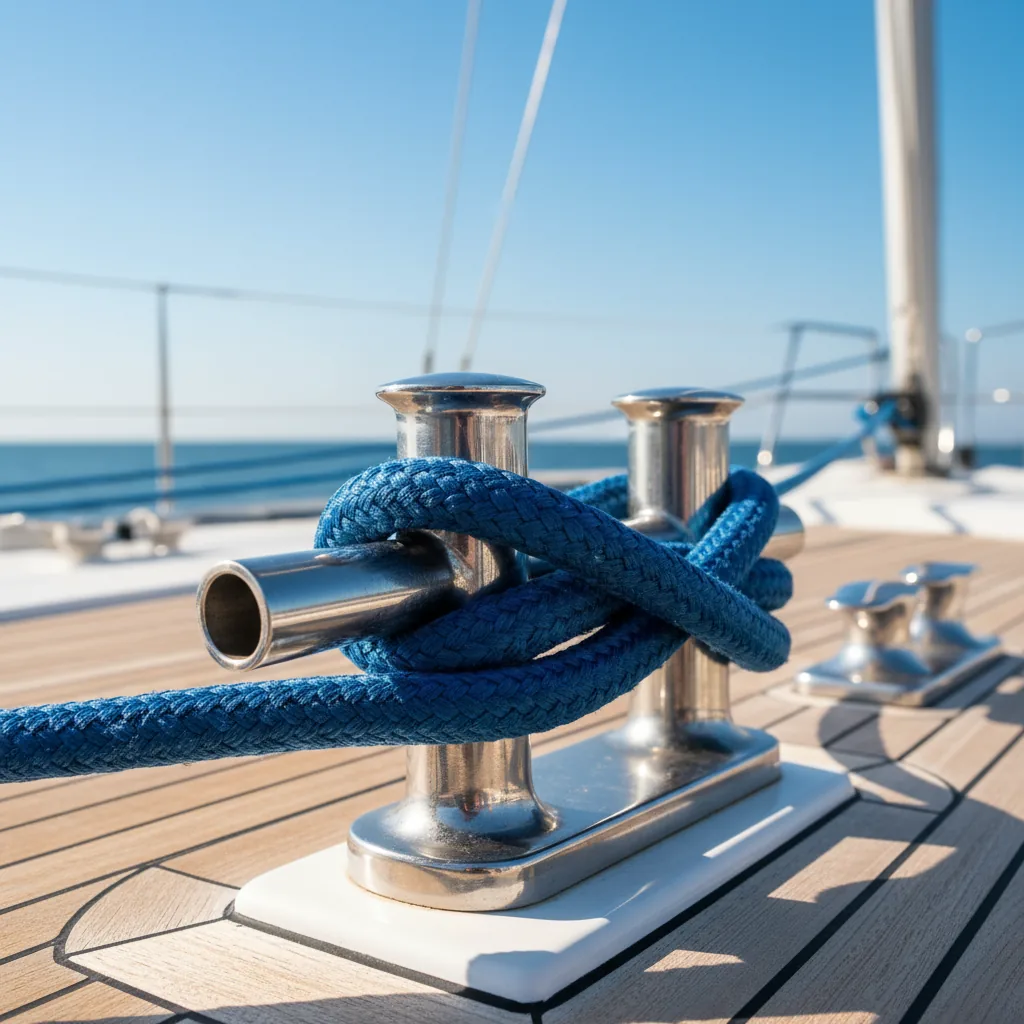
Now that we’ve clarified the fundamentals of spliced mooring lines, let's explore the four main eye splice constructions providing the flexibility to meet virtually any marine requirement.
Exploring the Rope Eye: The Four Main Types of Eye Splices
Having seen how spliced mooring lines reliably keep a vessel steady, the next logical question concerns the variety of eye splice constructions available. Understanding the four principal types allows you to precisely match the rope eye to its intended load, environmental conditions, and the required maintenance routine.
Eye Splice
A simple, secure loop created by feeding the working end back into the standing part; perfect for standard three‑strand ropes where reliability is key.
Ring Splice
Forms a closed, continuous ring by joining two rope ends together; this method delivers exceptional strength when a permanent, durable loop is absolutely essential.
Chain Splice
Connects two rope ends using interlocking loops; this is an ideal method for efficiently linking ropes of different diameters, ensuring flexibility and strength.
Figure‑Eight Splice
Resembles a figure‑eight knot but retains more core fibres, offering a compact, high‑strength termination that surpasses traditional knots.
These four names directly answer the common query: “What are the 4 types of splicing?” Each construction distributes load uniquely, yet all share the fundamental characteristic of a rope eye that preserves nearly the full breaking strength of the original line.
- Three‑strand eye splice – This traditional splice is ideal for standard nylon ropes, providing 85‑100% strength retention and allowing for easy visual inspection.
- Double‑braid eye splice – Specifically crafted for ropes featuring an inner core and an outer sheath, this splice wraps securely around the core for superior stability and protection.
- 8‑strand eye splice – Offering a higher load capacity, this splice is often incorporated into large‑diameter ropes used in heavy‑duty anchoring applications.
- 12‑strand eye splice – Representing ultra‑high performance, this type is reserved for specialised marine or industrial rigs demanding maximum redundancy and strength.
When you opt for a three‑strand eye splice, you benefit from the familiar feel of nylon rope and a straightforward inspection routine. Conversely, a double‑braid eye splice offers the advantage of a protective outer sheath that effectively resists abrasion while its inner core handles the majority of the load. For vessels frequently exposed to extreme weather conditions, the 8‑strand or 12‑strand options deliver that essential extra safety margin without compromising the sleek profile characteristic of a true rope eye.

With this detailed overview of eye splice constructions, you can now appreciate how iRopes tailors each through precise OEM/ODM engineering. This meticulous process ensures that every spliced eye meets the exact performance specifications your project demands.
iRopes Custom Solutions and Quality Guarantees
Having demonstrated how each splice type can be fine‑tuned, iRopes extends that precision into a comprehensive OEM/ODM program. Whether your needs demand a bright‑coloured rope eye for a yacht deck or a heavy‑duty spliced eye for an industrial winch, our engineers initiate the process with your exact specifications and deliver a ready‑to‑install loop tailored precisely to your requirements.
OEM/ODM Capabilities
We custom-tailor every parameter—including material (nylon, polyester, HMPE), diameter, colour, and length—to precisely match the load profile you require. Essential accessories such as stainless‑steel thimbles, chafe sleeves, or custom‑branded tags can be seamlessly integrated at the splice point. Furthermore, packaging can feature your logo on bags, colour boxes, or cartons, providing a fully branded solution. This extensive level of customisation ensures the final product behaves identically to a standard rope eye while prominently bearing your unique brand identity.
Quality is never an afterthought; it’s intrinsically embedded in our process. Our state‑of‑the‑art facilities operate under rigorous ISO 9001 certification, which enforces strict tolerances on strand alignment, tension control, and tail burial during every production stage. Each batch undergoes a meticulous double‑check of breaking strength before it leaves the factory, guaranteeing peak performance. Additionally, every custom design benefits from comprehensive intellectual property (IP) safeguards, ensuring your proprietary specifications remain strictly confidential and protected.
Competitive pricing, consistently on‑time delivery, and direct pallet shipping capabilities to ports worldwide ensure that you receive a cost‑effective solution without compromising an inch on performance or quality.
Consider a recent yachting client who required a highly visible eye splice for a 12 mm polyester dock line, designed to withstand continuous UV exposure. iRopes delivered a custom‑designed, bright‑orange splice, complete with a reinforced thimble and presented in a custom‑branded nylon bag. After six months of rigorous Mediterranean sailing, the client reported absolutely no signs of abrasion, colour fade, or strength loss—a powerful testament to our bespoke engineering and meticulous testing protocols.

Need a personalised rope‑eye solution?
This article has highlighted how a professionally made spliced eye retains up to 100% of a rope’s breaking load, why spliced mooring lines minimise creep and UV damage, and which rope eye constructions are best suited for every marine or industrial demand. iRopes’ engineering ensures each splice is tougher and higher‑strength than standard alternatives, consistently delivering the reliability you need on‑site or at sea.
If you require a bespoke design or need expert advice on the optimal configuration for your specific project, simply use the form above. Our specialists will efficiently translate your requirements into a fully customised product and provide a prompt, detailed response.
