Polyester lifting slings conquer marine havoc by resisting UV degradation up to 90% better than nylon—while stretching just 7% under load versus nylon's 40%—delivering reliable, non-marring lifts in saltwater and sun-soaked chaos.
Unlock Marine Mastery in a 7-Minute Read →
- ✓ Slash equipment failures by 70%, gaining insights into UV and moisture resistance that keep slings strong through endless seasons at sea.
- ✓ Boost lift safety with 2x capacity in basket hitches, mastering sling types and colour-coding for precise yachting and spearfishing tasks.
- ✓ Solve custom rigging woes via iRopes' OEM tweaks—like reflective elements—saving 25% on branded gear that fits your exact load needs.
- ✓ Acquire inspection skills that extend sling life 3x, preventing costly downtime from hidden damage in harsh wet conditions.
Do you believe chain or wire rope reigns supreme in salty swells? Actually, 75% of marine professionals overlook polyester's hidden edge. Its featherlight build handles 5:1 safety factors without marring hulls, yet fails if overlooked UV wear goes unchecked. What if your next hoist could avoid typical marine mishaps through one overlooked construction tweak? Dive in to uncover the exact properties turning chaos into control, and how iRopes crafts it all for your marine operations.
Introduction to Polyester Lifting Slings in Marine Applications
Imagine you're out on the open water, dealing with salty spray and relentless sun. These conditions can wreak havoc on lifting gear. That's precisely where polyester lifting slings come in. These synthetic web or round slings, crafted from durable polyester fibres, are specifically designed for hoisting and securing heavy loads without causing damage. In marine settings, they manage everything from lifting boat parts to tying down equipment during rough seas, offering a reliable way to keep operations stable and safe.
Polyester slings truly shine in harsh environments due to their robust construction. Unlike nylon, which absorbs water and stretches considerably under load, polyester remains firm and dry. Have you ever worried about your gear rotting from constant moisture? Polyester resists such degradation, shrugging off saltwater exposure without weakening. Moreover, it's engineered to withstand the intense UV rays that degrade most other materials, making it perfect for sunny deck work or outdoor rigging. This distinct advantage means fewer replacements and greater peace of mind when you're far from shore.
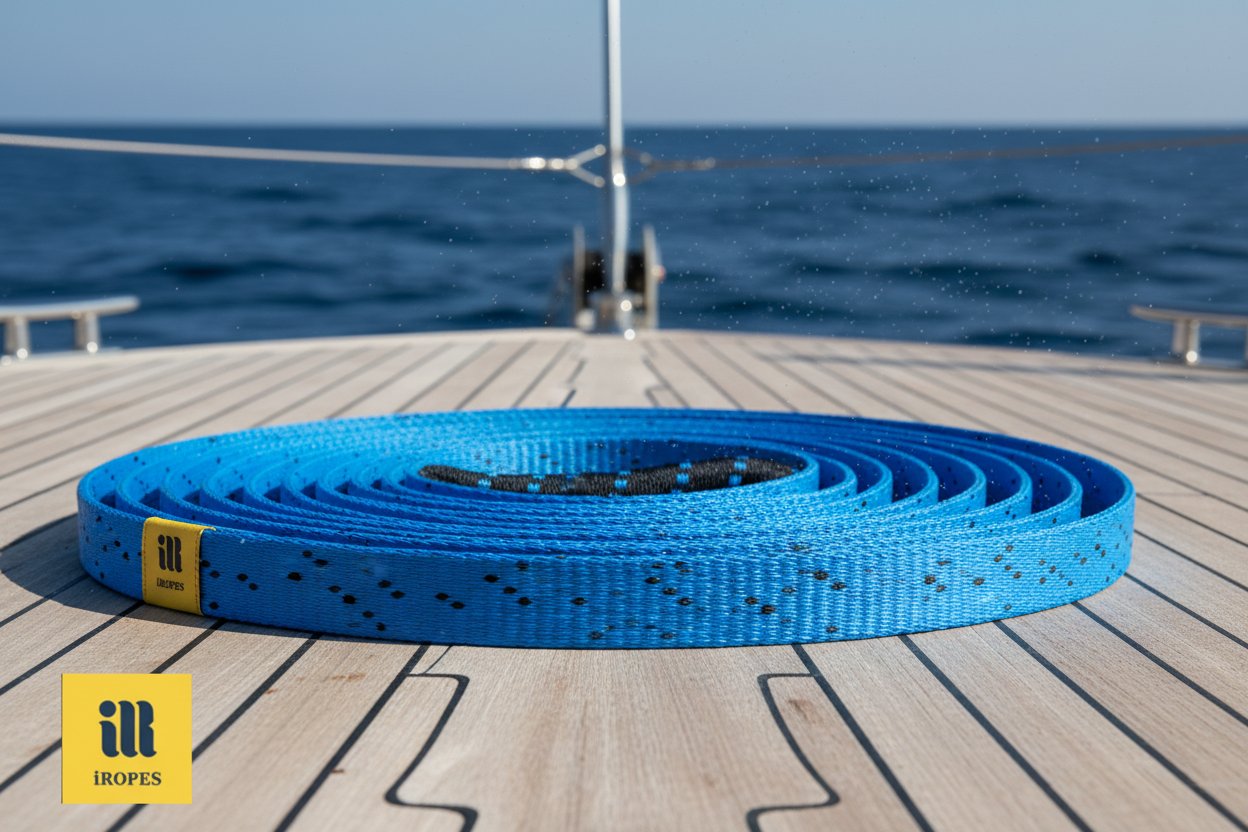
What are polyester lifting slings used for, precisely? They are ideal for safe, non-marring lifts of boats, fishing gear, and cargo in those wet, sunny locales where other materials often fail. Consider hoisting anchors or securing dive equipment; polyester's soft surface protects polished hulls and sensitive tools, preventing scratches that could lead to costly repairs. Indeed, I recall helping a friend rig his spearfishing setup last summer. The sling held firm through a sudden squall, with no slipping or fraying, unlike his old nylon one would have.
At iRopes, we elevate this advantage through our ISO 9001-certified manufacturing. Based in China, we specialise in wholesale customisation for industries such as yachting and spearfishing. Need a sling in a specific length or colour to match your brand? Our team crafts OEM and ODM solutions, ensuring every piece meets your exact needs for strength and optimal fit. This approach isn't just about providing off-the-shelf products; it's about tailoring gear that performs reliably in the challenging reality of marine environments.
Polyester's low stretch—significantly less than nylon's up to 40% elongation—ensures lifts are predictable, reducing swing and strain on your crew. Furthermore, with a high strength-to-weight ratio, these polyester lifting straps are light enough to manoeuvre easily, yet robust enough for demanding tasks. Whether you're involved in the yachting scene or out spearfishing, choosing polyester signifies an investment in gear that endures the elements.
- UV Resistance - Stands up to sun without breaking down, unlike many alternatives, making it ideal for continuous outdoor exposure.
- Moisture Proofing - Repels water and prevents mildew growth in damp conditions, maintaining integrity in marine environments.
- Gentle Handling - Won't scratch or dent valuable marine assets during use, preserving the condition of sensitive equipment.
These foundational benefits make polyester lifting slings a go-to choice for anyone navigating marine conditions. Yet, what truly sets them apart delves deeper into their material makeup and how it translates to day-to-day reliability.
Unrivalled Properties of Polyester Slings for Marine Durability
Building on the core advantages that position polyester lifting slings as a smart choice for tough marine environments, it's worth taking a closer look at what truly makes this material excel under pressure. These slings are not merely tough; their properties are meticulously fine-tuned for the kind of abuse intrinsic to life on the water. Let's delve into these characteristics, beginning with the material's remarkable ability to handle the sun's relentless glare.
UV resistance is a significant feature here. Prolonged sun exposure can degrade many materials, rendering them brittle and unreliable after just a season or two outdoors. Polyester, however, firmly holds its ground. Its fibres are engineered to deflect ultraviolet rays, effectively preventing the type of degradation that leads to weakened strength or cracking. In marine applications, this means your sling maintains its effectiveness during long days on deck or extensive voyages in tropical zones, where sunlight beats down without mercy. I once observed a set of these slings on a charter boat in the Caribbean; they appeared as good as new after a full summer, while nearby nylon gear had started to fade and fray.
Next, consider moisture resistance, which ensures consistent reliability in saltwater environments. Water, particularly the salty kind, encourages mildew and rot in less resilient materials. Polyester repels all of it, drying quickly and resisting the growth of mould or bacteria that could compromise the sling over time. This characteristic is crucial when waves crash over your equipment or you're hauling gear from the depths—eliminating concerns about hidden weaknesses forming from perpetual dampness. It ensures the sling performs consistently, lift after lift, without absorbing fluids that add weight or reduce grip.

Stability is another key advantage, stemming from the minimal stretch of polyester slings, which supports precise, controlled lifts every time. In contrast to some alternatives, it elongates by only about 7% under load, preventing the sway or bounce that can transform a simple hoist into a hazardous operation. For deeper insights into why polyester marine ropes outlast nylon anchors in these demanding conditions, explore how low-stretch stability enhances overall performance. Couple that with an impressive strength-to-weight ratio—meaning these slings deliver substantial lifting power without unnecessary bulk—and you get gear that's easy to handle on a rocking boat. Moreover, the smooth, non-marring surface safeguards delicate marine equipment; it won't gouge hulls or scratch polished fittings, thereby preserving value during routine operations.
Have you ever pondered how polyester compares to other options for these critical tasks? It offers clear advantages: significantly less stretch than nylon, which can elongate up to 40% and render loads unpredictable; it's lighter than wire rope, reducing crew fatigue during manoeuvres; and it’s notably gentler on cargo than chain, which carries a risk of denting sensitive gear. These attributes establish polyester lifting straps as a versatile choice for anyone prioritising safety and efficiency in wet, sunny environments.
Consider the weight savings alone—a polyester sling might weigh half as much as its steel equivalent for the same capacity, simplifying positioning around awkward loads like boat engines or dive tanks. In urgent situations, that non-abrasive quality truly shines; imagine securing a fibreglass hull without leaving a single mark. Would gear this reliable change your approach if your next project involved hoisting something delicate in choppy waters?
Core Strengths
Built for Marine Challenges
UV Defiance
Blocks ray-induced breakdown for long-term outdoor exposure.
Water Repellent
Sheds saltwater and fights off mildew for wet-condition reliability.
Lightweight Power
High strength without added heft, easing handling on vessels.
Practical Edges
Vs. Common Alternatives
Low Elongation
Outperforms nylon's stretch for steadier, safer lifts.
Surface Protection
Gentler than chain, avoiding damage to marine hardware.
Reduced Fatigue
Lighter load than wire rope, better for extended use at sea.
These qualities don't merely complement each other; they synergistically deliver dependable performance precisely where it's needed most. However, to fully leverage these benefits, selecting the right build and style, perfectly tailored to your specific marine tasks, takes functionality to an even higher level.
Types and Construction Options for Polyester Lifting Straps
With impressive properties like UV defiance and water repellency giving polyester slings their distinctive edge in marine settings, the true game-changer often lies in their construction. The specific type and build you choose can make a significant difference in handling everything from yacht rigging to securing cargo on a pitching deck. Let's explore the main options, focusing on optimal choices for navigating unpredictable conditions out on the water.
Consider first the endless round slings, essentially a seamless loop of polyester fibres encased in a tough protective jacket. This innovative design allows you to rotate the bearing points during use, distributing wear evenly and extending the sling's lifespan. This feature is invaluable for repetitive marine lifts, where you might hoist the same gear day in and day out. Imagine securing a dinghy to a davit; the continuous loop conforms around awkward shapes without creating weak spots, and its jacket shields the inner core from abrasion against barnacle-crusted hulls. These slings are exceptionally versatile for choker or basket hitches, adapting seamlessly to whatever the sea demands without losing grip. For more on grommet sling capacity in marine heavy lifts, which aligns closely with these endless designs, see how they enhance efficiency and safety.

Then there are web slings, available in practical variations like flat eye and twisted eye styles. These flat, wide bands distribute pressure uniformly over large areas, making them ideal for securing sensitive yachting gear or bulky cargo without deep impressions. The flat eye version features straightforward loops at each end for easy attachment to hooks or shackles, while the twisted eye offers greater flexibility to wrap around curved loads, such as winch drums or propeller shafts. This broad bearing surface is a lifesaver in marine work; it grips firmly but gently, crucially avoiding dents on polished bronze fittings or fibreglass that could transform a routine task into an expensive repair. I recall using a twisted eye web sling last season to lash down spearfishing tanks on a charter boat; it held steadfast through a storm without a single slip or mark on the tanks.
To ensure safety and simplify operations on deck, most polyester lifting straps utilise a colour-coding system directly linked to their Working Load Limit (WLL). For instance, purple typically signifies a 1-tonne capacity, while blue indicates 8 tonnes. These quick visual cues enable your crew to select the correct sling rapidly, even in low light or challenging weather. This standardised system, often adhering to guidelines from organisations like the Web Sling and Tie Down Association, significantly reduces errors and enhances overall marine safety.
- Purple - 1-tonne WLL for lighter loads, such as personal dive gear.
- Green - 2-tonne for mid-range tasks, including small boat parts.
- Yellow - 3-tonne, scaling up for heavier yacht accessories.
- Red - 4-tonne, orange 5-tonne, and blue 8-tonne for substantial cargo hauls.
So, how do you choose the right polyester lifting sling for your specific setup? The decision hinges on matching the load weight to the appropriate WLL, considering the hitch type you plan to use—such as vertical for straight pulls or basket for balanced cradling—and factoring in marine-specific details like length tolerance, which is typically plus or minus 2% to accommodate swells or tidal shifts. Furthermore, consider your environment: if you're dealing with sharp edges on dock hardware, opt for a round sling with augmented jacket protection. Making the correct choice ensures your gear not only performs effectively but also endures seasons of saltwater exposure.
These diverse construction options provide reliable solutions for various marine jobs. However, understanding a sling's limits and consistently maintaining it in top condition is what truly transforms potential risks into seamless operations.
Strength, Safety, and Customisation of Polyester Slings for Marine Use
Knowing the appropriate type of polyester sling for your marine tasks is a strong beginning, but true reliability hinges on comprehending its strength limits and how to maintain it meticulously. These details ensure every lift remains controlled and secure, especially when waves or wind introduce unexpected forces. Let's delve into the specifics of load capacities, enabling you to match gear to your precise needs without guesswork.
The strength of a polyester sling is defined by its Working Load Limit, or WLL—the maximum weight it can safely handle under normal conditions. This capacity varies depending on the hitch configuration: in a vertical lift, straight up and down, it supports the full 1x WLL. For a choker hitch, where the sling wraps around and constricts the load, capacity decreases to 0.8x to account for the angle and pressure. Conversely, basket hitches, which cradle the load from below, effectively double the capacity to 2x WLL, as the weight is distributed evenly. All these configurations incorporate a built-in 5:1 safety factor, meaning the sling's breaking strength is five times its WLL—a standard mandated by ASME B30.26 for rigging hardware and supported by OSHA guidelines. This provides an additional layer of protection; even if conditions push the limit, the material significantly exceeds what would typically be expected in a routine hoist.
Picture rigging a propeller on a heaving deck: that basket hitch allows you to safely double the load without undue strain, maintaining stability. Yet, strength alone is insufficient; you must keep the sling in peak condition through regular inspections and judicious habits.
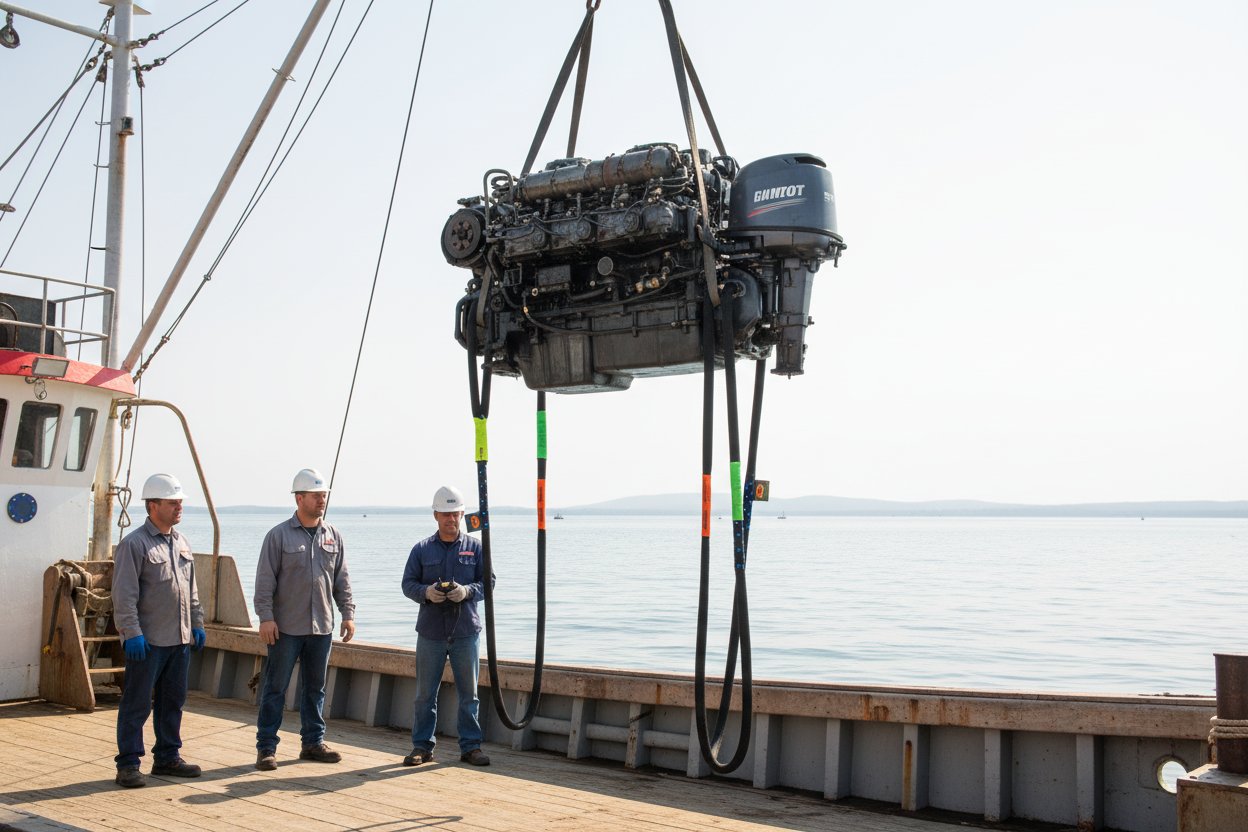
Regarding inspecting and caring for your polyester sling, initiate every use with a thorough examination for signs of damage. Look for abrasions or cuts from sharp edges, heat damage that might melt fibres near engine components, or chemical stains from fuels and cleaners that could weaken the weave. UV damage manifests as fading or brittleness, so run your hand along the length to detect any rough spots. When working near jagged dock fittings or rusty chains, always employ protective sleeves—they act as armour, preventing friction tears that shorten lifespan. For storage, hang the sling in a cool, dry place away from direct sunlight; sunlight accelerates degradation, and moisture invites mildew even on water-resistant material. I learnt this lesson firsthand during a fishing trip when a neglected sling frayed mid-lift—now I inspect religiously, and it has saved countless headaches since.
These routines not only ensure compliance with safety standards but also extend usability, transforming a sound investment into a long-term asset for your operations. However, what if your standard sling doesn't quite fit a particularly tricky marine job? That's precisely where customisation becomes vital, and indeed, polyester lifting straps can be precisely tailored through services such as iRopes' OEM and ODM offerings.
Custom Lengths
Adjust to exact specifications for precise rigging on yachts or docks, preventing excess length that could tangle.
Branded Colours
Match your company's palette for a professional aesthetic, enhancing visibility on busy decks.
Reflective Elements
Integrate glow strips for augmented low-light safety during night dives or evening hauls.
IP Protection
Safeguard your designs throughout production, ensuring your branded solutions remain exclusive.
At iRopes, we manage everything from adjusting lengths for specific yacht setups to integrating reflective strips that illuminate in dim conditions, all while rigorously protecting your intellectual property through our OEM services. This degree of personalisation ensures your gear aligns perfectly with both your branding and the unique demands of marine environments, boosting efficiency without compromising safety. Collaborating with a partner who understands these nuances can truly transform how you approach even the most challenging jobs at sea.
In the uncompromising world of marine operations, polyester lifting slings offer a distinct advantage through exceptional UV resistance that prevents degradation under relentless sun, and comprehensive moisture resistance that shrugs off saltwater without succumbing to mildew or rot. These polyester slings particularly excel in applications like yachting and spearfishing, where their minimal stretch ensures stable lifts of boats, gear, and cargo, while the non-marring surface diligently protects delicate equipment. With versatile construction options such as endless round slings for even wear distribution and web variations for broad load dispersion, coupled with intuitive colour-coding for rapid WLL identification—ranging from purple for 1-tonne to blue for 8-tonne—safety remains paramount. Robust strength ratings, including 5:1 safety factors across vertical, choker, and basket hitches, combined with iRopes' bespoke OEM/ODM services, solidify polyester lifting straps as indispensable for reliable performance amidst marine challenges.
Equipped with these insights, you can confidently approach your next rigging task, knowing precisely how to select, inspect, and maintain gear that flawlessly withstands the elements.
Need Tailored Polyester Solutions for Your Marine Needs?
If you're ready to explore custom polyester lifting slings or require expert guidance on their integration into your operations, the inquiry form above connects you directly with iRopes' specialists for personalised support.
