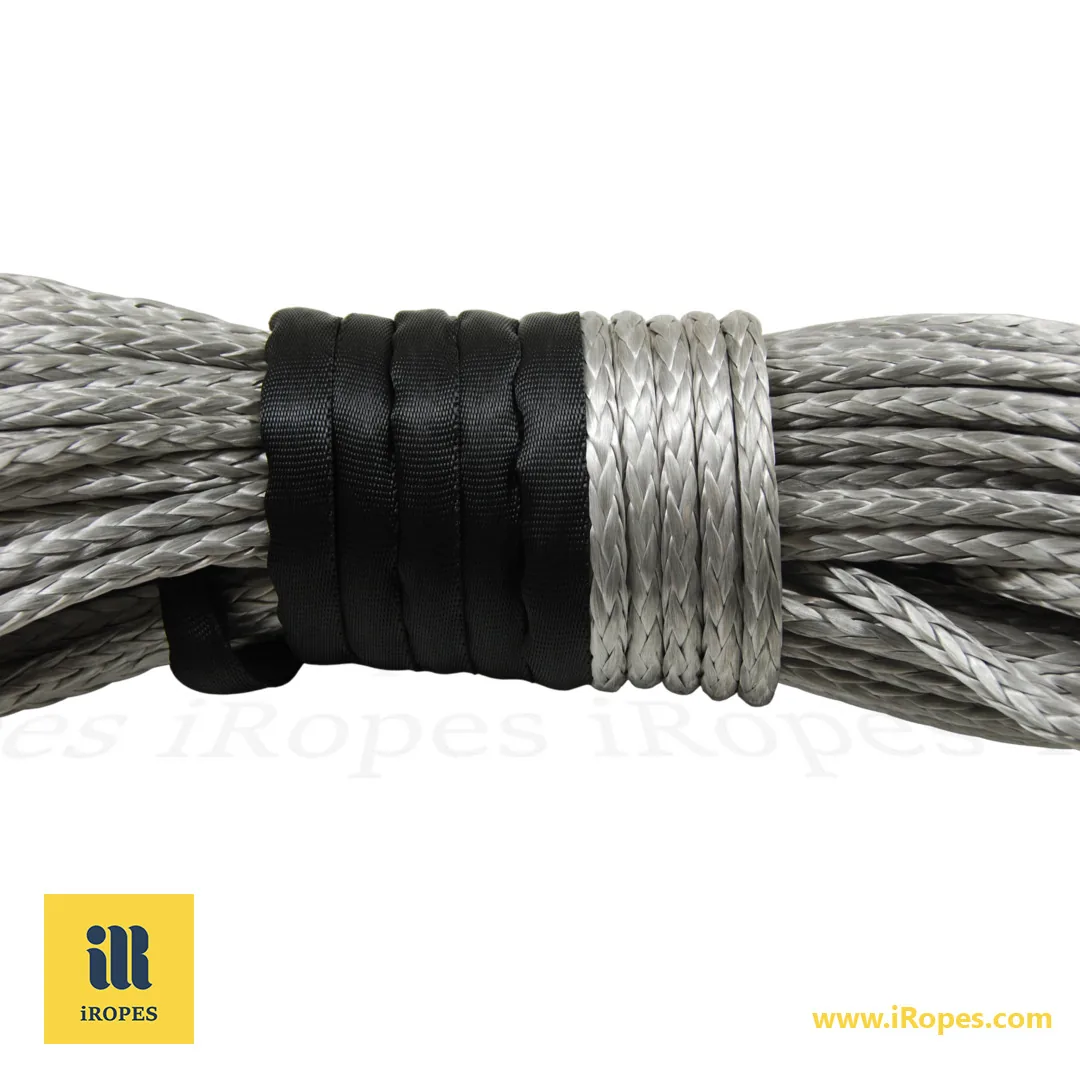
iRopes’ synthetic winch rope is up to 8.3 times lighter than 1-inch steel cable, yet it delivers the same ≈ 85,400 lb breaking strength.
What you’ll gain – ~2-minute read
- ✓ 7-9 times lighter than equivalent steel cables, cutting drum load and fuel use.
- ✓ Matching or exceeding steel breaking strengths (up to 17,500 lb) with significantly less mass.
- ✓ No sharp burrs and up to 60 % lower kinetic energy on snap-back, ensuring safer operation.
- ✓ Fully customisable diameter, colour, length, and accessories via OEM/ODM.
You’ve probably heard that a massive steel cable is the only way to achieve raw pulling power. But what if a lighter option could actually outperform it? iRopes’ synthetic winch rope delivers equal-or-greater breaking strength while shedding 85 % of the weight, slashing fuel use, and eliminating dangerous snap-back. Keep reading to discover the data-driven reasons why synthetic rope is the clear winner and how you can custom-tailor it to your exact needs.
Understanding the Limits of 1 inch Steel Cable
A 1 inch steel cable typically delivers a breaking strength of roughly 85,400 lbs. This translates to a working load limit (WLL) of about 17,080 lbs when applying a 5:1 safety factor. This information directly answers the common query, “What is the breaking strength of 1 inch steel cable?” It also clarifies why engineers rely on such high-capacity wire rope for the most demanding lifts.

Typical constructions for this size are 6x19 and 6x37. The first number denotes the number of strands, while the second indicates the wires per strand. These configurations provide a crucial balance of tensile capacity and core stability. Material choices usually involve galvanised steel for corrosion resistance or bright steel when visual inspection is a priority.
This heavy-duty cable finds its primary applications in industrial hoisting, structural support in construction, and large-scale material handling—situations where the ability to sustain multi-ton loads is non‑negotiable. Furthermore, the robust core of a 1 inch steel cable makes it highly suitable for fixed‑point anchoring on offshore platforms.
- Heavy weight - The sheer mass of a 1-inch steel cable adds significant load to winch drums and transport logistics.
- Corrosion risk - Even with galvanised finishes, deterioration occurs in salty or humid environments, requiring regular, costly inspection.
- Snap-back danger - When a steel cable fails, it recoils at high velocity, posing severe injury hazards to personnel and equipment.
These drawbacks become especially apparent when the cable is used in mobile recovery or exposed to marine conditions. In such environments, weight penalties and rust significantly accelerate maintenance cycles and increase operational costs.
In high-impact recovery scenarios, the kinetic energy released by a snapping steel cable can exceed 1,000 joules, making synthetic alternatives a markedly safer choice.
Understanding these limitations is crucial, as it sets the stage for evaluating smaller diameters like the quarter inch steel cable and, ultimately, the popular 3/8 inch winch cable, where synthetic rope options begin to demonstrate clear advantages.
Performance Profile of Quarter Inch Steel Cable
Having examined the constraints of a 1-inch steel cable, the logical next step is to look at the much smaller, yet widely used, quarter inch variant. This size often appears in aircraft rigging manuals and light-duty tie-down kits, where its compact profile offers a balance of strength and manoeuvrability.
For a quarter inch steel cable built with 7x19 aircraft-type construction, the breaking strength is roughly 7,000 lbs. This translates to a working load limit (WLL) of about 1,400 lbs when a 5:1 safety factor is applied. This directly answers the common query, “How much weight can a 1/4 inch steel cable hold?” and provides engineers with a clear baseline for safe design in specific applications.

Material choice plays a decisive role in the cable's long-term performance. Galvanised steel provides a protective zinc layer that slows corrosion in humid environments, while stainless-steel variants eliminate rust altogether but come with a higher price tag. Selecting the appropriate alloy, therefore, hinges on the operational climate and the available maintenance budget.
In practice, the quarter inch steel cable finds its niche in aircraft control-system cables, lightweight tie-downs for cargo, and various mechanical control loops where space is at a premium. Its relatively small diameter allows it to route through tight pulleys and sheaves without excessive friction, making it a favourite among aviation technicians and off-road enthusiasts alike.
Despite these strengths, this cable does have notable drawbacks. Its smaller strand diameter reduces flexibility, making it more susceptible to kinking when bent sharply. Additionally, the thin construction demands regular inspection for wear and corrosion, especially when exposed to salty or abrasive conditions. This adds to maintenance requirements and operational costs.
- Material – Galvanised or stainless steel determines corrosion resistance, impacting longevity.
- Typical uses – Ideal for aircraft rigging, light-duty tie-downs, and sensitive control systems.
- Limitations – Exhibits reduced flexibility, is prone to kinks, and requires diligent, regular maintenance.
Key Takeaway
A quarter inch steel cable delivers around 7,000 lb breaking strength but carries penalties in flexibility and maintenance. This prompts many high-performance users to consider lighter, safer synthetic alternatives, especially for demanding applications.
Understanding these performance characteristics equips specifiers to accurately decide whether the quarter inch steel cable meets their load‑capacity needs. It also helps them assess if a modern synthetic winch rope—offering comparable strength with significantly less weight—might be a more efficient choice for their next project.
Capabilities and Challenges of 3/8 Inch Winch Cable
The discussion shifts from the quarter-inch cable to the more widely used winch size, and with it, the picture of performance and limitation becomes clearer. A 3/8 inch steel winch cable typically reaches a breaking strength between 14,400 lbs and 17,637 lbs. Applying the industry-standard 5:1 safety factor, this translates to a working load limit (WLL) of roughly 2,880 lbs – 3,527 lbs. These numbers directly answer the frequent query, “How much weight can 3/8 steel cable hold?” while also setting realistic expectations for real‑world recovery work.

The typical construction for this diameter is 6x25 or 6x37, featuring a galvanised finish that offers protection against light rust in off-road environments. The extra strands provide a balanced combination of tensile capacity and abrasion resistance. Consequently, manufacturers widely recommend it for vehicle recovery, ATV/UTV winches, and many industrial winch setups.
Despite its respectable strength, three significant challenges often dominate its field use. Firstly, the cable’s mass can be three to four times heavier than an equivalent synthetic rope. This increases the load on winch drums and reduces fuel efficiency in mobile applications. Secondly, prolonged exposure to moisture accelerates corrosion, even with a zinc coating, which leads to frequent inspections and potential premature failure. Thirdly, if the steel cable snaps, the recoil energy can exceed 1,000 joules, creating a hazardous snap‑back that endangers operators and can cause severe damage to the winch housing.
Its excessive weight and sudden snap-back pose serious injury risks and can damage winch drums.
Because of these drawbacks, many professionals are now weighing the benefits of modern synthetic alternatives. A synthetic winch rope of comparable diameter can easily match or exceed the 17,000 lb breaking strength while weighing only a fraction of its steel counterpart. This reduced mass improves winch efficiency, eliminates rust concerns, and, most importantly, limits kinetic energy on failure, transforming a potentially lethal snap‑back into a gentle release.
Understanding the strengths and limitations of the 3/8 inch steel cable equips specifiers to decide when its proven durability justifies the trade‑offs. It also helps them determine when a lighter, safer synthetic solution from a specialist OEM like iRopes offers a more strategic fit for their next recovery or industrial winch project.
Why iRopes Synthetic Winch Rope Beats Steel Cables
Having examined the drawbacks of traditional steel cable, the logical next step is to explore why synthetic winch rope can outperform even the toughest metal options in various applications.

When a 3/8 inch steel cable can achieve a breaking strength of roughly 16,000 lb, the same capacity is achievable with a synthetic rope that is 7–9 times lighter. This significant weight saving translates into faster drum acceleration, lower fuel consumption on mobile winches, and reduced overall system wear. The benefits are equally clear for a 1 inch steel cable or a quarter inch steel cable—the synthetic counterpart offers comparable tensile performance while shedding the bulk that hampers manoeuvrability and efficiency.
- No sharp burrs – Eliminates cut hazards during handling or after a failure, promoting a safer work environment.
- Reduced kinetic energy – A snapped synthetic rope releases far less force than a steel cable, significantly lowering the risk of injury or damage.
- Built-in UV/abrasion protection – This prolongs service life in sunny or gritty environments, reducing the need for frequent replacements.
Beyond raw performance, iRopes transforms the rope into a bespoke component. Every specification can be meticulously tuned to the exact needs of your application, converting a one‑size‑fits‑all steel cable into a purpose‑built solution that optimises efficiency and safety.
Tailor‑Made
Your rope, your specifications
Material
Choose from HMPE, Dyneema, or blended fibres for optimal strength and stretch characteristics.
Diameter
Specify any size from 1/4" to 1" and beyond, to precisely match required load capacities.
Accessories
Add thimbles, loops, protective sleeves, or critical colour‑coded markings for identification.
Engineered Edge
Performance built in
Strength
Up to 9 times lighter than steel, yet meeting or exceeding equivalent breaking strengths.
Durability
UV‑stable, abrasion‑resistant coating actively guards against sun damage and grit.
Global
ISO 9001 certified production, shipped worldwide with dedicated IP protection.
The ISO 9001 certification guarantees that every metre of rope leaves the factory under the same strict quality controls, protecting your investment. Combined with full intellectual‑property safeguards and a robust logistics network that delivers pallets directly to overseas warehouses, iRopes provides the confidence that a custom synthetic winch rope will arrive on time, perform exactly as promised, and remain uniquely yours.
With these advantages in mind, the next logical step is to meticulously match the rope’s capabilities to the specific demands of your operation, such as selecting the optimal synthetic winch rope that outperforms steel cable, ensuring you choose the absolute right tool for the job.
Request Your Custom Synthetic Winch Rope Solution
Having reviewed the heavy weight, corrosion risk, and severe snap‑back danger of 1 inch steel cable, the limited flexibility of quarter inch steel cable, and the bulk and safety issues associated with 3/8 inch winch cable, it’s abundantly clear why iRopes’ synthetic winch rope provides equivalent or even higher breaking strength while being 7–9 times lighter. Our comprehensive OEM/ODM capabilities allow you to fully customise diameter, material, colour, accessories, and performance characteristics to precisely match your exact application. This is all backed by ISO 9001 quality assurance and efficient worldwide delivery.
If you’d like personalised guidance on selecting the ideal synthetic rope for your project, simply complete the enquiry form above, and our dedicated rope specialists will be in touch promptly to assist you.