90% of marine crane straps fail due to saltwater corrosion and UV degradation in harsh sea conditions—costing operations up to $50,000 in downtime per incident. Discover proven fixes from **iRopes** to slash that risk and ensure reliable lifts every time.
Unlock Marine Lifting Mastery in Just 12 Minutes →
- ✓ Pinpoint top failure causes like abrasion and overloading to cut downtime by 70% and prevent costly accidents.
- ✓ Master sling types—synthetic web to chain—for 20% stronger performance in saltwater environments.
- ✓ Learn expert selection criteria matching load angles and crane types for 5:1 safety margins automatically.
- ✓ Adopt inspection protocols and **iRopes'** ISO 9001-certified customs to comply with ASME B30.9 effortlessly.
You might assume standard **crane straps** handle sea spray just fine, yet that 90% failure rate stems from overlooked marine specifics. Dynamic wave forces, for instance, can multiply loads by 1.8 times, turning routine lifts deadly. What if swapping to tailored **iRopes** solutions, with UV-resistant coatings and precise diameters, could eliminate these hidden threats before they strike? Dive in to uncover the exact custom tweaks that transform vulnerability into unshakeable reliability for your offshore operations.
Why Crane Straps Fail in Marine Operations
Imagine you're out on a bustling offshore rig, waves crashing against the deck, and suddenly a **crane strap** gives way under the load. That startling 90% failure rate for **crane straps** in marine settings isn't just a number—it's a wake-up call for anyone handling heavy lifts at sea. Building on the critical need for dependable lifting gear we touched on earlier, let's dive into what really causes these breakdowns in such unforgiving conditions.
Saltwater acts as a silent enemy, seeping into every fibre and triggering corrosion that weakens even the toughest materials over time. Think of it like rust creeping into an old bike chain left out in the rain; eventually, it snaps when you need it most. UV rays from constant sun exposure add to the trouble, breaking down synthetic fibres and making them brittle. Moreover, selecting an improper material, say one not rated for wet environments, sets the stage for disaster from the very start. These factors alone account for most of those alarming failure statistics.
- Corrosion from saltwater - Accelerates metal degradation and absorbs into synthetics, potentially reducing strength by up to 50% with prolonged exposure.
- UV degradation - Fades and cracks outer layers, particularly on nylon-based straps, leading to hidden internal weaknesses.
- Improper material selection - Using non-marine-grade options overlooks crucial stretch and load requirements, causing premature wear.
Beyond material weaknesses, consider the relentless pounding from the sea itself. Rough handling during lifts scrapes away protective coatings, causing abrasion that turns a sturdy strap into frayed threads. Temperature swings—from scorching deck heat to chilly night dives—make materials expand and contract unpredictably, stressing seams and eyes. Overloading in choppy waters is another common pitfall; dynamic forces multiply the effective weight, pushing straps beyond their working load limit without warning. Have you ever watched a crane operator battle swells? One rogue wave, and what seemed like a safe lift turns risky.
To grasp these issues fully, it's worth examining the main types of **lifting slings for cranes** and why they're so prone to trouble offshore. Synthetic web slings, often made from nylon or polyester, offer flexibility for awkward shapes, but soak up water, causing them to lose up to 20% of their strength when wet. Round slings, with their endless loop design, protect delicate loads well on land. Yet in marine use, they tangle easily and degrade from salt build-up. Wire rope slings bring heavy-duty steel construction for big hauls, but saltwater corrodes the strands rapidly, creating weak spots that lead to kinking or bird-caging. Chain slings, built from alloy links, handle abrasion better than most, though constant submersion leads to pitting and elongation over time. While each type has its place, without modifications for the sea, vulnerabilities quickly accumulate.

These failure points don't just risk equipment—they endanger lives and halt operations, costing thousands in downtime. Spotting them early means choosing **crane rigging slings** specifically built to withstand the ocean's fury, such as those tailored with resistant coatings or custom lengths for better control.
Essential Lifting Straps for Cranes in Harsh Marine Settings
Spotting those failure risks is an essential first step. Now, let's explore the **lifting straps for cranes** that truly hold up against the ocean's demands. In marine operations, where every lift counts amid salt spray and swells, the right **crane rigging slings** make all the difference. We're talking about gear designed not just to carry loads, but to thrive in the wet, wild conditions of offshore platforms or dockside cranes. **iRopes** steps in here with solutions that blend durability and adaptability, ensuring your operations run smoothly without the drama of unexpected snaps.
Consider synthetic web slings, a go-to for many marine teams due to their lightweight feel and ability to conform around irregular shapes—like wrapping around a buoy or engine part without damaging it. Made from nylon or polyester, these flat or wide straps come in single or double ply for added toughness. Nylon offers great shock absorption, which is handy when waves jolt the load. However, it absorbs water and chemicals, potentially cutting its strength if exposed to saltwater for extended periods. Polyester, on the other hand, resists UV better and holds up against oils and acids common in engine lifts, though it doesn't stretch as much. Ever tried manoeuvring a heavy crate on a rocking deck? These slings' flexibility reduces the hassle, yet always check for sufficient chemical resistance to avoid surprises.
For heavier hauls where synthetics might falter, turn to wire rope and chain slings. These are the heavy hitters, built from steel for unyielding strength in brutal marine environments. Wire rope slings, often 6x19 or 6x37 strand constructions with a fibre or steel core, handle massive weights up to hundreds of tonnes and resist kinking under tension. They're perfect for towing equipment offshore, where abrasion from deck edges is constant. Chain slings, typically grade 80 or 100 alloy steel, shine in multi-leg setups. Imagine two, three, or four branches connected via master links for balanced lifts of bulky cargo. These configurations spread the load evenly, preventing swings in choppy seas, and their links shrug off impacts that would shred softer materials. What draws operators to them? That raw durability means fewer replacements, even after repeated submersion.
Synthetic Web Slings
Flexible for awkward loads
Lightweight Design
Easier to handle on unstable decks, reducing crew fatigue during long shifts.
Chemical Resistance
Polyester variants protect against saltwater degradation for extended use.
Shock Absorption
Nylon types cushion dynamic forces from sea motion, enhancing safety.
Wire Rope & Chain Slings
Built for heavy-duty endurance
High Load Capacity
Steel builds support tons in multi-leg setups for stable marine lifts.
Abrasion Toughness
Resists wear from rough handling and deck friction over time.
Configurable Legs
Adjustable branches ensure even weight distribution in windy conditions.
However, one size rarely fits all in the unpredictable marine world. This is why **customisation** turns standard slings into game-changers. At **iRopes**, our OEM and ODM services allow you to tweak diameters for precise fits, lengths to match your crane's reach, and even add reflective strips for better visibility during low-light operations. Imagine rigging a night lift without straining to spot the lines—that's the advantage these tailored **crane straps** provide. By aligning with your exact setup, they boost efficiency while cutting down on environmental vulnerabilities.
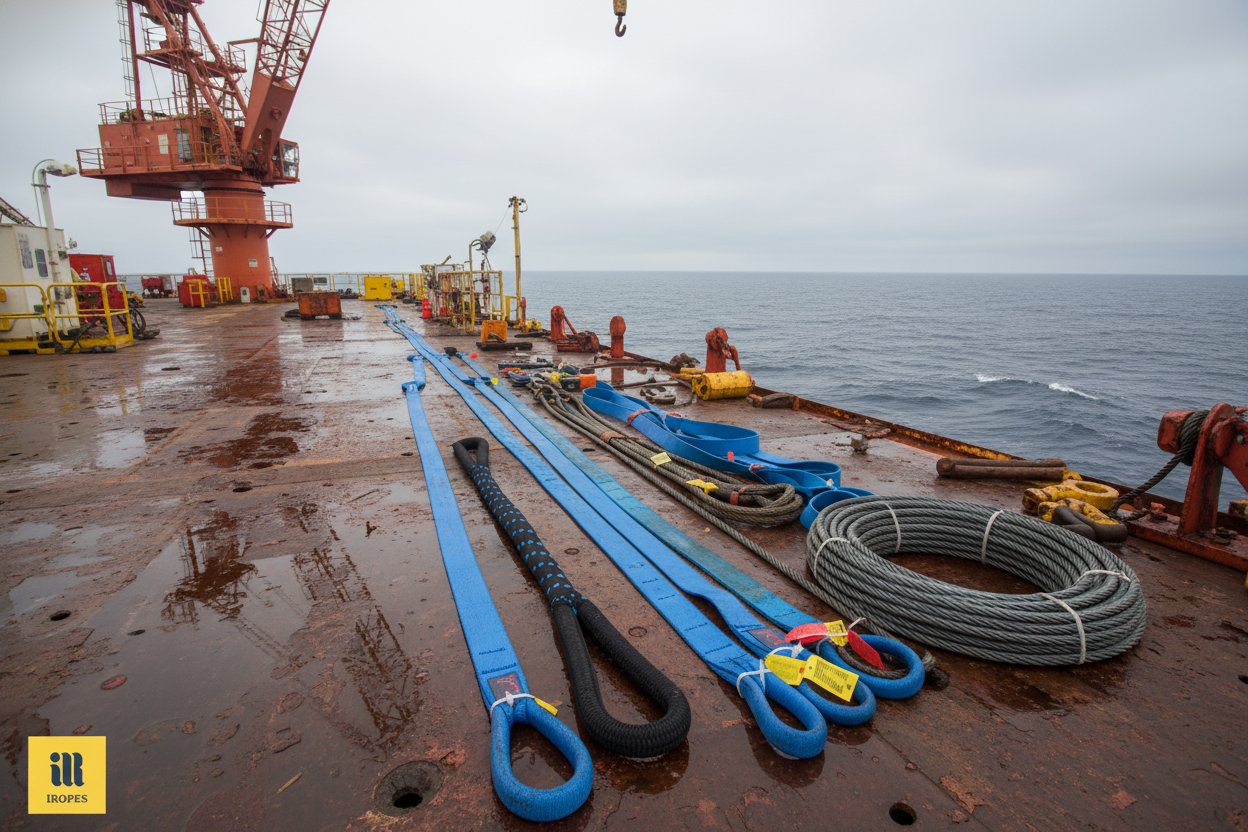
Matching these options to your load and conditions isn't just shrewd—it's essential for keeping things safe and productive. As we move forward, consider how factors like hitch angles and crane mobility play into picking the perfect fit.
How to Choose Reliable Crane Rigging Slings for Marine Cranes
Those hitch angles and crane mobility factors we just touched on represent crucial considerations when selecting **crane rigging slings** that won't let you down at sea. Getting this right means matching your gear to the real demands of the job, transforming potential headaches into smooth operations. Let's walk through the key considerations, starting with your load's demands and how you rig it up.
Every lift begins with the basics: the load's weight and shape dictate everything. The working load limit, or WLL, signifies your sling's safe capacity. For instance, a 5-tonne engine block would require slings rated at least that, with a built-in safety factor like 5:1 for synthetics to handle unexpected stresses. Fragile items, such as glass panels for a rig module, call for wider web slings to spread pressure and avoid dents, while bulky cargo like pipes might need chain for grip without slipping. Now, hitch configurations change the game completely. A vertical hitch, straight up and down, utilises the full WLL. However, choker hitches—where the sling pinches the load—cut capacity to about 80% due to the bend, making them ideal for cylindrical shapes yet riskier on soft materials. Basket hitches cradle the load like a hammock, boosting capacity to 2:1, but they require stable footing to prevent shifting in swells. And don't overlook angles: if your sling legs spread at 60 degrees from vertical, the load on each drops to half the WLL, so wider angles demand stronger setups to avoid overloads mid-lift. Picture rigging a pallet in rough seas—the wrong angle could swing it wildly, turning a routine job risky.
- Assess total weight - Factor in dynamic sea forces that can double effective load.
- Check shape and fragility - Opt for padded eyes on delicate items to prevent crushing.
- Select hitch type - Vertical for direct pulls, basket for balanced support, choker for tight grips.
- Calculate sling angles - Use charts to adjust WLL; under 120 degrees total is safest.
Beyond the load itself, your environment and **crane type** guide the choice towards **crane rigging slings** that endure marine grit. Offshore cranes, perched on floating platforms, face constant motion and corrosion. Prioritise abrasion-resistant coverings on wire rope to fend off deck scrapes. Mobile cranes on supply vessels need flexible synthetics for quick setups amid tight quarters, while tower cranes at ports handle steady but salty winds—galvanised chains work well here for longevity. Abrasion-resistant materials, like polyurethane-coated polyester, add a shield against the constant rub of sharp edges or barnacle-crusted gear, extending life in these demanding setups. For custom marine needs, consider tailored lengths to match boom reach or UV-stabilised fibres that won't become brittle under tropical suns. To explore more crane-specific lifting solutions, check out our engineered lifting options designed for various load configurations and safety requirements.
So, how do you nail the right **lifting strap for your crane**? Begin by matching the WLL to your maximum expected load, then integrate fragility considerations—such as soft eyes for breakables—and environmental adjustments like saltwater coatings. If off-the-shelf solutions fall short, custom builds from specialists like **iRopes** ensure compliance with your exact specifications, like multi-leg bridles for uneven offshore weights. This comprehensive approach not only meets your requirements, but also builds in that crucial extra margin for the unexpected in marine environments.

With the right selection locked in, maintaining those slings in optimal condition through regular checks becomes the next crucial layer of defence against wear.
Preventing Failures: Safety Standards and Inspection for Crane Rigging Slings
With the right selection locked in, maintaining those slings in optimal condition through regular checks becomes the next crucial layer of defence against wear, especially in the salty, unforgiving marine world. Think about it—your **crane rigging slings** might be perfectly chosen for the load, but without adhering to solid safety standards and inspections, they could still let you down when it matters most. Let's break down the essentials that keep operations running safely, drawing on proven protocols to spot issues before they escalate into problems.
Compliance begins with industry benchmarks such as ASME B30.9, which establishes rigorous guidelines for sling fabrication, use, and maintenance. This ensures they handle loads without snapping, covering everything from design to clear marking of capacities on the gear. Such clarity helps operators avoid overloads in dynamic sea conditions. OSHA further contributes with enforceable rules under 29 CFR 1910.184, mandating safe working practices, including training for crews on rigging basics and the immediate removal of damaged equipment. What does this mean in practice? It protects against fines and, more importantly, keeps your team out of harm's way during lifts on pitching decks. At **iRopes**, our ISO 9001 certification guarantees that every sling we produce meets these marine-grade quality levels, from material testing to final assembly, providing gear that is not just compliant but built to last offshore.
Inspection protocols act as your daily shield—simple yet vital routines that catch wear before it worsens. Before each use, conduct a quick visual and hands-on check for signs like cuts deeper than half the strap width, abrasion exposing inner fibres, or kinks in wire ropes that signal fatigue. For chains, look out for stretched links or heat damage from friction. Guidelines are clear: if any damage reduces the original strength by 10% or more, retire the sling immediately to prevent snaps under tension. Ever had that uneasy feeling before a big lift? These checks build confidence, turning routine into an essential habit that saves time and trouble down the line. For detailed marine sling inspections and certification tips, explore our guide on synthetic sling inspection.
- Visual scan for cuts and frays - Run fingers along edges to feel for nicks; discard if fibres are broken or pulled apart.
- Check for abrasion and heat marks - Look for shiny spots or discolouration indicating rubbing against sharp cargo or hot surfaces.
- Test fittings and eyes - Ensure hooks and thimbles are secure without cracks, and eyes aren't distorted from past overloads.
Beyond checks, best practices like proper storage and testing extend your slings' life considerably. Keep them coiled loosely in a dry, shaded spot away from chemicals and sunlight to fend off further degradation—hanging them on racks works wonders for wire and chain types. Proof testing, often at 1.25 to 2 times the WLL post-manufacture or after repairs, verifies integrity without risking everyday use. For global marine operations, **iRopes'** custom packaging seals everything in protective bags or cartons, branded to your specifications, ensuring they arrive ready for deployment anywhere from the North Sea to the Pacific. To learn more about overcoming saltwater challenges with specialized marine slings, read our article on marine slings.

Layering these habits with expert partnerships means failures drop dramatically, allowing you to focus on the lifts rather than the worries.
In the demanding world of marine operations, understanding why **crane straps** fail—often due to saltwater corrosion, UV exposure, and mismatched materials—empowers you to select robust **lifting straps for cranes** that withstand harsh conditions. From flexible synthetic web slings for awkward loads to durable wire rope and chain options for heavy hauls, **crane rigging slings** must align with load weights, hitch configurations like chokers or baskets, and crane types such as offshore or mobile units. Prioritising abrasion-resistant customisations, alongside ASME B30.9 and OSHA compliance, plus rigorous inspections for cuts, frays, and elongation, ensures safety and longevity backed by **iRopes'** ISO 9001-certified solutions.
Armed with these insights, you're better equipped to prevent those 90% failure rates and optimise your rigging for efficient, risk-free lifts at sea. For tailored advice on crane-specific setups or marine-grade customisations, the inquiry form below offers personalised guidance from our experts.
Ready to Customise Your Marine Crane Rigging Solutions?
If you'd like expert recommendations on selecting the ideal crane straps for your operations, including detailed inspection protocols and certification needs, fill out the inquiry form above—we're here to help elevate your marine lifting safety and performance.
