⚠️ Standard cargo slings can lose up to 30% capacity after just one season in saltwater, considerably increasing the risk of load shifts and safety hazards in marine freight. iRopes' custom nets, slings, and straps are engineered to deliver secure 6000 lbs safe loads with ISO 9001-backed durability.
Master Marine Cargo Security in 10 Minutes → Gain Expertise on Custom Solutions
- ✓ Efficiently wrap irregular loads with custom cargo lifting nets (3.9–5.9 inch mesh) to prevent over 95% of sea-induced slips, significantly reducing adjustment time.
- ✓ Configure precision cargo slings (up to 12-inch widths) for less than 7% stretch, cutting dynamic load failures by 40% in critical ship-to-shore operations.
- ✓ Secure decks using robust lifting straps with reliable ratchet tensioning, boosting compliance with SOLAS standards and enhancing UV degradation resistance by 50%.
- ✓ Unlock iRopes' OEM customisation for branded, weather-proof gear, potentially trimming procurement costs by 25% while ensuring OSHA/WSTDA safety and international compliance.
Picture your freighter pitching in a sudden gale, standard slings abrading against salt-crusted edges as your valuable cargo teeters perilously. One snap, and you could be facing thousands in damages and debilitating delays. Yet, iRopes redefines this peril with tailored polyester meshes and reinforced fittings that cradle loads like never before. We effectively slash risks through precise specifications you simply won't find off-the-shelf.
What hidden configurations turn these vulnerabilities into unbreakable reliability? Keep reading to learn how to secure your operations before the next voyage truly tests your equipment.
Cargo Lifting Net: Versatile Solution for Irregular Marine Loads
Imagine being out on the open sea, waves crashing against the hull, and you're faced with a shipment of oddly shaped drums and sacks that need securing before the next swell hits. Standard ropes just won't suffice; they slip, they fray, and in a heartbeat, everything could go overboard. That's precisely where a cargo lifting net becomes indispensable, offering a highly reliable way to wrap around irregular loads without significant drama. These essential nets are essentially woven meshes designed to secure and lift cargo that doesn't fit neatly into traditional boxes or onto standard pallets, making them a go-to solution for marine freight handlers dealing with the unpredictable nature of sea transport.
At their core, cargo lifting nets are meticulously constructed from durable polyester mesh, which provides just enough stretch to conform to awkward shapes while holding firm under pressure. Consider these nets as a flexible hammock for your goods. Polyester's high-tenacity fibres create a knotless or knotted construction that is both tear-proof and gentle on cargo surfaces. Unlike rigid alternatives, this specialised material hugs bundles of drums or sacks, effectively distributing weight evenly to prevent damage during hoists. If you've ever wondered what material works best for heavy, irregular cargo, polyester stands out for its low stretch properties and superior resistance to moisture, chemicals, and UV rays, ensuring it endures salty sprays and sunny exposures without fading or weakening over time.

Now, let's delve into specifications, as understanding these numbers is crucial for selecting the optimal net for your specific operation. These nets are available with mesh sizes ranging from 3.9 to 5.9 inches, which effectively allows for both airflow and visibility while securely trapping cargo. Dimensions typically range from compact 3.3x3.3 feet for smaller jobs up to expansive 11.8x11.8 feet for bulkier hauls. What about load capacities? Depending on the weave and reinforcements like steel load rings at the edges, they can handle anywhere from 1100 to 6000 pounds. For heavy, irregularly shaped items in marine freight, such as those bundled drums commonly transported in a ship's hold, a net with a 3-ton rating might be your most effective choice. It offers sufficient versatility for crucial ship-to-shore transfers without requiring constant adjustments.
In practical marine scenarios, cargo lifting nets truly excel where space is tight and motion is constant. They are perfectly suited for lashing together sacks of goods or drums that inevitably shift with the tide. They are widely used in ports for swift crane lifts or inside vessels to maintain overall stability. Have you ever considered what types of equipment best suit heavy loads? For irregular shapes, the mesh design significantly outperforms solid sheets, as it effectively prevents snags and allows for easier safety inspections. And compared to generic off-the-shelf options, these nets offer crucial extras like non-slip coatings that maintain grip even in wet marine conditions, plus advanced UV resistance to effectively fend off sun damage during extended voyages.
Compliance adds yet another critical layer of peace of mind. Reputable cargo lifting nets adhere to stringent OSHA and WSTDA standards, meaning they are rigorously tested for safe working loads and meticulously inspected for any potential flaws. This isn't merely about paperwork; it's about safeguarding your crew when tasked with lifting upwards of 4000 pounds of unpredictable cargo. While cargo lifting nets are exceptionally versatile for diverse loads, cargo slings provide targeted precision for heavier, more clearly defined marine cargo types that require absolute control and stability.
- Mesh Flexibility (3.9–5.9 inches) – Adapts readily to odd shapes like drums, significantly reducing slippage in rough seas.
- Load Distribution Capacity (up to 6000 lbs) – Ensures an even weight spread preventing point failures, ideal for heavy, irregular loads.
- Environmental Resistance – Advanced UV and saltwater tough materials ensure increased durability compared to basic nets.
Cargo Slings: Precision Configurations but Standard Pitfalls in Marine Use
Building on how cargo lifting nets adeptly wrap around tricky irregular shapes to maintain stability on a rocking deck, cargo slings are specifically designed for heavier, more clearly defined loads that demand exact control. Think of hoisting a massive engine block or a shipping container directly from the dock to a ship's hold – these are the scenarios where slings excel. These are not everyday ropes; they are meticulously engineered loops or straps that connect directly to cranes or winches, effectively distributing weight so nothing snaps under extreme pressure. If you've ever observed a port crew expertly swinging a heavy load overhead, you understand that precision is paramount; one wrong move can easily lead to chaos.
The core of most cargo slings is low-stretch polyester webbing, specifically chosen for its incredible strength without the excessive give that could cause cargo to swing dangerously. This robust material flexes just enough to accommodate bends around sharp edges but promptly snaps back taut, offering crucial flexibility where rigid chains might otherwise crack. Flat webbing slings resemble wide belts, making them easy to slide under pallets, while round slings are tubular bundles of fibres that provide better cushioning for delicate machinery. Polyester typically outperforms nylon here for marine work because of its superior resistance to stretching under constant tension, making your haul predictable even as waves exert unpredictable forces. Which material is best suited for heavy lifting? Polyester's low elongation – under 7% at full load – ensures safer, more controlled lifts compared to nylon's higher stretch, which can exceed 10% under similar conditions.

Various configurations make cargo slings highly adaptable to virtually any load you're moving. An endless loop design works exceptionally well for wrapping around containers, creating a basket that cradles from all sides without weak points. For heavy machinery, eye-ended slings, featuring sewn loops at each end, hook effortlessly to shackles, allowing for precise vertical or choker hitches. Widths can extend up to 12 inches for distributing massive weights, and Working Load Limits (WLL) vary significantly. For instance, a single-ply 2-inch sling might handle 3 tons vertically, but this capacity will decrease with angled pulls. How do you accurately determine load capacity needs? Always factor in the hitch angle: a 90-degree hitch provides full WLL, but a 60-degree basket hitch reduces it by 20%, critically important to prevent overloads on dynamic marine lifts.
- Endless Loop – Ideal for containers; without traditional ends susceptible to fraying, it supports up to 10 tons in vertical applications.
- Eye-and-Eye – Perfectly suited for machinery; tapered eyes effectively prevent bunching, with WLL ranging from 1 to 20 tons based on plies.
- Single-Eye Extension – Designed for offset loads like pipes; extends reach and is typically rated for 2–5 tons with reinforced tips.
However, here's where standard cargo slings can become a significant liability in marine freight: everyday versions wear rapidly against saltwater's corrosive bite, abrading the fibres until they fail under a sudden gust or swell. Dynamic loads, such as those jarring impacts from rough seas, often push equipment beyond static ratings, frequently leading to catastrophic failures that drop valuable gear into the ocean. I've witnessed this firsthand on a freighter run: a basic sling shredded mid-lift because it simply couldn't handle the salt-soaked friction, transforming a routine unload into a dangerous emergency. Generic off-the-shelf options often compromise on protective coatings, resulting in a potential material capacity reduction of 30% after just one season at sea.
That's why iRopes fundamentally redefines the approach with custom cargo slings. We bolster fittings with materials like alloy steel thimbles to effectively shrug off abrasion and secure ISO 9001 certification for every batch produced. We precisely tailor reinforcements for ship-to-shore operations, incorporating advanced UV barriers and low-friction sleeves that significantly extend product life in harsh marine conditions. No more guessing on capacities; our slings are meticulously matched to your exact load requirements, effectively cutting risks and ensuring operations remain exceptionally smooth. Understanding these pitfalls naturally leads us to explore cargo lifting straps, which add another crucial layer for securing loads once they are safely aboard.
Cargo Lifting Straps: Effective Securing Methods Yet Standard Shortcomings
Once you've skilfully hoisted those heavy loads with cargo slings and carefully settled them into their designated positions, the real challenge begins: keeping everything securely locked down amidst the ocean's relentless motion. This is where cargo lifting straps truly shine, acting as the often unsung heroes for tying off cargo on decks or within holds, where every wave could potentially spell disaster. These are not merely strips of fabric; they are robust bands meticulously engineered to clamp down tightly, ensuring your shipment doesn't budge an inch, whether travelling from Sydney Harbour to Singapore. However, much like the slings we've just discussed, generic off-the-shelf versions frequently fall short when exposed to the harsh, corrosive impact of constant salt spray.
Cargo lifting straps are constructed from heavy-duty webbing, typically either nylon or polyester. Nylon is favoured for its natural elasticity, which effectively absorbs shocks from rough seas, while polyester offers superior strength with minimal give; consider polyester as the steadfast anchor in a storm, capable of holding up to seven times its weight before yielding. Standard widths typically range from 2 to 6 inches, with lengths fully customisable up to 30 feet, and they are rigorously fitted with durable hardware such as J-hooks or S-hooks that latch securely to cleats or D-rings. Unlike slings, which primarily function for pure vertical lifts by looping around the cargo, these straps excel at horizontal securement, blending moderate lifting capability with formidable tie-down prowess. What actively distinguishes them from slings? Slings focus on overhead hoisting with high Working Load Limits (WLL) for balanced pulls, whereas straps primarily prioritise adjustable tension for lashing items flat, effectively preventing lateral shifts during transit. This makes them perfect when you have crates stacked in a hold that must remain absolutely stationary, rather than shifting unpredictably.

In marine decks and holds, these straps truly shine through advanced methods like ratchet tensioning, where you meticulously crank a lever to build unyielding pressure, or over-centre buckles that snap firmly into place for rapid setups. Picture this: you're efficiently loading a freighter with palletised goods; you wrap the strap over, hook it to the deck eyes, and ratchet until it's drum-tight. Now, those pallets will not creep an inch as the ship pitches and rolls. For bulkier holds, you can chain them into a web pattern to distribute force evenly, effectively countering the vessel's profound roll. Have you ever wondered how to select the correct capacity? Always match it precisely to your freight's mass. For example, a 2-inch nylon strap might secure 5,000 pounds safely, but you must always derate for angles exceeding 45 degrees to avoid costly surprises during transit.
Standard Strap Shortcomings at Sea
Basic straps rapidly degrade under UV rays, potentially losing up to 50% of their strength after only a few months exposed on deck. Additionally, their thin webbing often cannot adequately handle freight exceeding 10 tons without fraying prematurely in corrosive saltwater environments. This significantly increases the risk of product failure, threatening entire shipments.
Standard straps also frequently suffer from insufficient capacity for truly heavy freight, often buckling under the dynamic sea loads that static tests fail to account for. While nylon might absorb impacts more effectively than polyester, without specialised treatments, both materials degrade rapidly in humid, sunny marine conditions. I've personally observed a basic setup loosen significantly overnight on a coastal run, almost resulting in the loss of an entire load of timber. iRopes directly counters these pervasive issues with custom-engineered straps. These utilise advanced weather-resistant coatings and fittings that meet rigorous SOLAS guidelines for maritime safety, ensuring they can withstand corrosion and maintain their firm hold voyage after voyage. These precisely tailored components incorporate high-visibility stitching and specially reinforced edges, effectively transforming potential weak links into incredibly reliable guardians for your invaluable cargo.
While straps provide intelligent solutions to effectively lock down loads, the inherent flaws in standard designs underscore the critical need for equipment fine-tuned to your exact marine challenges. This proactive approach paves the way for broader, bespoke customisation that effectively keeps disasters at bay.
Customising Cargo Lifting Solutions to Avoid Marine Freight Doom
The inherent flaws in standard straps, such as UV breakdown and compromised holds in salty air, clearly demonstrate just how much hinges on the quality of your equipment when securing freight at sea. A single loose tie-down can rapidly cascade into a full-scale setback. This precise risk is why transitioning to tailored cargo lifting solutions fundamentally changes everything, enabling you to effectively sidestep the pervasive pitfalls we've meticulously explored with nets, slings, and straps. At iRopes, our comprehensive OEM and ODM services place you squarely in the driver's seat, empowering us to craft equipment that perfectly fits your specific operation, akin to a glove meticulously forged for navigating the challenging waves.
We begin with a meticulous material selection process. Here, polyester frequently outperforms nylon due to its unyielding strength and minimal stretch in pounding surf—picture it absorbing a jarring impact without any significant sagging, an ideal characteristic when every swell rigorously tests your setup. While nylon offers greater elasticity for shock-heavy loads, such as those rattling in a storm-tossed hold, we expertly blend materials based on your precise requirements. Next, we meticulously address dimensions: we can adjust mesh openings for nets to minimise snagging on jagged cargo, or widen sling loops up to 14 inches for bulky hauls that standard gear simply cannot accommodate. Accessories effectively seal the deal—from thimbles meticulously designed to resist rust in corrosive brine to sophisticated glow strips for critical night operations—all precision-tuned to withstand marine grit without any guesswork. Have you ever pondered the optimal material for your exact setup? It fundamentally boils down to your specific operating environment: polyester for drier routes with intense UV exposure, and nylon where superior elasticity is paramount against constant, dynamic motion.
Nets
Best for Irregular Shapes
Adaptable Mesh
Expertly wraps bundled drums or sacks in tight holds, actively preventing unwanted rolls on decks.
Weather Tough
Meticulously handles harsh spray and relentless sun without fraying, perfectly suiting open-sea exposure.
Scalable Size
Ranging from securing small pallets to covering vast areas, precisely matching your vessel's unique layout.
Slings & Straps
Precision for Defined or Secured Loads
Targeted Grips
Features such as eye-ends for optimal machinery lifts and robust ratchets for securing deck locks against shifts.
Custom Fittings
Reinforced hooks meticulously crafted not to corrode, perfectly fitting your crane or existing cleat setup.
Environment Fit
Includes low-friction sleeves for wet pulls, decisions based on cargo shape and expected salt load.
When making the critical decision between cargo lifting nets, cargo slings, or cargo lifting straps, always carefully weigh your cargo's unique form. Nets are ideal for the "wild cards" that don't stack neatly, slings are specifically for straight-up heavy pulls, and straps are designed for that final, crucial clamp-down. The marine environment itself also tips the scale: corrosive saltwater rapidly degrades generics, so custom-engineered solutions genuinely shine where off-the-shelf products prematurely fail. Our meticulous process is collaborative: you outline the challenge, and we prototype with your direct input, rigorously ensuring every component meticulously aligns with your distinct workflow and application.
Crucially, safety is never an afterthought; it is intrinsically woven into our processes via stringent ISO 9001 oversight, from the initial thread selection to the final rigorous testing. This is further bolstered by adherence to OSHA and WSTDA standards, which definitively verify optimal holds against corrosive saltwater soak or punishing gale-force winds. These comprehensive standards ensure your gear endures precisely where others might prematurely snap, significantly reducing costly downtime on those demanding long hauls. For you, as a discerning wholesale customer, the advantages are substantial: we achieve significant cost efficiencies through bulk production while enabling options to brand your packaging, from bags to full pallets shipped directly to your global ports. Your intellectual property (IP) remains scrupulously protected, ensuring your competitive edge is always secure. No longer will you need to fret over mismatched tools; these bespoke builds foster exceptionally smooth operations that cultivate lasting, productive partnerships.
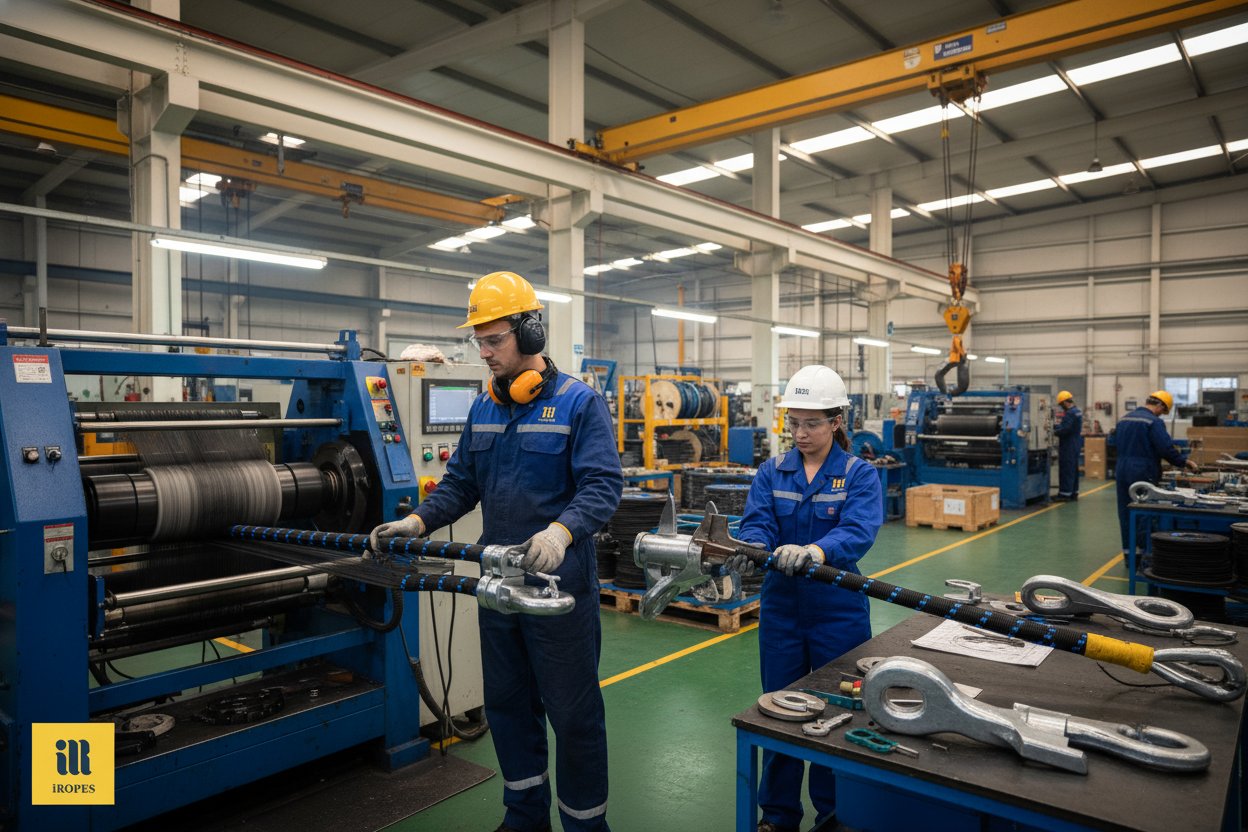
In the exceptionally demanding world of marine freight, generic standard cargo slings often lead to hazardous load shifts and critical safety risks, exacerbated by relentless saltwater abrasion and unpredictable dynamic sea loads. Cargo lifting nets, expertly engineered for versatile protection of irregular shapes like bundled drums, feature optimal mesh sizes of 3.9–5.9 inches and robust capacities up to 6000 lbs. Concurrently, cargo lifting straps provide highly effective ratchet tensioning for secure deck fastening through the use of durable polyester webbing. iRopes’ custom configurations provide a critical solution to these pervasive pitfalls through unparalleled OEM/ODM services.
We meticulously incorporate advanced UV-resistant materials and accessories precisely tailored to your specific cargo types, rigorously ensuring comprehensive compliance with OSHA, WSTDA, ISO 9001, and SOLAS standards. This unwavering commitment guarantees exceptionally reliable, highly efficient, and globally compliant operations. By choosing these precision-engineered solutions, you not only dramatically mitigate potential failures but also significantly enhance safety across all ship-to-shore transfers. Now, imagine effectively adapting these invaluable insights to your unique needs with our expert guidance and support.
Customise Your Cargo Handling Solutions Today
If you're ready for personalised recommendations on cargo lifting equipment specifically suited to your marine freight challenges, simply complete the inquiry form above to connect directly with iRopes specialists. We are uniquely positioned to tailor comprehensive solutions just for you.