The right synthetic winch cable delivers ≈ 12 000 lb breaking strength at 5/16 in and ≈ 20 000 lb at 3/8 in—apply the 1.5–2× safety factor for winches up to about 5 000 lb or 9 000 lb, respectively.
Quick‑Read: ~3 min
- ✓ Apply the 1.5–2× safety factor to choose a safe winch cable size for common winch ratings.
- ✓ Use the diameter–strength guidance below to pinpoint the right rope without trial and error.
- ✓ Compare synthetic vs Manila rope by weight, durability, abrasion, and UV resistance.
- ✓ Access iRopes’ OEM/ODM catalogue and receive a custom‑cut rope shipped within 10–15 working days.
Choosing the correct winch cable size is critical for safety and performance. Most off‑roaders pick a rope that simply fits the drum, but that approach can overlook the 1.5–2× safety factor and the 15‑ft length‑reduction rule. In this guide you’ll see the exact sizing steps, a clear look at winch cable sizes, and where a manila rope size still makes sense. You’ll also learn how iRopes can ship a custom‑cut rope that matches your winch—no guesswork required.
Understanding winch cable size: Safety factor and calculation
After we’ve highlighted why picking the right rope is a safety‑critical decision, it’s time to dive into the numbers that keep your winch from turning into a hazard. The core of that math is the winch cable size you choose, which directly determines how much load the rope can safely bear.

In simple terms, winch cable size is the rope’s diameter, and a larger diameter usually means a higher breaking strength. That strength is the maximum force the rope can endure before it fails. Your winch’s working load limit (WLL) must always be lower than the rope’s breaking strength, which is why the safety factor comes into play.
- Determine pull rating – note the maximum load your winch can pull, expressed in pounds or kilonewtons.
- Apply the safety factor – multiply the pull rating by a factor of 1.5 to 2.0 to get the required breaking strength.
- Select the nearest rope diameter – choose the smallest diameter whose published breaking strength meets or exceeds that required value.
That three‑step rule answers the common query “What size rope for winch?” in a single sentence: use a rope whose breaking strength is at least 1.5–2 times the winch’s rated pull, then pick the smallest diameter that satisfies that strength.
Let’s walk through a real‑world example. Suppose your off‑road winch is rated at 12 000 lb. Multiply 12 000 lb by 1.5, giving a minimum breaking strength of 18 000 lb; using the more conservative 2× factor yields 24 000 lb. A 3/8 in synthetic rope typically breaks at roughly 20 000 lb, comfortably within the 1.5× range but just shy of the 2× margin. If you prefer the higher safety margin, you would step up to a 7/16 in rope, which usually breaks around 26 000–28 000 lb, satisfying both calculations.
iRopes regularly supplies diameters from 5/16 in to 1/2 in in popular lengths of 55–120 ft, giving you flexibility to match drum size while respecting the rule‑of‑thumb that each increase in diameter shortens the optimal length by about 15 ft.
“A 1.5× safety factor is the industry minimum; many manufacturers, including WARN and RAMSEY, design to 2× for added peace of mind.” – Winch design engineer, Master Pull
By applying this formula you can quickly translate any winch rating into a concrete winch cable size recommendation, then verify that iRopes’ catalogue offers the exact diameter and length you need. The next logical step is to compare Manila rope options for situations where synthetic rope might not be ideal.
Choosing the right manila rope size for winch applications
After exploring how the safety‑factor formula guides synthetic rope choices, you’ll notice that some users still choose Manila when the job calls for high grip and predictable handling. The same principle—pick a rope whose breaking strength exceeds the winch’s pull by 1.5 to 2 times—applies, but the numbers look different for natural‑fibre rope.

Typical breaking‑strength values for common Manila diameters are modest compared with high‑tech synthetics but remain useful for lighter pulls. A 1/4 in Manila rope will usually break around 2 000 lb, a 5/16 in strand reaches roughly 3 000 lb, and a 3/8 in rope can hold close to 4 500 lb. What is Manila rope strength? In short, each increase of 1/16 in in diameter adds roughly 1 000 lb of breaking capacity.
- Match the winch’s pull rating – multiply the winch’s maximum draw by 1.5 to 2 and compare it to the Manila breaking‑strength guidance.
- Consider the working environment – Manila’s natural fibres offer sure grip and decent abrasion tolerance on rough surfaces.
- Account for weight and care – Manila is heavier per foot than HMPE, absorbs moisture, and needs drying and inspection to maximise service life.
If you’re hauling through scrubland, rigging around bark or rock, or you prefer a rope that doesn’t melt under friction heat, Manila can be a practical choice despite its lower ultimate strength. However, it is more susceptible to moisture and UV degradation than many synthetics, so regular inspection and storage out of direct sun are essential.
When to Choose Manila
Select Manila rope for winch work that involves frequent contact with rough surfaces, controlled low‑speed pulls, or budgets that demand a rugged, economical line. Pair it with stainless‑steel thimbles to maximise lifespan, and remember the 1.5–2× safety factor still governs the final diameter decision.
By aligning the breaking‑strength guidance with the winch’s pull rating, you can pick a Manila rope that meets the required safety margin while benefiting from its handling characteristics. Next, we’ll match specific diameters to winch ratings and typical lengths so you can finalise your choice.
Exploring winch cable sizes: Diameter, breaking strength, and length recommendations
Having examined the safety‑factor maths, the next step is to match a concrete diameter to the winch you intend to drive. The right size not only meets the required breaking strength but also fits comfortably on the drum without excessive slack.
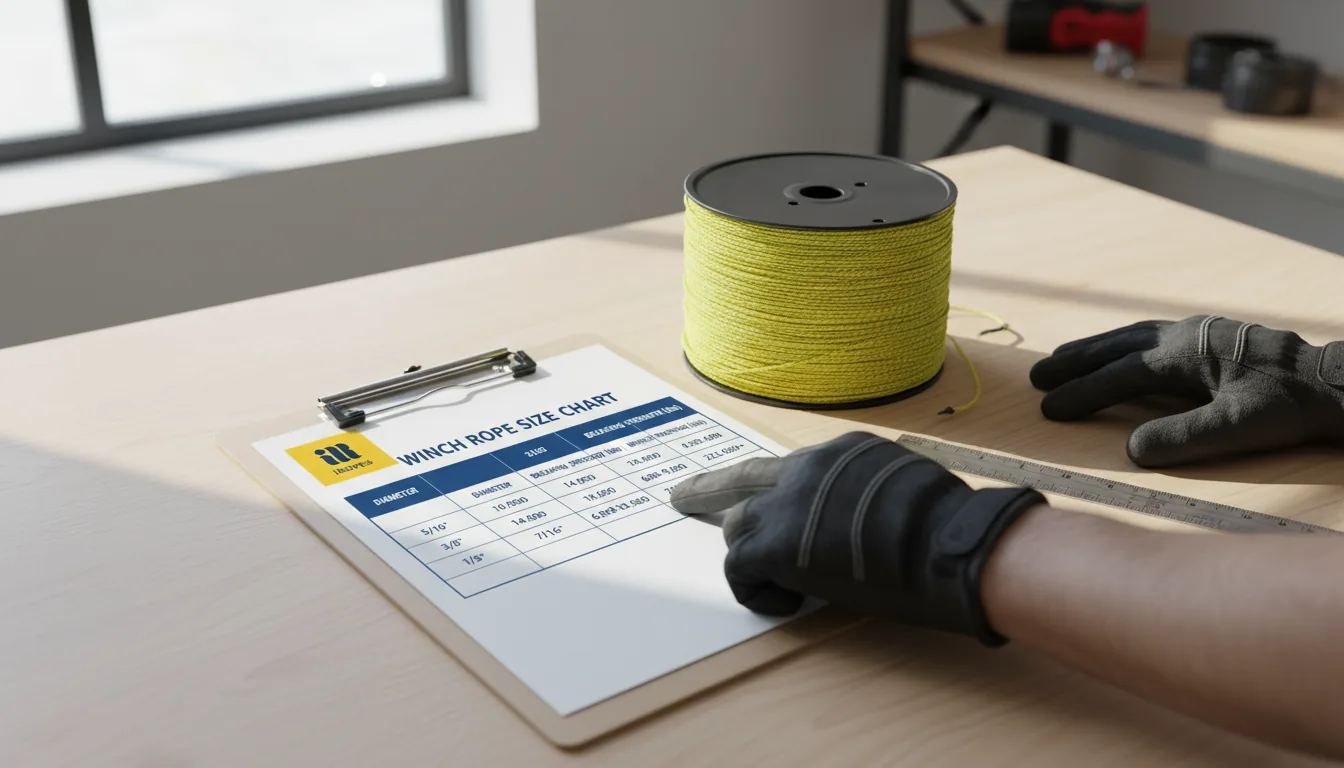
When you step up to a larger diameter, the drum can accommodate fewer feet of rope. A practical rule of thumb is to subtract roughly 15 ft from the standard 55–120 ft spool each time you move up a size increment. This keeps the rope tight on the drum and helps prevent early wear.
How strong is a 5/16 winch cable? A 5/16‑inch synthetic line typically breaks at about 12 000 lb. Applying the 2× safety factor gives a working load limit of roughly 6 000 lb, making it suitable for winches rated up to about 5 000 lb.
Diameter & Strength
What each size can bear
5/16 in
≈ 12 000 lb breaking strength – typically suits winches ≤ 5 000 lb.
3/8 in
≈ 17 600–20 000 lb breaking strength – matches winches up to about 9 000 lb.
7/16 in
≈ 26 000–28 000 lb breaking strength – ideal for winches in the 12 000 lb class.
1/2 in
≈ 34 000–36 000 lb breaking strength – for higher‑capacity winches ≥ 15 000 lb.
Winch Rating & Length
Recommended spool lengths
Typical lengths by size
5/16 in: 100–120 ft; 3/8 in: 85–100 ft; 7/16 in: 65–80 ft; 1/2 in: 55–70 ft.
Length rule of thumb
Increase diameter by one size? Reduce rope length by about 15 ft to maintain safe drum fill.
iRopes supply range
Regular supply: 5/16–1/2 in diameters in popular 55–120 ft lengths, with OEM/ODM terminations to spec.
Get a personalised rope solution from iRopes
By applying the 1.5–2× safety factor you can confidently choose the correct winch cable size, weigh the benefits of a manila rope size for abrasion‑heavy work, and use the winch cable sizes guidance above to match your winch’s rating and drum length. iRopes regularly supplies diameters from 5/16 in to 1/2 in in popular lengths of 55–120 ft, ensuring you have the exact option you need.
As an ISO 9001‑certified manufacturer, iRopes provides full OEM and ODM support, from materials and core types to colours, patterns, and accessories. We protect your IP, offer non‑branded or customer‑branded packaging, and ship pallets directly worldwide. If you’d like customised guidance for your application, complete the form above and our rope specialists will contact you with a free, tailored quote.
