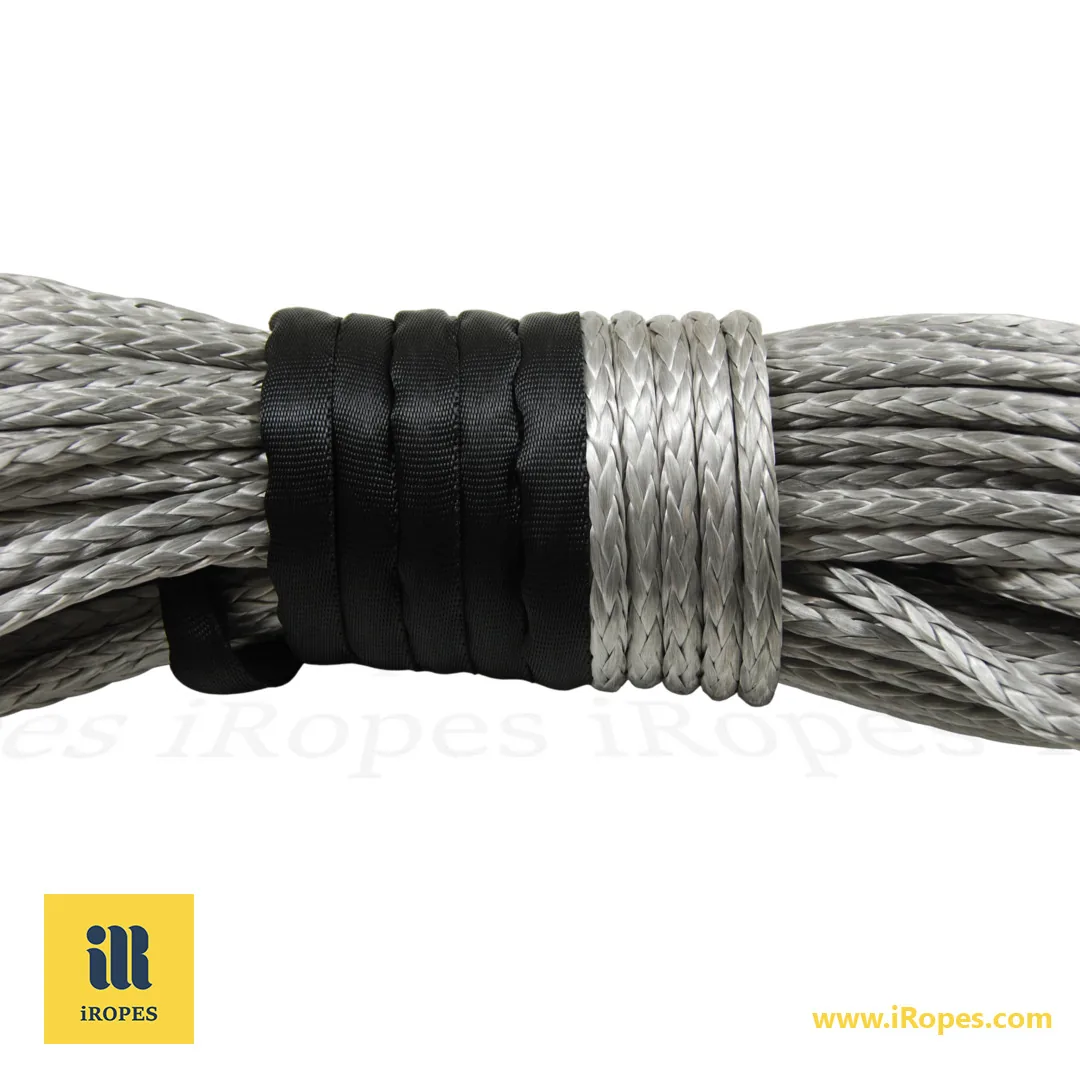
0.045 lb/ft for a ¼″ UHMWPE winch rope – 85% lighter than steel and ≈15× stronger by weight. Save about 11.5 lb on a 100‑ft line versus steel to boost recovery speed instantly.
≈ 3 min read – What you’ll gain
- ✓ Reduce drum load by about 11.5 lb on a 100‑ft line versus steel cable → faster pulls.
- ✓ Achieve a 1.5× safety factor with custom‑diameter selection → reliable strength.
- ✓ Cut shipping weight and costs with lightweight UHMWPE.
Many think steel cable is the only strong option, but we’ll reveal how a custom‑engineered UHMWPE rope from iRopes slashes weight while raising strength, and how a simple sizing tweak can shave seconds off every winch pull. As a leading rope maker in China, iRopes focuses on strong synthetic fibres for 4 wheeler winch rope and backs every build with ISO 9001 quality control. Stay tuned to discover the exact calculations, safety margins, and branding tweaks that turn a mundane rope into a genuine performance edge.
Understanding pp rope weight and its impact on winch performance
When you’re out on a trail and the winch kicks in, every kilogram you add to the drum changes how quickly the line feeds and how much electrical draw the system sees. That hidden load starts with the rope’s own weight, so grasping the basics of pp rope weight is the first step to a smoother recovery.
Polypropylene (PP) is a low‑density plastic, roughly 0.91 g/cm³. In practical terms, a ¼‑inch PP rope weighs about 0.03 lb per foot, which feels almost weightless compared with a steel cable of the same size. This figure is the cornerstone for estimating how a 4 wheeler winch rope will affect your vehicle’s balance.

Want to see the math in action? Follow these three simple steps:
- Calculate the rope’s volume per foot (cross‑sectional area × 12 in). For a ¼″ rope, the area is π × (0.125″)² ≈ 0.049 in².
- Multiply by PP’s density (≈0.033 lb/in³): 0.049 in² × 12 in ≈ 0.589 in³ → ≈0.019 lb per foot for solid PP.
- Adjust for construction (braid/twist, coatings). A practical factor brings the typical ¼″ PP rope to ≈0.03 lb/ft per vendor specs.
That calculation shows why PP is often chosen for lightweight setups, but how does it really stack up against the alternatives you might consider?
- PP rope – about 0.03 lb/ft for ¼″, giving a light‑handed feel on the winch drum.
- Steel cable – roughly 0.16 lb/ft at the same diameter, adding noticeable inertia.
- UHMWPE synthetic – around 0.045 lb/ft for ¼″, still heavier than PP but far stronger per pound.
If you’ve ever searched “How much does a 1/4" synthetic winch rope weigh per foot?” you’ll find the answer is approximately 0.045 lb/ft for a UHMWPE line, compared with the 0.03 lb/ft figure for polypropylene. The difference may seem small, yet over a 100‑foot length it’s about a 1.5‑lb swing in total weight. Against steel cable, the saving is far greater, which influences winch speed and handling.
Now that you understand the density behind pp rope weight and how it compares to steel and high‑tech synthetics, you’re ready to move on to evaluating which material best matches the strength and handling you need for your 4 wheeler winch rope.
Exploring sisal fiber rope characteristics and ideal applications
Now that we’ve weighed the impact of rope mass, let’s turn our attention to a material that feels completely different in the hand – sisal fibre rope. This natural option brings a unique blend of strength, UV tolerance and environmental friendliness. For off‑roaders, it’s best reserved for utility lines around your vehicle rather than your primary 4 wheeler winch rope.

Sisal comes from the leaves of the Agave plant, so its fibres are naturally coarse and breathable. It offers solid UV tolerance compared with some synthetics, and because the polymer is plant‑based it will biodegrade without leaving toxic residues – a rare trait among load‑bearing ropes.
Sisal may feel old‑school, but its natural composition delivers useful tensile capacity while returning harmlessly to the earth at end of life. If sustainability matters, it’s a credible utility option.
In practical terms, a typical ¼‑inch sisal fiber rope delivers a breaking strength of roughly 4‑5 kN (about 900‑1,100 lb). Thicker diameters add proportionally more pull and still stay lighter than an equivalent steel cable, which can be decisive when drum weight matters.
When you compare sisal to modern synthetics, a few clear trade‑offs appear. The natural fibre scores high on biodegradability and UV tolerance, yet it lags behind UHMWPE in absolute tensile strength, abrasion resistance, and water absorption. If your recovery work is occasional and low‑load, sisal can serve for utility tasks. For high‑speed, heavy‑pull scenarios the synthetic advantage usually outweighs the eco‑benefit.
Pros & Cons
Pros – biodegradable, UV‑tolerant, lower cost; Cons – lower break strength than UHMWPE, higher stretch under load, more prone to moisture absorption. Choosing sisal hinges on whether sustainability or maximum pull takes priority.
So, what is the breaking strength of sisal rope? In a standard ¼‑inch size you can expect around 900‑1,100 lb before the fibres start to fray. That rating is well below most ATV/UTV winch requirements, so reserve sisal for light‑duty utility use and choose synthetic for the main winch line.
Understanding these characteristics sets the stage for the next decision point: selecting the exact diameter and construction that aligns with your winch’s rating. The sizing guide ahead translates these numbers into a clear match for any 4 wheeler winch rope requirement.
Choosing the optimal 4 wheeler winch rope: material, size, and customization
After exploring sisal’s eco‑friendly traits, it’s time to pinpoint the exact rope that will pair with your winch’s power. The right diameter not only meets the pull rating but also keeps the drum turning smoothly.

Start by checking the winch’s rated pull and then follow these three steps to select the correct rope diameter.
- Locate the winch’s maximum pull (e.g., 6,000 lb) on the specification plate.
- Apply a safety factor of 1.5× the rated pull; the rope’s breaking strength should exceed this value.
- Choose the smallest diameter whose listed breaking strength meets the safety‑factor target.
Size & Strength
Diameter → break strength → weight per foot
3/16"
Breaks at ≈4,800 lb; weighs only a few hundredths of a pound per foot. Ideal for light‑duty ATV winches.
¼"
Breaks at ≈9,000 lb; weight ~0.045 lb/ft. Works well with 5,000‑6,500 lb winches.
½"
Breaks at ≈34,000 lb; weight ~0.12 lb/ft. Reserved for heavy‑duty 4‑wheelers.
Customization
Make the rope yours
Colours
Choose from standard safety hues or request a bespoke palette that matches your vehicle branding.
Reflective strips
Integrate high‑visibility reflective tape or glow‑in‑the‑dark fibres for night‑time recovery.
OEM/ODM
iRopes protects your intellectual property while delivering custom logos, packaging, and colour‑coded bundles, with ISO 9001‑backed QA and reliable global shipping from China.
If you wonder “what size rope for an ATV winch?”, the rule of thumb is: a 3/16″ line for winches under 3,500 lb, ¼″ for 4,500‑6,000 lb, and 3/8″ or larger when the winch exceeds 7,000 lb. The rope’s break strength should be at least 1.5 times the winch’s maximum pull. For a deeper look at why synthetic rope outperforms traditional winch wire rope, see our detailed comparison here.
With the right diameter selected, you can now explore the colour, reflective, and branding options that turn a standard rope into a signature part of your recovery kit – a perfect segue into the safety and handling practices that follow. Discover how custom UHMWPE rope solutions from iRopes can be tailored to your exact specifications, including logo embossing, unique colourways, and performance‑enhancing accessories by reading more.
Ready for a customised rope solution?
By now you understand how pp rope weight influences winch efficiency, when a sisal fiber rope may suit eco‑friendly utility needs, and how to match the right diameter to your 4 wheeler winch rope for strength and handling. iRopes leverages high‑performance UHMWPE to deliver lightweight, strong, customisable lines that meet your exact specifications. Learn more about UHMWPE rope advantages and applications in this article.
If you’d like expert guidance to fine‑tune material choice, diameter, colour or branding for your off‑road recovery kit, our specialists are ready to help. As a trusted OEM/ODM manufacturer in China, we offer IP protection, ISO 9001 quality assurance, and non‑branded or customer‑branded packaging with punctual global delivery. Use the form above to get personalised assistance.