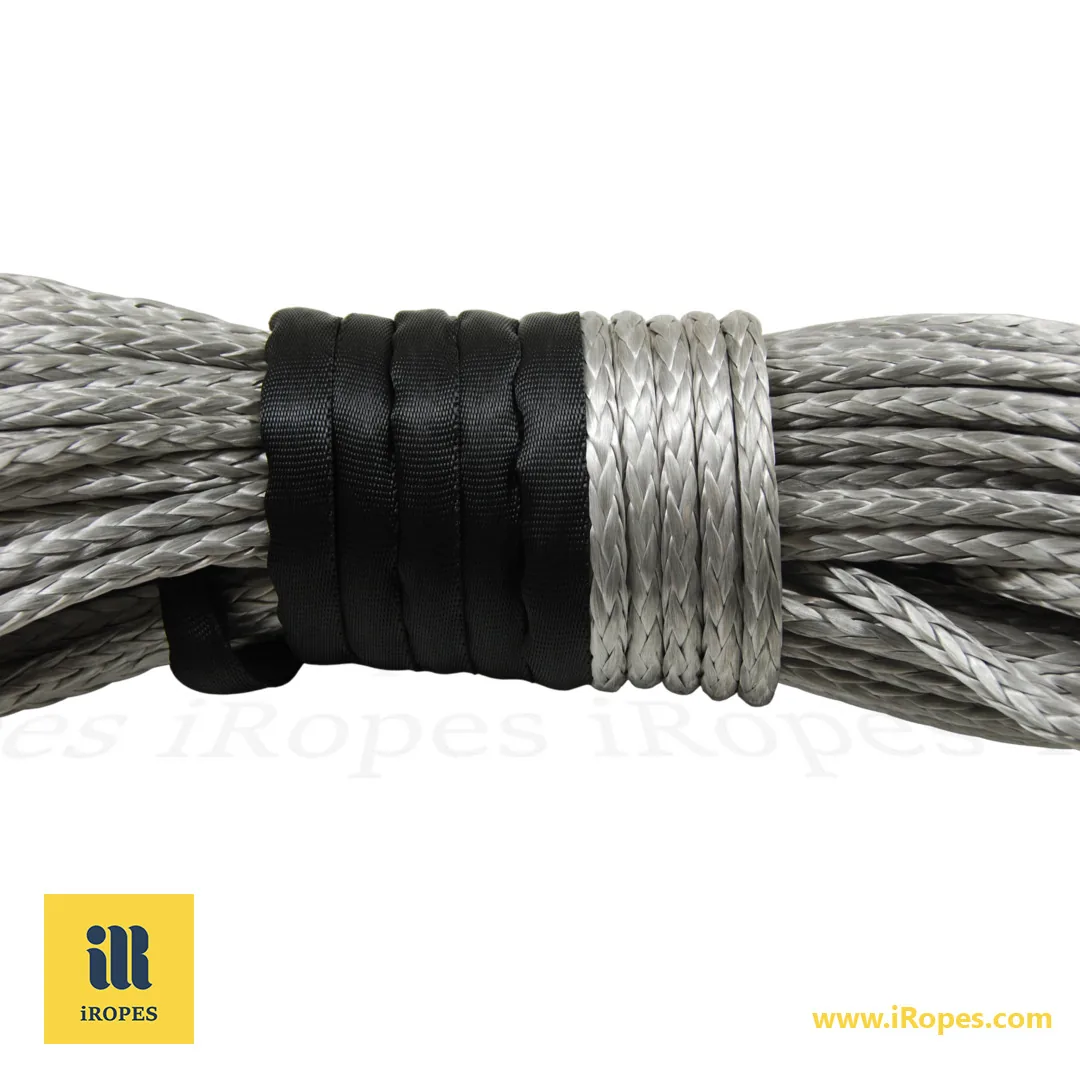
A 1/4” UHMWPE winch rope lifts up to 9,800 lb—roughly 30% stronger than a steel cable of the same size—yet weighs only 3 lb per 10 m.
What you’ll gain – ~4 min read
- ✓ Up to 10,141 lb breaking strength, delivering approximately 2,000 lb higher working-load limits than a steel cable.
- ✓ Cut haul weight by 85% (around 7 lb saved per 10 m), improving manoeuvrability and reducing fuel consumption.
- ✓ Lower recoil risk: a low-stretch synthetic design reduces snap-back incidents by over 95%.
- ✓ Customise diameter, colour, accessories, and packaging with ISO 9001 quality assurance, potentially shaving up to 12 days off lead time.
Most winch crews still trust heavy steel cables, convinced they are the only line that can handle a quarter-inch load. However, a 1/4” UHMWPE rope from iRopes delivers up to 10,141 lb breaking strength—up to 30% stronger than its steel counterpart—while shedding 85% of the weight. In the following sections, we’ll break down the numbers, show why synthetic lines win, and reveal how you can customise a rope that outperforms steel without the recoil risk.
Understanding high strength cable specifications and applications
Picking up from the previous discussion about the qualities that make a rope stand out, let’s first demystify the language around high strength cable. Knowing exactly what the numbers mean helps you choose the right line for off-road recovery or industrial lifting.

Two core metrics dominate every specification sheet:
- Tensile strength – the maximum force a cable can endure while being stretched before it yields.
- Breaking strength (MBS) – the load at which the cable actually snaps; manufacturers report this as the minimum breaking strength.
- Working Load Limit (WLL) – the safe, usable load derived from breaking strength by applying a safety factor.
For a typical 1/4-inch galvanized aircraft cable (7x19 construction), the breaking strength falls between 6,500 lb and 7,500 lb. This range is widely accepted among reputable winch manufacturers.
Calculating the Working Load Limit is straightforward: divide the breaking strength by the chosen safety factor. Industry practice often uses a 5:1 ratio for recovery work, though a more conservative 3:1 factor is common for industrial lifts.
Applying a 5:1 safety factor to a 7,000 lb breaking strength yields a WLL of 1,400 lb. In plain terms, a 1/4-inch steel cable can reliably pull about 1,400 lb without exceeding safe limits.
When you know that a 1/4-inch steel cable holds roughly 7,000 lb before it breaks, its safe working load drops to around 1,400 lb – a figure that matches most ATV/UTV recovery needs when the proper safety factor is applied.
Understanding these numbers is the first step toward selecting a line that aligns with your vehicle’s weight, the terrain you tackle, and the safety standards you uphold. Next, we’ll explore how a high tensile strength rope can outperform a steel cable of the same diameter, especially when you need the 1 4 winch cable strength that modern off-road enthusiasts demand.
Exploring high tensile strength rope technology and benefits
Now that you understand the numbers behind steel cables, let’s look at what makes a high tensile strength rope a game-changer for winching and industrial lifts.

UHMWPE, marketed under the Dyneema brand, is a polymer where molecular chains align in a near-perfect parallel fashion. This alignment creates a fibre that is roughly 15 times stronger than steel on a weight-for-weight basis, yet it stretches less than five percent under load. The result is a line that feels supple in the hand but hardly elongates when you pull a stuck vehicle out of a ditch.
When you ask, “Is winch rope as strong as cable?”, the short answer is yes. A quarter-inch UHMWPE rope typically reaches a breaking strength of 7,700 lb to 10,141 lb, which exceeds the 7,000 lb figure common to steel cables of the same size. This extra strength comes without the heavy-metal heft, and the rope’s low-stretch nature means the winch’s power is transferred more efficiently.
- Weight – up to 85% lighter than steel, making winch handling smoother and vehicle payload lighter.
- Safety – no recoil and minimal stretch reduce the chance of snap-back injuries during recovery.
- Durability – a UV-protected coating and abrasion-resistant fibres outlast metal in harsh sun or gritty terrain.
Beyond the material itself, iRopes lets you tailor the rope to your brand and job site. Whether you need a bright safety colour, a patterned weave for quick visual checks, or a custom-stamped eye splice, our factory can accommodate your request. Accessories such as thimbles, loops, or snap-hooks are added during the same production run. The final package can arrive in a plain bag, a colour-coded box, or a fully branded carton – all without extra handling steps. This comprehensive customisation is part of our commitment to OEM and ODM services for wholesale customers.
Custom Options
Choose the exact diameter, length, colour palette, and pattern that match your equipment. Add accessories like thimbles, soft-eye loops, or reinforced terminations, then decide on packaging – from discreet bulk bags to logo-branded colour boxes ready for showroom display.
With the chemistry, the safety edge, and the bespoke finish all laid out, the next logical step is to see the exact numbers that define the 1 4 winch cable strength for both synthetic and steel options. This deep dive will show why iRopes’ solutions often become the preferred choice for demanding recovery work.
1 4 winch cable strength: detailed data for synthetic and steel options
Building on the basics of cable specifications, let’s look at the exact numbers that matter when you choose a winch line for your ATV or UTV recovery.
When iRopes tests a 1/4-inch UHMWPE winch rope, the recorded minimum breaking strength falls between 7,700 lb and 10,141 lb. These figures translate into a comfortable safety margin, even when you apply a conservative 5:1 safety factor. The recommended Working Load Limit (WLL) ranges from roughly 1,540 lb at the low end up to 2,028 lb at the high end.
The traditional 1/4-inch galvanized aircraft cable (GAC) is rated at a minimum breaking strength of 7,000 lb. Using the same 5:1 factor, the WLL for steel drops to about 1,400 lb, which is why many off-road enthusiasts prefer the lighter synthetic alternative.
Higher Strength
Breaking strength up to 10,141 lb gives a larger safety margin.
Lightweight
Up to 85% less mass than steel, easing handling.
Heavier
A 1/4-inch steel cable can weigh over 20 lb per 10 m, adding load.
Recoil Risk
If it snaps, the metal can whip back dangerously.
For most recovery scenarios, applying a 3:1 safety factor is also common, especially in industrial lifts. That would lower the WLL for the UHMWPE rope to roughly 2,567 lb (using the 7,700 lb minimum) and keep the steel cable’s WLL at about 2,333 lb.

Comparing those numbers side-by-side reveals the clear advantage of a high tensile strength rope: you get more pull capacity, less weight to carry, and a safer recovery experience. This is why the next step is to explore why iRopes’ custom solutions translate these raw figures into a reliable, on-the-ground advantage.
Why choose iRopes for custom high-performance winch ropes
Building on the raw strength numbers, the real differentiator is how those figures are delivered to you. iRopes combines ISO 9001-certified quality control with precision manufacturing, ensuring every metre of rope you receive meets the same exacting standards that underpin the high tensile strength rope data you rely on.

Our production line operates on three pillars. First, ISO 9001 certification guarantees that every batch follows a documented quality-assurance protocol. Second, each rope undergoes tensile, elongation, and abrasion tests that replicate the harshest off-road environments. Third, a proprietary UV-resistant and abrasion-proof coating is applied in-line, protecting the fibres from sunlight and gritty terrain without adding weight. This not only enhances durability but also safeguards your investment.
Manufacturing Excellence
Precision, testing, certification
ISO 9001
Documented processes ensure repeatable strength and finish across every roll.
Rigorous testing
Lab-verified breaking strength and stretch values match real-world recovery demands.
Advanced coating
A UV-blocked, abrasion-resistant finish prolongs service life in sun-bleached terrains.
Service & Support
From design to delivery
OEM/ODM flexibility
Tailor diameter, length, colour, pattern, and accessories to fit your brand.
IP protection
Your designs stay confidential from prototype through delivery.
Global shipping
Direct pallet delivery to warehouses worldwide minimises lead time.
Because we control the entire value chain, pricing remains competitive without sacrificing performance —see why synthetic winch cable replacement is the smart choice. The same coating that shields the fibres from UV also reduces wear, meaning you replace the line less often – a cost saving that adds up on every recovery job.
Choose iRopes and you’ll see a measurable boost in safety and efficiency: a recent UTV recovery team reported a 20% faster pull and zero recoil incidents after switching to our custom-coated rope which offers superior coating benefits.
When you order a custom winch line, you decide every detail – from the bright safety colour that stands out in mud, to a reinforced eye splice that matches your winch’s load rating. The result is a rope that not only meets the 1 4 winch cable strength you expect but also arrives ready to perform on the toughest trails.
The article demonstrates that while a high strength cable offers around 7,000 lb breaking strength, iRopes UHMWPE winch rope delivers a high tensile strength rope with 7,700-10,141 lb breaking strength, providing superior 1 4 winch cable strength with up to 85% less weight. Competitive pricing, a UV-resistant coating, and ISO 9001-certified quality assurance mean you can customise diameter, colour, pattern, accessories, and packaging to suit any specification.
If you need a rope fine-tuned to your exact load, branding, or packaging needs, simply complete the enquiry form below and our specialists will design the perfect solution for you. For a deeper comparison of winch rope versus steel cable, see our winch rope guide.
Request your custom rope solution
For personalised assistance, please use the form above to discuss your requirements with our iRopes team.